Small business SEO services help owner-operated and independently run companies rank on Google without the enterprise budget, agency bloat, or wasted spend that sink most small marketing dollars. At Kash Digital Marketing, we built our small business SEO program specifically for businesses that need every dollar to work hard: transparent monthly SEO services, honest affordable pricing, no long contracts, and a relentless focus on the leads and revenue that keep your doors open.
If you're a small business owner searching for the "best local seo services for small business," you've probably already been burned once, or you've heard horror stories from other owners: a flashy agency promised the world, took a retainer for six months, and delivered a stack of reports nobody could read and a phone that never rang. That experience is common, and it's exactly why we built this page to be genuinely useful on its own. Whether you end up working with us or not, by the time you finish reading you'll understand what real small business SEO involves, what it should cost, how long it takes, and how to tell a good agency from a bad one.
Small business SEO is not a scaled-down version of enterprise SEO. It's a different discipline entirely, one built around speed to first results, budget discipline, and ruthless prioritization of the handful of activities that actually move revenue for a business with limited resources. That's the discipline this page walks through, end to end.
⭐ 5.0 rating · ✅ Google & Meta certified · ⚡ Reply usually within an hour · 🛡️ 100% white-hat · 🇺🇸 Serving US small businesses

What Small Business SEO Services Actually Include
Small business SEO services are a coordinated set of activities, Google Business Profile optimization, keyword targeting, on-page content, citations, reviews, and technical fixes, built to fit a limited budget and produce revenue quickly. Unlike enterprise SEO, which might run dozens of parallel workstreams across hundreds of pages, small business SEO succeeds by doing fewer things extremely well, in the right order.
The core building blocks are the same ones any solid SEO program uses. What changes for a small business is sequencing and scope: we don't try to rank for 500 keywords in month one, we identify the 15 to 30 keywords most likely to bring in paying customers and go after those first. This "narrow and deep" approach is what makes small business SEO services affordable without becoming ineffective.
The core services every small business SEO program needs
Every legitimate small business SEO engagement should include Google Business Profile optimization, local keyword research, on-page optimization of your core service pages, basic technical SEO health, citation consistency, and a plan for reviews. Anything less leaves gaps competitors will exploit. Our local SEO services provide the deeper version of this foundation for businesses that are ready to invest more heavily.
Why small business SEO needs its own strategy, not a scaled-down enterprise plan
A common and costly mistake is applying enterprise SEO thinking to a small budget: massive keyword lists, dozens of blog posts a month, and content nobody reads because it targets terms with far more competition than the budget can win. Small business SEO strategy inverts this. It starts with the keywords you can realistically rank for in the next 60 to 90 days, builds momentum and cash flow from those wins, and only then expands into harder terms. This sequencing is the single biggest difference between small business SEO that works and small business SEO that quietly burns a budget for a year.
How Kash Digital Marketing structures small business campaigns
We start every small business engagement with a free audit, prioritize the three or four highest-impact fixes, and build outward from there. You're never paying for busywork or reports designed to look impressive rather than move your business forward. This transparent, ROI-first structure is also why our SEO pricing is built around real deliverables, not inflated retainers.
Setting expectations before work begins
Before any work starts, we walk through exactly what will happen, in what order, and roughly when you should expect to see movement. This isn't a courtesy, it's a practical necessity: a small business owner juggling a hundred priorities needs to know whether a quiet first month is normal progress or a warning sign. We'd rather set that expectation clearly upfront than have you wondering three weeks in whether anything is actually happening behind the scenes. Clear expectations, set honestly from day one, are one of the simplest ways an agency can earn trust with a small business client.

Affordable SEO Services Without the Corner-Cutting
Affordable SEO services for small business means smart prioritization of high-impact work, not a discount version of a real strategy. The word "affordable" scares off some business owners because they've seen what happens when an agency chases a low price by cutting corners, thin content, spun citations, or ignoring technical problems entirely. That's not what affordable should mean, and it's not how we operate.
Real affordability comes from doing the right things in the right order, not from doing less of everything. A well-sequenced campaign generates its first leads within weeks, which effectively helps fund the next phase of work. That's a fundamentally different model than an agency that charges a flat premium retainer regardless of what actually needs doing.
What makes an SEO service genuinely affordable
An affordable SEO service concentrates your budget on the handful of activities proven to move revenue for a business like yours: your Google Business Profile, your highest-intent local keywords, and the technical basics that let Google index your site properly. Everything else waits until those fundamentals are earning their keep.
How we keep small business SEO pricing honest
We quote based on your actual competitive landscape and goals, not a generic package designed to upsell you later. You'll know exactly what you're paying for and why, month by month, which is the clearest way we know to prove that affordable and effective aren't opposites. See our SEO pricing page for how these custom quotes work in practice.
Affordable does not mean short-term thinking
It's worth being direct about a tension every small business owner feels: the cheapest option today can become the most expensive mistake within a year, if it involves tactics that get your site penalized or simply waste months producing nothing. Affordable, done right, still means white-hat methods, real optimization, and genuine content, just applied with discipline about sequencing and scope rather than a bloated menu of deliverables. We'd rather deliver a smaller number of things done properly than a long list of shallow tasks that look good on an invoice but don't move your rankings.

Cheap SEO Services: What "Cheap" Actually Costs You
Searching for "cheap seo services" is understandable when budgets are tight, but the cheapest bid is frequently the most expensive decision a small business makes all year. We want to address this head-on rather than dodge it, because a genuinely helpful guide has to be honest about where low prices come from and what they usually mean.
There's an important distinction here: affordable, value-driven SEO delivered by a competent team is a smart investment. Rock-bottom "cheap" SEO, the kind sold with promises of thousands of backlinks or guaranteed page-one rankings for a flat $99 a month, is almost always built on shortcuts that put your site at risk. Understanding the difference protects both your budget and your business.
How rock-bottom pricing usually gets funded
An agency charging a fraction of what real SEO work costs has to cut somewhere. Common shortcuts include mass-produced spun content, purchased or spammy backlinks, fake or incentivized reviews, and templated location pages copy-pasted across dozens of cities. Each of these can trigger a Google penalty that takes months, sometimes years, to recover from.
Real costs behind quality SEO work
Legitimate SEO involves real research, real writing, real outreach for links, and real ongoing management, work that takes trained people real hours. There's a floor beneath which a price simply can't cover genuine, safe, effective work. Recognizing that floor helps you evaluate any quote you receive, including ours.
Questions that expose a "cheap" provider's real methods
Ask any low-cost provider directly: how many links will you build and from where? Who writes the content, and can I see samples? How do you generate reviews? What happens if my rankings drop? A provider offering rock-bottom pricing while dodging these questions is telling you everything you need to know without saying a word. A provider confident in their methods will answer specifically and happily, because there's nothing to hide.
- Explains exactly how links are earned, not bought
- Shows real writing samples, not generic filler
- Never guarantees a specific ranking position
- Uses ethical, platform-compliant review generation
- Reports on calls and leads, not just rankings or impressions
- Offers no long-term contract, earning renewal through results

SEO for Small Business: Where to Start
SEO for small business should begin with a clear-eyed audit of what's already working, what's broken, and which two or three fixes will move the needle fastest. Too many owners start SEO by guessing, writing a few blog posts, tweaking a homepage headline, without ever confirming those actions target something a real customer searches for.
The right starting point is always diagnostic. We look at your current Google Business Profile completeness, your site's basic technical health, your existing rankings if any, and how your closest three or four competitors are winning the searches you want. From that picture, a genuinely prioritized plan emerges.
The three questions every small business should answer first
Before spending a dollar on SEO, answer: what do my customers actually type into Google before hiring or buying from someone like me? Where do I currently rank for those terms? And which competitors are beating me, and why? These three questions, answered honestly, produce a far better roadmap than any generic checklist.
Building a foundation before chasing growth
New or growing small businesses are often tempted to skip the boring foundational work, an accurate Google Business Profile, a fast and mobile-friendly website, consistent business information online, in favor of flashier tactics. That's backward. Foundation work is unglamorous but it's what everything else stands on, and skipping it means every later investment underperforms. Our technical SEO work exists precisely to make sure this foundation is solid before we build on top of it.
Realistic goals for a small business SEO program
A realistic small business SEO program sets specific, achievable goals: rank in the map pack for your core service plus city within 90 days, generate a defined number of qualified leads per month by month four, or grow organic traffic by a set percentage over two quarters. Vague goals like "get more traffic" produce vague results. Specific, revenue-tied goals keep the whole campaign accountable to what actually matters to your business.

SEO Packages for Small Business: How to Choose the Right Scope
SEO packages for small business should be scoped around your goals and competition, not sold as a rigid tier picked off a shelf. Many agencies sell "bronze, silver, gold" packages that bundle the same generic deliverables regardless of whether you're a solo consultant or a five-location home services company. That mismatch wastes budget in one direction or leaves gaps in the other.
We use flexible packages as a starting conversation, not a rigid menu. A package should flex around what your specific market requires: more citation and review work for a business new to an area, more content and link building for one entering a crowded niche, more technical work for a site with existing structural problems.
What a solid starter package should include
At minimum, a starter small business SEO package should include Google Business Profile optimization, core on-page fixes for your top three to five service pages, basic citation cleanup, and a plan for reviews. Anything thinner leaves obvious gaps a competitor will exploit within months.
| Package Tier | Best For | What's Typically Included |
|---|---|---|
| Starter | New or very small businesses, tight budgets | GBP optimization, core page fixes, citation cleanup, review setup |
| Growth | Established businesses ready to scale leads | Starter package plus content expansion, local link building, service-area pages |
| Full Local Dominance | Multi-service or multi-location small businesses | Growth package plus deeper content program, ongoing PR/link outreach, advanced tracking |
Why we avoid one-size-fits-all packages
A rigid package forces you to either overpay for services you don't need or underinvest in the ones that would actually move your business. We'd rather have an honest conversation about your goals and competition, then build a scope that matches, even if that means a smaller starting engagement than a flashy package would suggest. That honesty is part of why clients stay with us without needing a contract to hold them.
Scaling your package as results come in
The smartest way to approach small business SEO packages is to start focused, prove the return on a narrower scope, and expand once the leads it produces justify a bigger investment. This low-risk, prove-it-first model means you're never betting your whole marketing budget on an unproven relationship, and it keeps our incentives aligned with yours throughout.
Red flags in package-based pricing
Watch for packages that bundle vague line items like "social signals," "content syndication," or a suspiciously specific number of backlinks per month, phrases that often signal filler deliverables designed to justify a price rather than genuinely move rankings. A trustworthy package describes its deliverables in plain language you can understand and verify, not jargon that sounds impressive but can't be checked against real outcomes. If a package description leaves you more confused about what you're buying than when you started reading it, that's worth asking about directly before signing anything.

Monthly SEO Services: What You're Actually Paying For
Monthly SEO services are an ongoing subscription of optimization, content, and link-building work, and understanding what happens each month is the best way to judge whether you're getting real value. SEO is not a one-time project you complete and walk away from; rankings require continuous maintenance and growth, which is why nearly every legitimate provider, us included, structures pricing as a monthly retainer.
The key question isn't whether monthly SEO services exist, it's what specific work happens inside that monthly fee. A vague monthly retainer with no clear deliverables is a red flag; a monthly service with a clear, evolving task list tied to measurable outcomes is what you should expect.
What happens in a typical month
A typical month includes Google Business Profile posts and management, ongoing citation and review monitoring, one or more pieces of new or improved content, technical health checks, and outreach for new local links, followed by a report covering rankings, traffic, and leads generated.
Why monthly work compounds instead of resetting
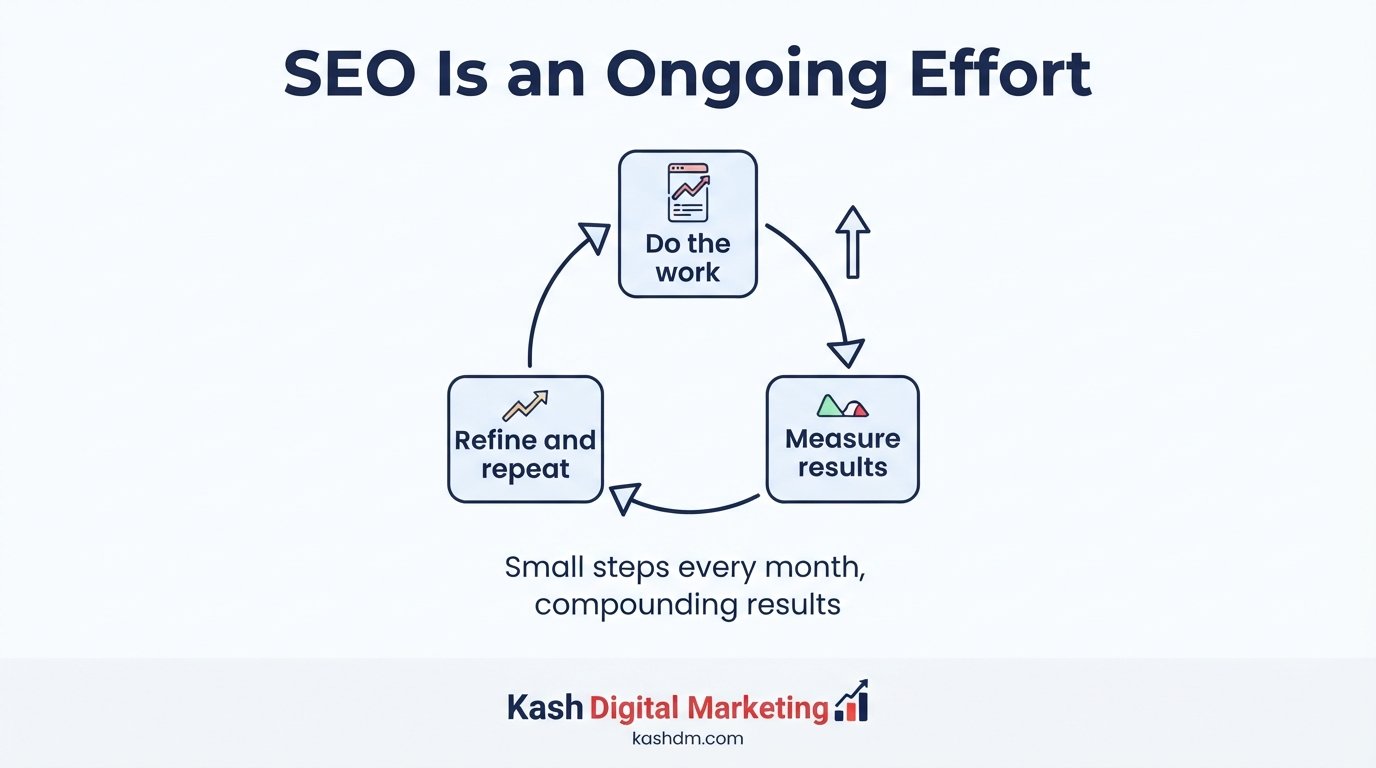
Unlike a one-time website redesign, SEO work accumulates. Each month's content adds to your site's topical authority, each link adds to your domain's trust, each review adds to your prominence in the map pack. Monthly SEO services exist because this compounding only happens with consistent, ongoing attention, and stopping too early means losing momentum right before it would have paid off.
| Month | Typical Focus | Expected Outcome |
|---|---|---|
| Month 1 | Audit, GBP optimization, technical fixes | Foundation set, early indexing improvements |
| Month 2-3 | Content expansion, citations, reviews, initial links | Movement on longtail and local terms |
| Month 4-6 | Scaling content and links, competitive terms | Leads growing, rankings on core terms climbing |
| Month 6+ | Ongoing optimization and expansion | Compounding leads, broader keyword coverage |
Evaluating whether your monthly SEO service is working
Judge your monthly service by three things: are rankings for your priority keywords moving in the right direction, is organic traffic to your key pages growing, and most importantly, are you seeing more calls, form fills, or bookings that you can trace back to search. A monthly service that can't show progress on at least the first two within a reasonable timeframe deserves a hard conversation.
SEO for Startups: Building Visibility From Zero
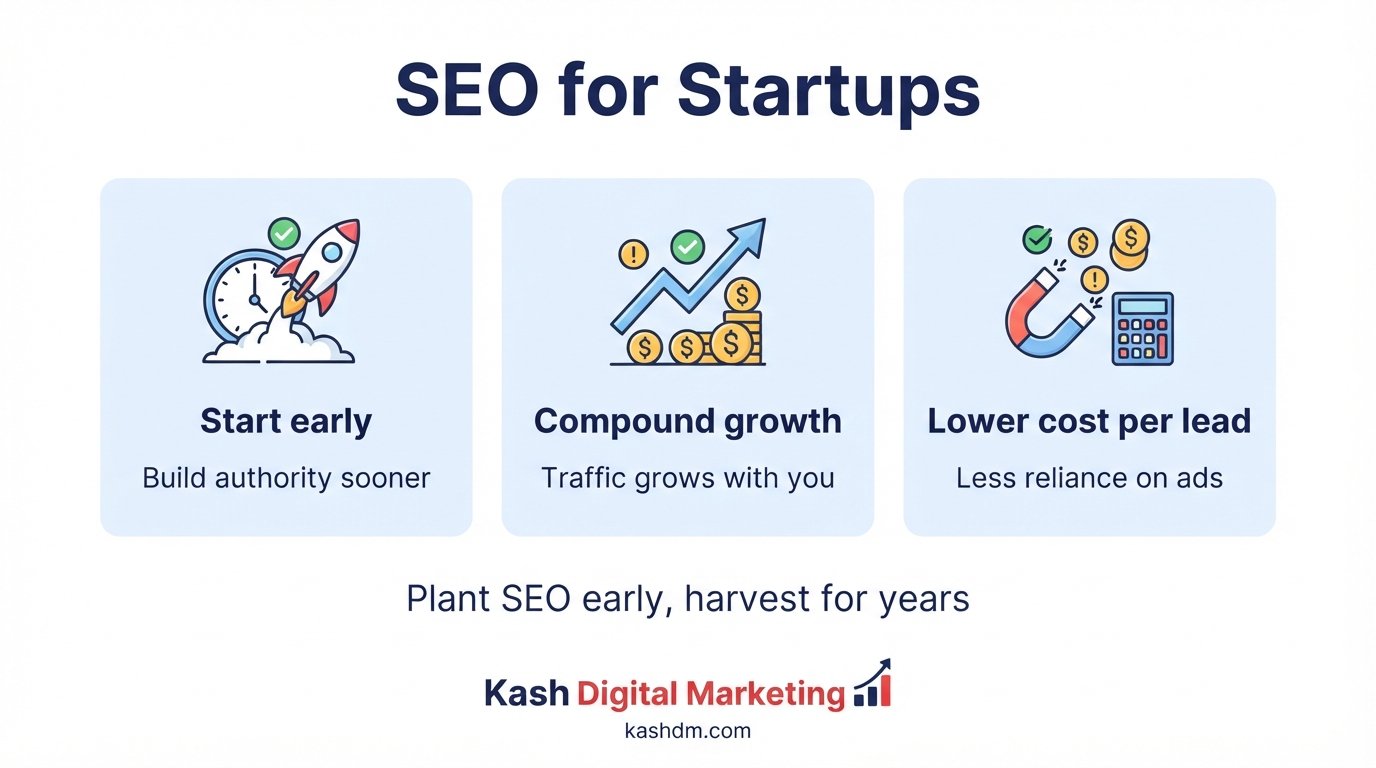
SEO for startups means building search visibility from scratch while resources are at their scarcest, which makes sequencing even more critical than for an established small business. A brand-new business has no existing rankings, no accumulated reviews, and often no citations at all. That's a real disadvantage, but it's also an opportunity: every early action compounds from day one instead of fighting years of neglect.
Startups benefit enormously from getting the foundation right immediately rather than retrofitting it later. A Google Business Profile set up correctly on day one, with accurate categories and a complete service list, starts earning trust immediately instead of losing months to an incomplete listing.
The first 30 days for a new business
In the first month, a startup should claim and fully complete its Google Business Profile, secure consistent citations across major directories, and publish a genuinely useful, well-optimized homepage and core service pages. These steps cost relatively little but establish the foundation everything else builds on.
Competing against established competitors early on
New businesses often worry they can't compete against competitors with years of reviews and links. The reality is more encouraging: longtail, low-competition keywords are winnable almost immediately, and a startup that consistently earns genuine reviews and publishes helpful content can close the gap with established competitors faster than most owners expect, particularly in less saturated local niches.
Balancing SEO with other early-stage marketing priorities
Startups juggle limited time and money across many priorities at once, product, hiring, cash flow, and marketing all compete for the same scarce resources. SEO earns its place in that mix because, unlike paid ads that stop producing the moment spending stops, the visibility built in a startup's first year keeps compounding for years afterward. We help early-stage businesses invest just enough, at just the right moments, to build that lasting foundation without diverting resources the business needs elsewhere.
DIY SEO vs Hiring an Agency: An Honest Comparison
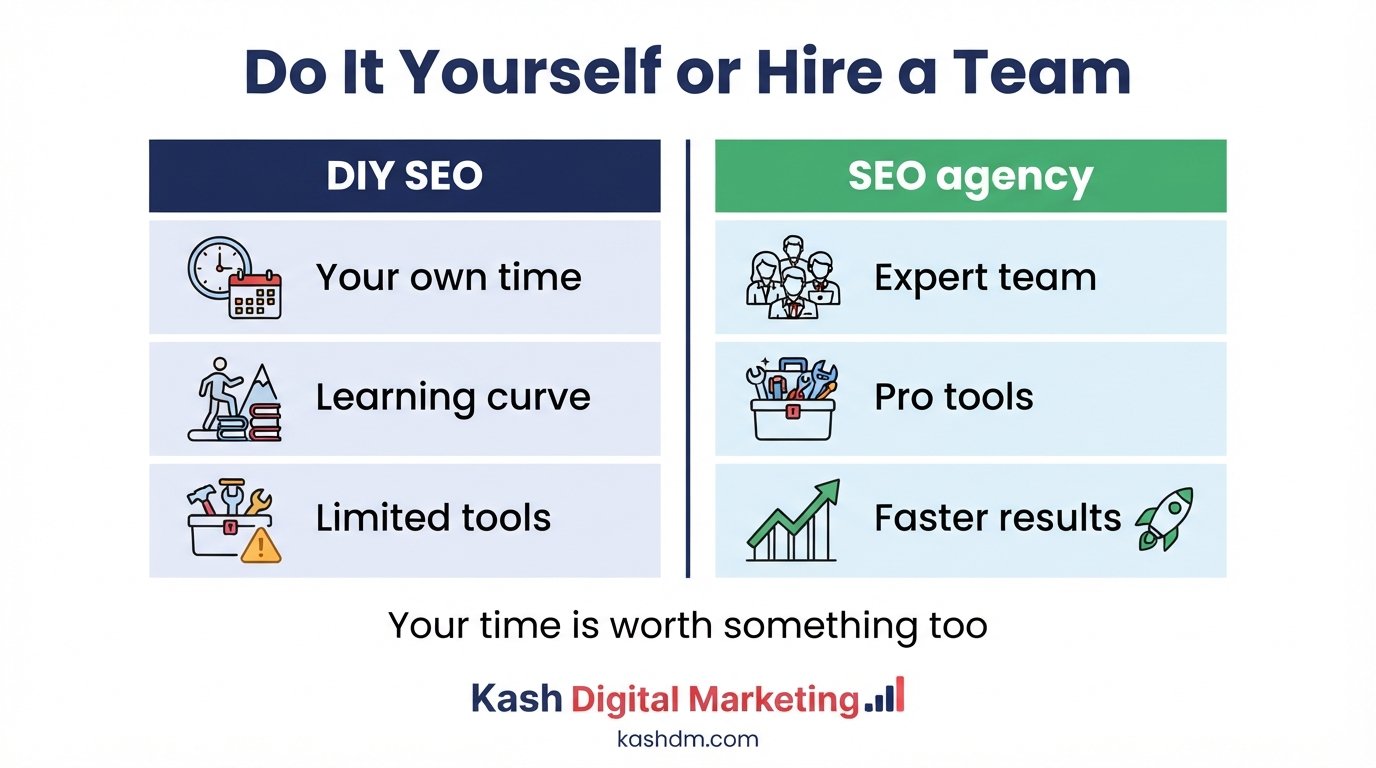
DIY SEO can genuinely work for the basics, but it usually stalls exactly where hiring an agency starts paying for itself. We think small business owners deserve an honest answer here rather than a sales pitch, because some businesses are perfectly capable of handling their own SEO, at least at first.
The clearest way to think about it is time and expertise. SEO isn't conceptually difficult, but doing it well requires ongoing research, technical knowledge, writing skill, and outreach ability, plus the time to execute consistently month after month. Most business owners are already stretched thin running the business itself.
What a business owner can realistically DIY
Claiming and completing your Google Business Profile, requesting reviews from happy customers, and fixing obvious website issues, broken links, missing contact information, slow pages, are all within reach of a motivated owner with a few hours to spare. These basics matter and shouldn't wait for an agency.
| Task | DIY Feasibility | Why |
|---|---|---|
| Claim & complete Google Business Profile | High | Straightforward, mostly data entry |
| Request reviews from customers | High | Just requires consistency |
| Keyword research at scale | Medium-Low | Requires tools and interpretation skill |
| Technical SEO fixes | Low | Requires developer-level knowledge |
| Content writing that ranks | Low-Medium | Requires SEO writing skill, not just writing skill |
| Link building | Low | Requires outreach relationships and time |
Where DIY SEO typically stalls
Most owners hit a wall around technical SEO, competitive content strategy, and link building, areas that require specialized tools, ongoing research, and relationships that take years to build. This is usually the point where growth plateaus despite continued effort, and where the return on hiring a team clearly outweighs the retainer cost.
A hybrid approach that works for many small businesses
Many of our small business clients start with a hybrid model: they handle simple, ongoing tasks like responding to reviews themselves, while we handle strategy, technical work, content, and link building. This division plays to each side's strengths, the owner's authentic voice and customer relationships, and our SEO expertise and available time, and it often produces better results at a lower cost than either pure DIY or a fully outsourced approach.
The hidden cost of DIY SEO: opportunity cost
There's a cost to DIY SEO that rarely shows up in any spreadsheet: the hours an owner spends learning, researching, and executing SEO tasks are hours not spent serving customers, managing staff, or growing the parts of the business only the owner can do. For many small business owners, the effective hourly value of their own time is higher than what it would cost to hire the work out, once that opportunity cost is honestly accounted for. This doesn't mean DIY is always the wrong choice, but it's worth factoring into the decision rather than comparing only the sticker price of an agency retainer against a false assumption that DIY is free.
Local SEO for Small Business: The Highest-ROI Channel
Local SEO for small business is almost always the single highest-return marketing channel available, because it puts you in front of nearby customers at the exact moment they're ready to buy. Unlike national SEO, which competes against enormous budgets, local SEO is a neighborhood game where a focused small business can genuinely outrank much larger competitors.
The reason is straightforward: local search rewards relevance and prominence within a defined geographic area, not just raw domain authority or ad spend. A small business that fully optimizes its Google Business Profile, earns genuine reviews, and builds locally relevant content can beat a national chain's generic, neglected local listing.
Why local SEO fits the small business budget so well
Local SEO's competitive set is narrower than national SEO, which means meaningful results require less budget to achieve. Instead of competing against every business in the country for a broad term, you're competing against the dozen or so businesses serving your actual service area, a far more winnable fight. Our full local SEO services page covers this in depth for businesses ready to go deeper.
The map pack as a small business's biggest opportunity
Landing in the Google map pack, the top three local listings shown with a map, captures a disproportionate share of clicks and calls for local searches. For a small business, ranking in that top three for even a handful of core service-plus-location searches can transform monthly lead flow, often more dramatically than any other single marketing action available.
Local SEO across different small business types
Local SEO's exact emphasis shifts by business type. Home-services companies lean heavily on urgency and "near me" searches; see our dedicated home services SEO page. Healthcare and professional practices lean on trust and credibility signals; see our healthcare SEO page. Retail and hospitality businesses lean on visual content and reviews. We tailor the emphasis to your specific type while keeping the same core foundation intact.
Building a defensible local position over time
Once a small business establishes a solid local SEO position, real reviews, consistent citations, genuine local links, a strong Google Business Profile, that position becomes surprisingly durable. Competitors who neglect these fundamentals struggle to catch up quickly, because prominence signals like reviews and links accumulate slowly and can't simply be purchased into existence overnight. This durability is part of what makes local SEO such a sound long-term investment for a small business: the advantage you build compounds and protects itself, rather than evaporating the moment a competitor spends more on ads for a month.

Google Business Profile for Small Business: Your Most Valuable Free Asset
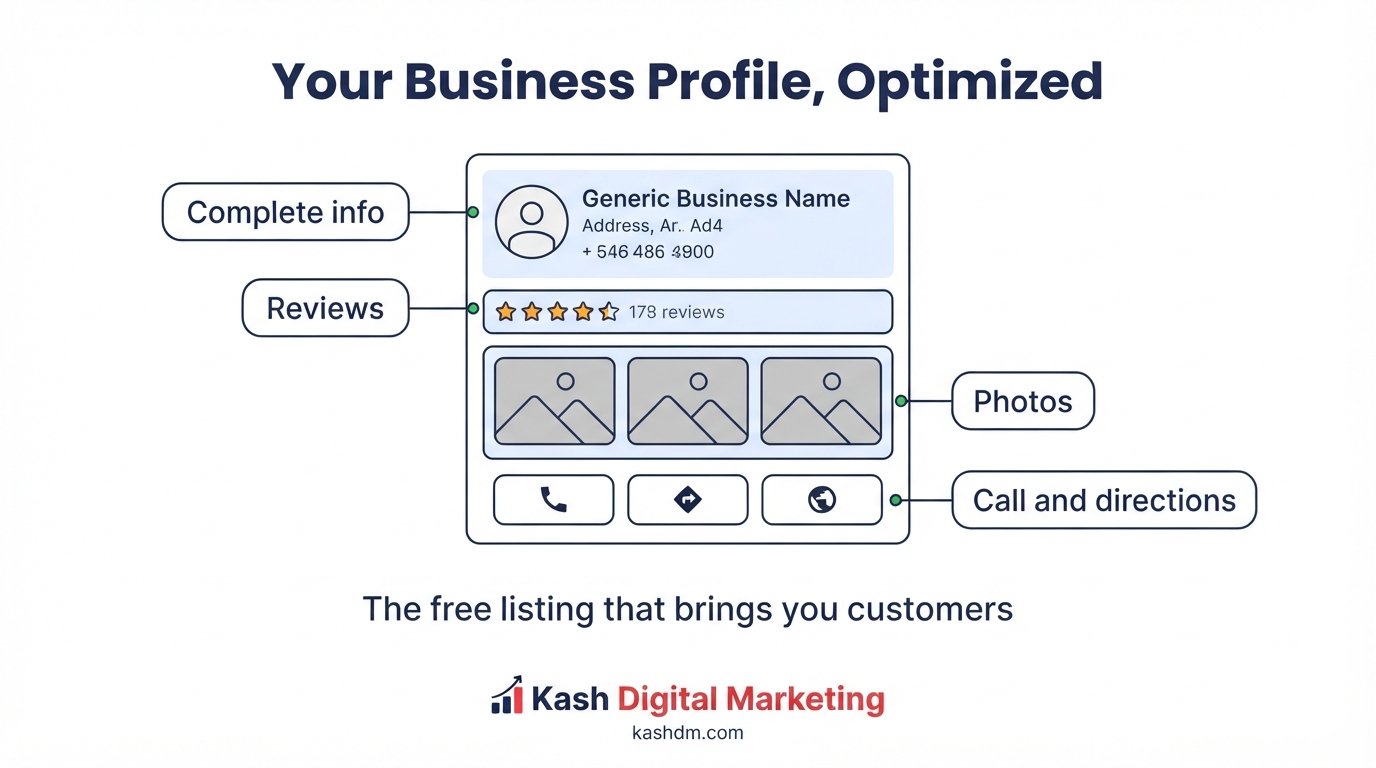
Your Google Business Profile is frequently worth more to a small business than its entire website, because it's the first thing most local customers see and it's completely free to claim and optimize. For a small business with a limited budget, this makes GBP optimization the single highest-leverage activity available, dollar for dollar.
A fully optimized profile, accurate categories, complete services, real photos, active posts, and a strong review base, competes for the map pack directly. An incomplete or neglected one, even for a great business, effectively forfeits that visibility to a competitor who simply filled out their listing more completely.
The fields that matter most for a small business
Prioritize your primary category (choose the one that matches your most valuable service), a complete and accurate service list, business hours kept current, and a description that naturally includes the services and areas you serve. These fields drive the bulk of your relevance signal to Google.
Photos, posts, and staying active on a budget
You don't need a professional photographer to start. Clear, well-lit phone photos of your team, your work, and your location go a long way, and a simple habit of posting an update or offer every week or two keeps your profile signaling activity to Google without requiring paid tools or agency help.
- Primary category matches your most valuable service
- All relevant secondary categories added
- Complete, accurate service and product list
- Business hours current, including holidays
- At least 10 real photos of your team, work, and location
- Weekly or biweekly Google Posts
- Review request process in place for every completed job or sale
- Questions and answers section actively monitored
When to bring in professional GBP management
Basic upkeep is DIY-friendly, but strategic category selection, ongoing optimization as Google changes features, and integrating your profile with your broader SEO strategy benefit from professional management, particularly once you're competing in a crowded market. We include full Google Business Profile management in every one of our small business SEO engagements because of how much leverage it carries.
Small Business SEO Checklist: A Practical Starting Point
A practical small business SEO checklist turns an overwhelming topic into a manageable, sequenced list of actions, which is exactly what a busy owner needs. This isn't an exhaustive technical audit, it's the set of foundational actions that produce the most impact for the least effort, in the order we'd tackle them.
Use this as a starting point whether you're working with an agency or tackling SEO yourself. Completing even the first section puts you ahead of a large share of local competitors who haven't bothered.
Foundation checklist
- Claim and fully complete your Google Business Profile
- Confirm your business name, address, and phone number match exactly across your website and top directories
- Make sure your website loads quickly and works properly on mobile
- Install basic analytics and call tracking so you can measure results
- Identify the 10 to 20 keywords your customers most likely search
On-page and content checklist
- Each core service has its own dedicated page, not a shared paragraph on a general page
- Page titles and headings include your service and location naturally
- Every page has a clear call to action
- Content answers real customer questions, not just keyword-stuffed filler
- Images have descriptive alt text
Off-page and ongoing checklist
- Citations built and corrected across major directories
- A consistent process in place for requesting reviews
- At least one piece of new or updated content published monthly
- Rankings and traffic reviewed monthly, not just set and forgotten
- Technical health rechecked quarterly
Working through this checklist honestly, and being willing to admit where gaps exist, is the fastest way for any small business to understand where it stands before spending a dollar on outside help.

SEO on a Budget: Making Every Dollar Count
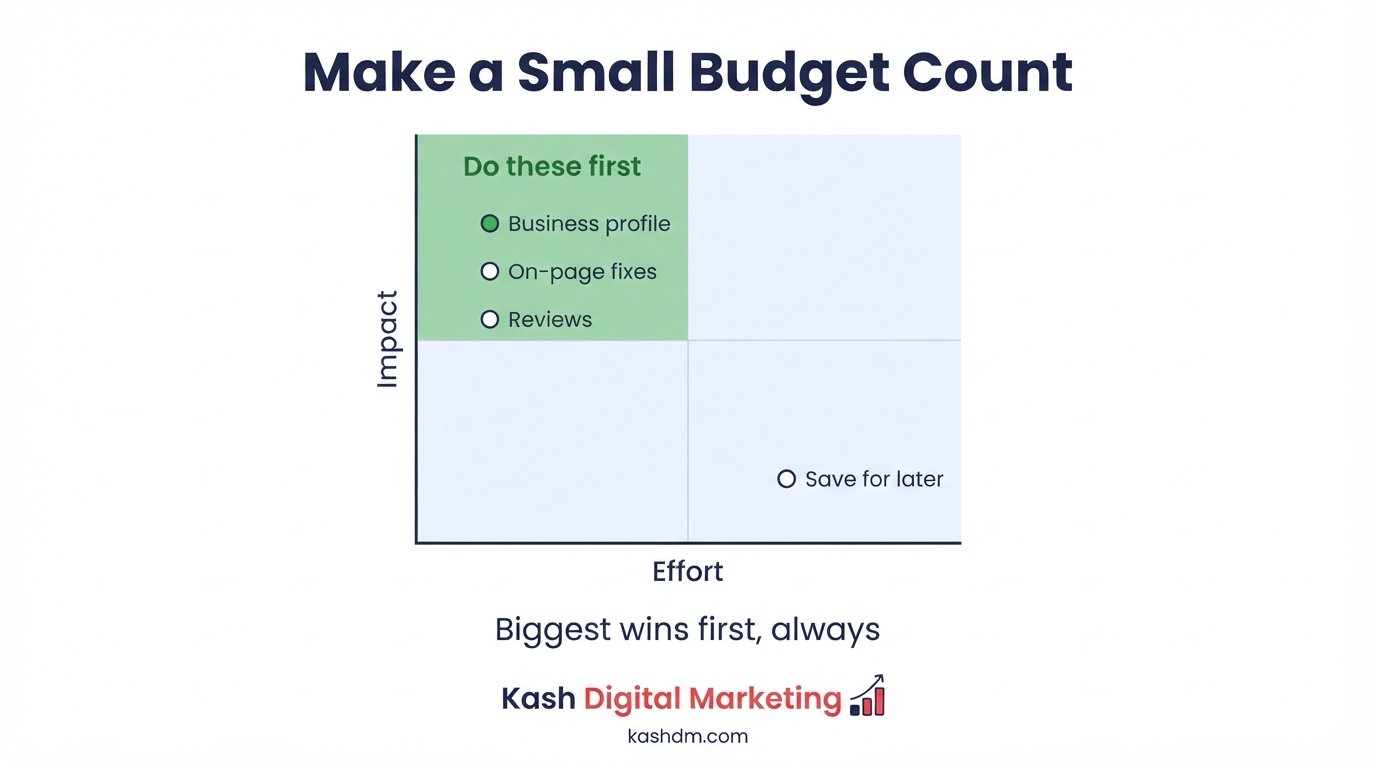
SEO on a budget is entirely possible when spending is concentrated on the activities with the clearest path to revenue, rather than spread thin across everything at once. A limited budget doesn't have to mean limited results, it means the plan has to be disciplined about sequencing rather than trying to do everything simultaneously.
The businesses that get the most from a tight SEO budget are the ones willing to say no to lower-priority activities in favor of the two or three that matter most right now. That discipline is often harder for an owner to enforce alone than it sounds, which is one of the genuine values an experienced partner brings.
The 80/20 of small business SEO spending
In our experience, roughly 80 percent of a small business's early SEO results come from Google Business Profile optimization, core service page content, and basic technical health, the remaining budget for links, expanded content, and advanced tracking pays off more once that foundation is solid. Spending in that order maximizes return on a limited budget.
Stretching a limited budget further
A tight budget stretches further when you avoid duplicated effort, don't pay for tools or services you're not ready to use effectively, and focus content creation on pages that directly support a purchase decision rather than tangential blog topics. We help budget-conscious clients cut exactly this kind of waste out of their plan from the start.
When to increase your SEO investment
The right time to increase an SEO budget isn't a fixed calendar date, it's when the current investment is clearly producing leads and the next tier of keywords or content would plausibly produce more. Watching for that signal, rather than committing to a bigger budget upfront out of hope, keeps your SEO spending as disciplined as the rest of your business finances.
ROI of SEO for Small Business: How to Think About Returns
The ROI of SEO for small business comes from comparing what a campaign costs against the lifetime value of the customers it brings in, not just the traffic or rankings it produces. Rankings and traffic are useful signals, but they're not the point, revenue is, and a good small business SEO program should be evaluated on that basis from the start.
Because SEO builds an asset rather than renting attention the way paid ads do, its ROI curve looks different too: modest in the first few months while the foundation is built, then accelerating as rankings, reviews, and content compound.
A simple framework for estimating SEO ROI
Estimate your average customer value, multiply by your expected close rate on new leads, and compare that to your monthly SEO investment. A campaign that costs a modest monthly fee but produces even a handful of new customers a month, each worth hundreds or thousands of dollars over their relationship with your business, typically pays for itself many times over within the first year.
| Factor | Why It Matters for ROI |
|---|---|
| Average customer value | Determines how many new customers justify the investment |
| Customer lifetime value | Repeat customers make even modest lead volume highly profitable |
| Close rate on leads | Higher close rates mean fewer leads needed to hit revenue goals |
| Campaign cost | Compared against value generated, not viewed in isolation |
| Time to first results | Affects cash flow planning during the ramp-up period |
Why SEO's ROI tends to improve over time
Unlike paid advertising, where cost per lead stays roughly constant or even rises as competition increases, SEO's cost per lead tends to fall over time as rankings, reviews, and content accumulate. The same monthly investment that produced a handful of leads in month three can produce several times that by month twelve, because the underlying assets keep compounding rather than resetting.
Setting realistic ROI expectations
Be wary of anyone promising a specific ROI figure before understanding your market and competition. Realistic expectations, modest early returns building toward strong returns by month six to twelve, protect you from both unrealistic disappointment and from providers overselling what's achievable in the short term.

How Much Does Small Business SEO Cost
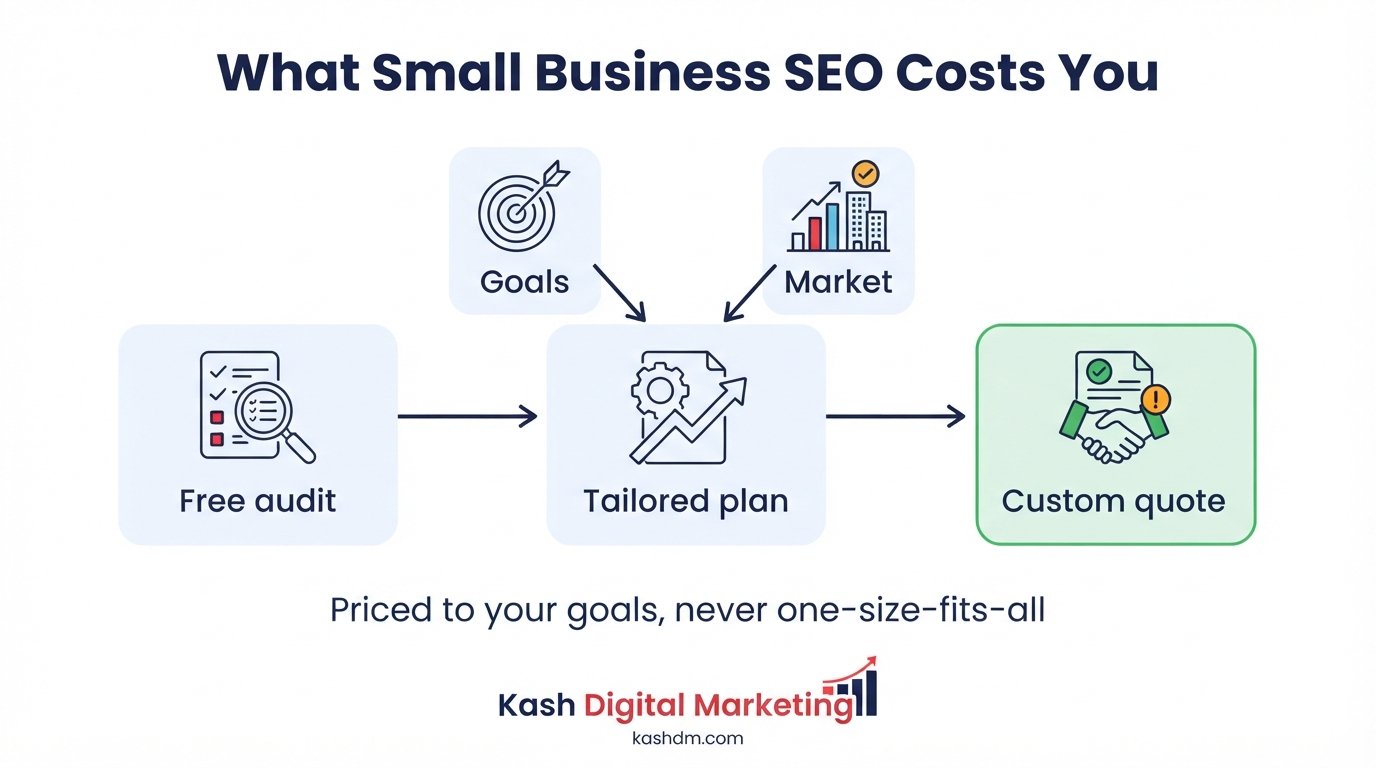
Small business SEO typically costs a fraction of enterprise SEO because the competitive scope is narrower, but the honest answer still depends on your market, competition, and goals. We start every conversation with a free audit and a custom quote rather than a generic price list, because a quote that doesn't reflect your actual competitive situation isn't really honest.
That said, business owners deserve a general sense of scale before reaching out, so here's how the major variables typically move price.
What drives small business SEO pricing up or down
More competitive markets and industries, dense metros, crowded niches like personal injury law or cosmetic dentistry, require more work and cost more. Less competitive local niches and smaller markets can see strong results with a more modest investment. The number of services and locations you need covered also affects scope.
| Factor | Effect on Cost |
|---|---|
| Market competitiveness | Higher competition increases required investment |
| Number of services/locations | More pages and profiles to optimize raises scope |
| Current site condition | A site needing significant technical repair adds upfront cost |
| Speed of desired results | Faster timelines may require more concentrated (costlier) effort |
| Industry | Regulated or high-value industries often warrant deeper content and trust-building work |
Why we quote custom instead of publishing a fixed price
A fixed, one-size-fits-all price either overcharges businesses in easy markets or undercharges, and underdelivers, for businesses in tough ones. What we can tell you plainly is where we start: most local engagements begin between $400 and $500 a month, and the exact figure comes after a free audit. Our SEO pricing guide breaks down what sits inside that range and what pushes it higher.
Comparing cost against alternatives
It's worth comparing small business SEO cost against the alternatives: paid ads that stop the moment spending stops, print or local advertising with far less measurable return, or doing nothing and losing customers to competitors who do show up in search. Against those alternatives, a well-run SEO investment is frequently the most cost-effective growth channel a small business has available.
How pricing typically evolves over the life of an engagement
Most small business SEO engagements don't stay at a fixed price forever, and that's by design rather than a hidden upsell. Early months often focus on foundational work that's relatively bounded in scope, while later months, once the foundation is solid and results are showing, naturally expand into more content, more link building, and more competitive keyword targets. We walk clients through this evolution honestly at the outset, so a reasonable increase in scope down the line never comes as an unwelcome surprise. The goal is always that the investment grows in step with the results it's producing, never ahead of them.
SEO for New Business: Getting It Right From Day One
A new business that sets up its SEO foundation correctly from the very beginning avoids months of costly correction later and starts building authority immediately instead of playing catch-up. Owners launching a new business have a rare opportunity: there's no legacy of neglected listings, outdated information, or inconsistent citations to clean up first.
The temptation for a new business is to deprioritize SEO in favor of more urgent-feeling tasks, and some delay is reasonable in the earliest weeks. But the longer the delay, the more ground competitors gain, and the more expensive it becomes to close that gap later.
The essential first steps for a new business
Register and fully complete your Google Business Profile immediately, secure a fast and properly structured website even if it's simple at launch, and claim consistent citations across the major directories before any incorrect information has a chance to spread across the web.
Avoiding the mistakes that plague new businesses
New businesses commonly make avoidable mistakes: an incomplete Google Business Profile left unclaimed for months, a slow website thrown together without SEO in mind, or inconsistent business information submitted across different platforms by different people. Each mistake compounds the longer it sits uncorrected, which is why getting it right at launch saves real time and money down the line.
Building credibility as a new, unproven business
New businesses lack the years of reviews and links that established competitors have accumulated. We address this directly by front-loading review generation from your very first customers, publishing genuinely helpful content that demonstrates real expertise even without a long track record, and pursuing early local links and press coverage that build credibility faster than waiting passively for it to accumulate on its own.

SEO for Single-Location Business: Focused, Not Spread Thin
A single-location business has a real SEO advantage over multi-location competitors: it can put its entire focus and budget behind dominating one clearly defined area instead of spreading resources across several markets. Owners of single-location businesses sometimes assume they're at a disadvantage against bigger, multi-location competitors, but the opposite is often true for local search.
Because Google rewards relevance and prominence within a defined geographic area, a single-location business that fully commits to its one market, deep content, strong reviews, consistent citations, can dominate that market more completely than a larger competitor whose attention is divided across five locations.
Why single-location businesses should avoid overexpansion in content
A common mistake is building service-area pages for neighborhoods and towns the business barely serves, hoping to capture more search volume. This usually backfires, producing thin, templated pages that dilute the site's quality without adding real value. A single-location business is almost always better served by one comprehensive, genuinely excellent page for its core area than by a dozen thin ones.
Depth over breadth for single-location strategy
Instead of spreading thin across many keywords and areas, single-location businesses win by going deep: comprehensive service pages, a robust FAQ section addressing real customer questions, and a concentrated effort on reviews and citations specific to their one true market. This depth-first approach consistently outperforms a scattered, breadth-first one for businesses serving a single, well-defined area.
When a single-location business should consider expanding its footprint
If a single-location business genuinely begins serving a wider radius, more customers driving in from surrounding towns, delivery or service reaching further out, expanding SEO to cover that broader area makes sense, but only once the business footprint has actually grown. Expanding SEO ahead of actual service reach creates exactly the thin, disconnected content problem described above.

SEO for Service Businesses: Ranking Without a Storefront
Service businesses that travel to customers rather than operating from a storefront need a slightly different SEO setup, but they can rank just as strongly across their entire service area. Plumbers, cleaners, landscapers, mobile mechanics, and similar businesses often worry that lacking a public-facing address puts them at a disadvantage. It doesn't, as long as the profile and site are configured correctly.
Google explicitly supports service-area businesses, allowing you to hide your exact address on your Google Business Profile while defining the cities, neighborhoods, or radius you actually serve. Set up properly, this lets a service business rank across its full territory without misrepresenting a physical location it doesn't have.
Setting up a service-area business profile correctly
Define your service areas accurately in your Google Business Profile, avoid overstating your radius beyond where you can realistically and reliably serve customers, and make sure your website reflects the same service areas consistently. Overstating your service area is a common mistake that confuses both customers and Google.
Content strategy for service businesses without a storefront
Service businesses benefit especially from dedicated pages covering each core service, paired with genuinely useful content about what to expect, project timelines, pricing ranges, and common customer questions. Because there's no physical storefront to build trust through walk-in visits, this content does more of the trust-building work that a storefront would otherwise carry.
Reviews and trust signals matter more for service businesses
Without a visible storefront, customers rely even more heavily on reviews, photos of completed work, and clear licensing or insurance information to decide whether to trust a service business enough to invite them into their home or business. We prioritize review generation and visual proof of work especially heavily for these clients, because it directly substitutes for the trust a physical location would otherwise provide.

Content Marketing for Small Business: Writing That Ranks and Sells
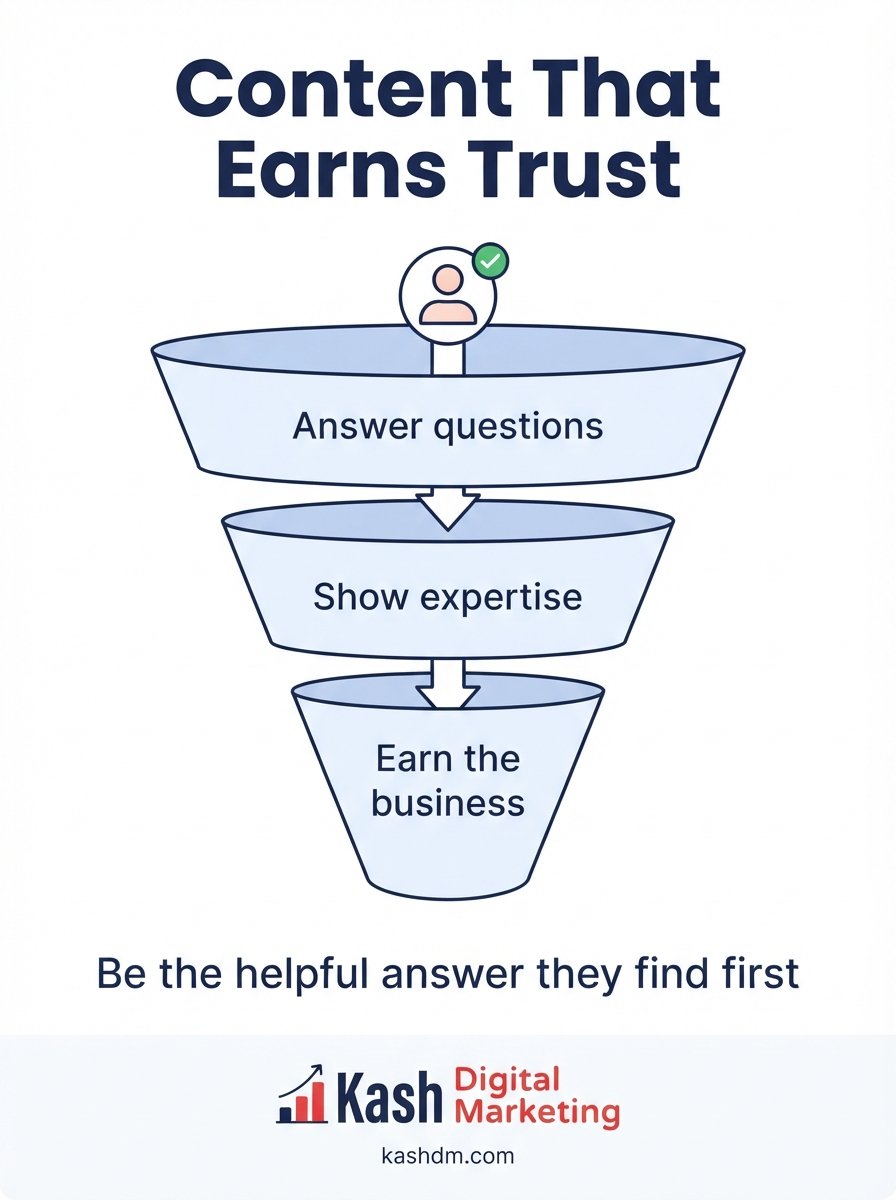
Content marketing for small business works best when every page is built to answer a real customer question and move them toward contacting you, not to hit an arbitrary word count. A small business rarely has the resources to publish dozens of articles a month, so every piece of content needs to earn its place by targeting a keyword real customers search and by genuinely helping the reader.
The most valuable content for most small businesses isn't a blog, it's a set of excellent core pages: your homepage, your individual service pages, and an FAQ that addresses the objections and questions that come up again and again in real customer conversations.
Prioritizing pages that support a buying decision
Before writing a single blog post, make sure your core service pages are genuinely strong: clear descriptions of what you offer, honest pricing guidance where appropriate, photos or examples of past work, and a clear call to action. These pages convert the traffic your other SEO work sends you, so they deserve the first and best content investment.
Blog and educational content, used strategically
Once core pages are solid, blog-style content can extend your reach into additional longtail keywords and demonstrate expertise. The best small business blog content answers real questions customers have already asked in person or by phone, which is both easier to write authentically and more likely to match what people actually search for.
Keeping content sustainable for a small team
Content marketing doesn't have to mean constant new production. Updating and improving existing pages, adding a new FAQ entry when a new question comes up, refreshing outdated information, often delivers more value per hour than constantly chasing new topics. We build content plans that fit realistically within a small business's available time and budget, drawing on the same rigor as our full SEO content writing services for businesses ready to invest more heavily in this area.
Repurposing content to save time
A small business doesn't need to create everything from scratch every time. An FAQ answer given verbally to a customer over the phone can become a paragraph on a service page. A social media post that performed well can be expanded into a short blog article. A common customer objection your sales team hears weekly can become the backbone of a dedicated page addressing it directly. This kind of repurposing keeps content fresh and relevant without demanding hours of new writing time each week, and it keeps the content grounded in what real customers actually ask and care about, rather than what a generic keyword tool suggests in isolation.
Small Business Link Building: Earning Authority the Right Way
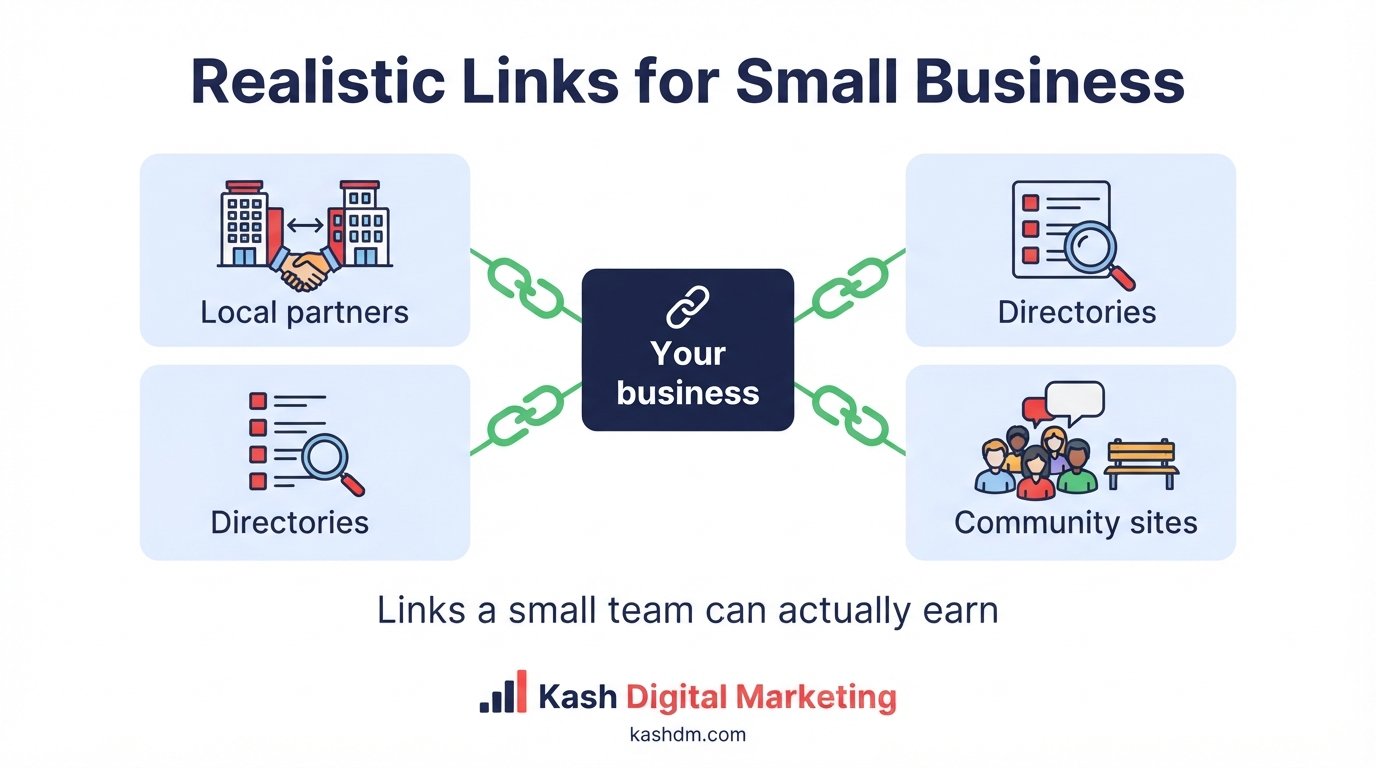
Small business link building works best when it stays local and relevant, community sponsorships, local press, partnerships with complementary businesses, rather than chasing generic links that mean little to your actual market. Link building has an intimidating reputation, but for a small business it doesn't require a large budget or aggressive outreach, it requires genuine local relationships and a bit of creativity.
The links that move the needle most for a small business are the ones a real local customer might also click: a mention from the local chamber of commerce, a feature in a community newspaper, a partnership page from a complementary local business, a sponsorship listing from a youth sports league you support.
Low-cost, high-value local link opportunities
Sponsoring a local event, joining your chamber of commerce, partnering with non-competing local businesses for cross-promotion, and reaching out to local bloggers or publications for a feature are all accessible link-building tactics that don't require a large budget, just genuine community involvement.
Why quality matters more than quantity in link building
A single relevant, authoritative local link is worth more than dozens of low-quality, irrelevant ones, and chasing volume over quality is one of the fastest ways to attract a Google penalty. Our link building services apply the same white-hat, quality-first discipline to small business campaigns as to any larger engagement.
Building relationships that generate links over time
The most sustainable link building comes from genuine relationships, with other local business owners, community organizations, and local media, that generate mentions and links naturally over time rather than through one-off outreach campaigns. We help small business clients identify and nurture exactly these relationships, because links earned through real community involvement tend to be the safest, most durable, and most reputation-enhancing kind available.
Small Business SEO Tools Worth Using
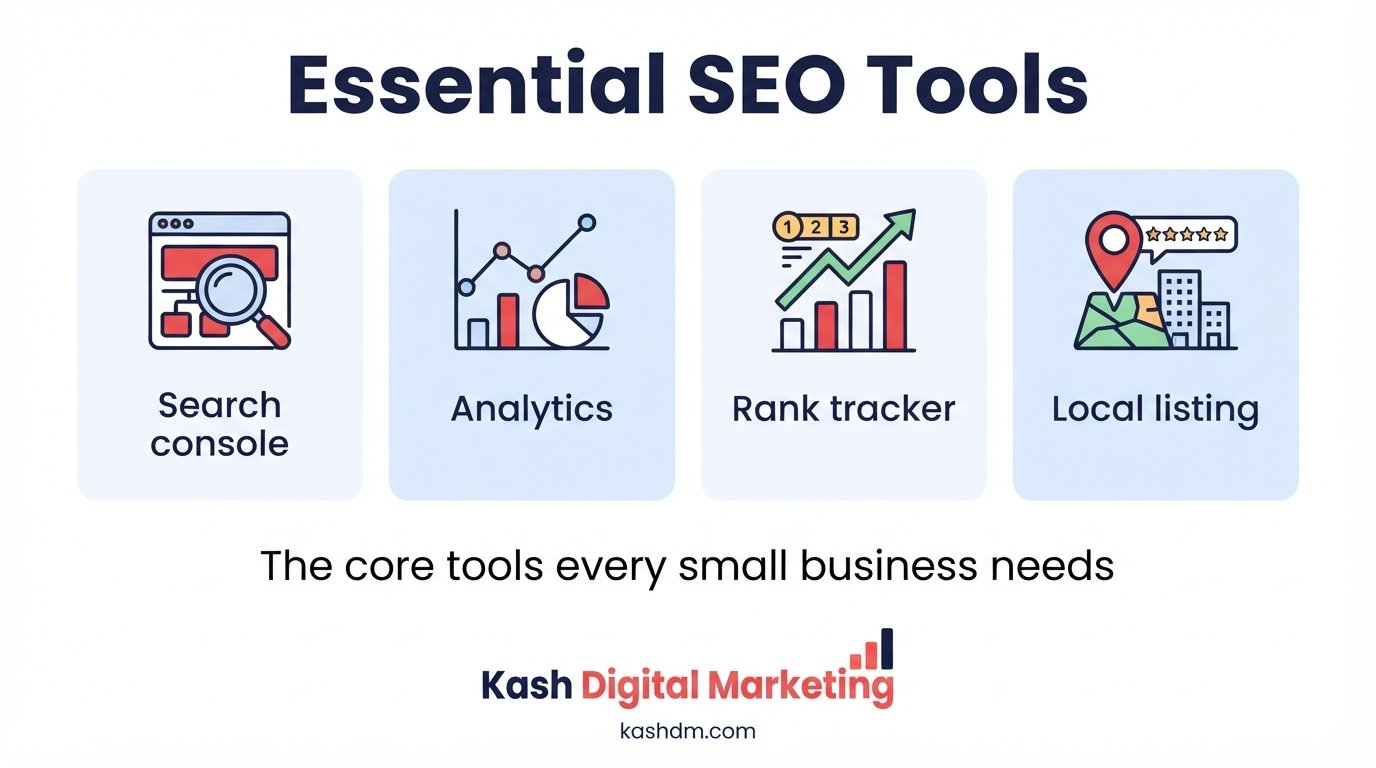
A small handful of well-chosen tools covers most of what a small business needs to monitor and improve its SEO, without requiring an enterprise-level software budget. Owners often assume effective SEO requires an expensive suite of tools. In reality, a few free or low-cost tools cover the essentials, with paid tools becoming worthwhile only once a campaign has grown in complexity.
Free tools every small business should use
Google Search Console and Google Analytics are free, essential, and directly connected to how Google sees and measures your site. Google Business Profile's own insights panel shows exactly how customers find and interact with your listing. These three alone provide most of the visibility a small business needs to track basic SEO health.
| Tool | Purpose | Cost |
|---|---|---|
| Google Search Console | Monitors indexing, rankings, and technical issues | Free |
| Google Analytics | Tracks website traffic and behavior | Free |
| Google Business Profile Insights | Shows profile views, calls, and direction requests | Free |
| A rank tracking tool | Monitors keyword position changes over time | Low-cost to moderate |
| A citation management tool | Keeps NAP consistent across directories | Low-cost to moderate |
When paid tools become worth the investment
Paid keyword research and competitor analysis tools become worthwhile once you're ready to expand beyond the basics, when you need deeper competitor insight or are managing a larger keyword and content portfolio. For most small businesses in the early stages, the free tools above cover the essentials well.
Tools versus expertise
It's worth remembering that tools only inform decisions, they don't make them. The same rank tracking data can lead to very different, and very differently effective, strategies depending on who's interpreting it. We use professional-grade tools across every client engagement, but the judgment applied to that data is what actually produces results, not the tool itself.
Measuring Small Business SEO: Metrics That Actually Matter
Measuring small business SEO success means tracking calls, leads, and bookings, not just rankings or traffic that never translate into revenue. It's easy for a report to look impressive while telling you nothing useful: rising impressions, growing keyword counts, or increased site visits mean little if none of it converts into paying customers.
We build measurement around the metrics that actually reflect business health, alongside the leading indicators, rankings and traffic, that predict where those metrics are headed next.
The metrics worth tracking monthly
Track your map-pack and organic keyword rankings for priority terms, your Google Business Profile actions (calls, direction requests, website clicks), your organic website traffic, and, above all, the phone calls and form submissions your campaign generates, ideally attributed through call tracking.
Setting up simple, effective tracking
Even a small business without a dedicated analytics team can set up call tracking numbers, form submission tracking, and basic Google Analytics goals relatively easily, and doing so turns SEO from a leap of faith into a measurable, accountable investment.
Reviewing progress without obsessing over daily fluctuations
Rankings and traffic naturally fluctuate week to week; obsessing over daily changes leads to reactive decisions that undermine a sound long-term strategy. We recommend reviewing progress monthly, looking at trends rather than single data points, and reserving deeper analysis for genuine, sustained shifts rather than normal short-term noise.

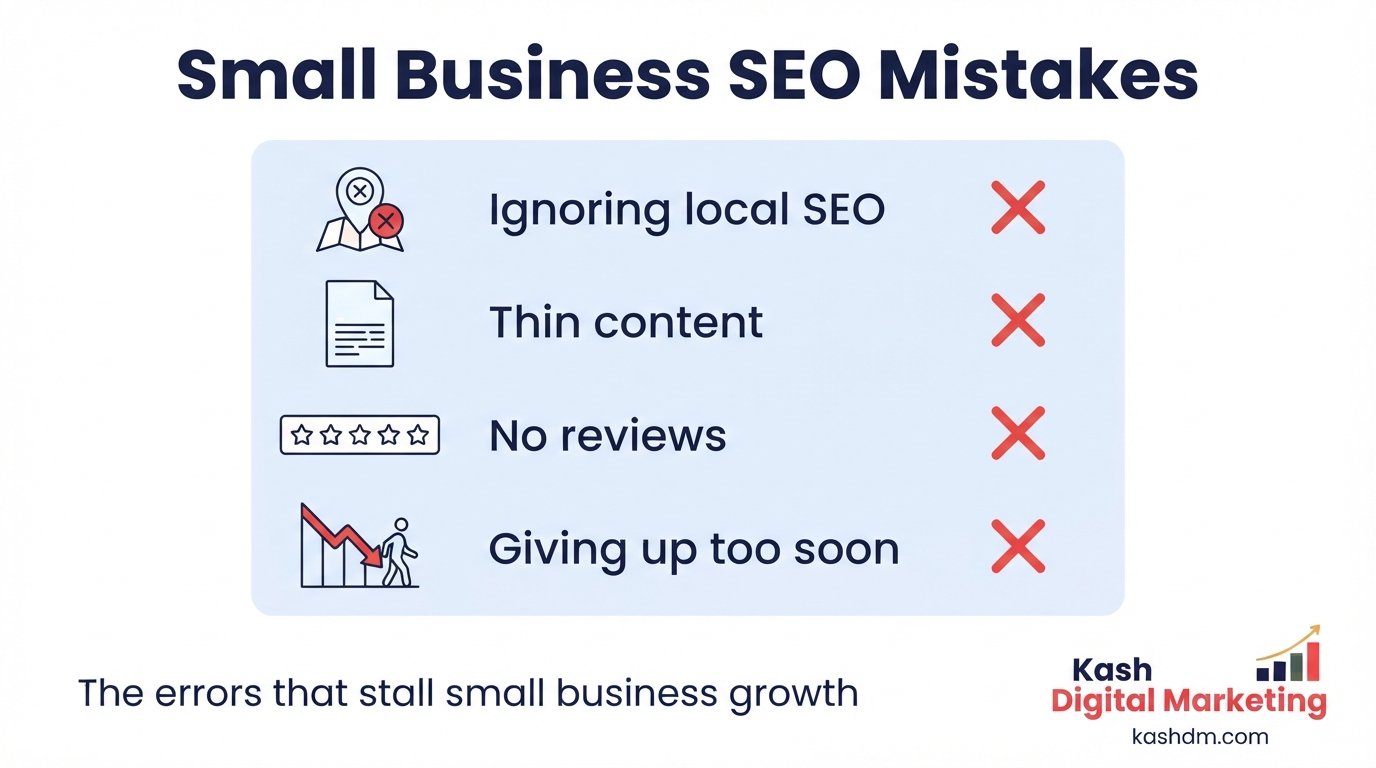
Common Small Business SEO Mistakes to Avoid
The most common small business SEO mistakes are avoidable, and knowing them in advance saves months of wasted effort and budget. Part of the value we provide is steering clients away from the traps that quietly derail so many small business SEO efforts before they ever get going.
Mistakes that waste budget and time
- Skipping or neglecting the Google Business Profile
- Chasing too many keywords at once instead of prioritizing
- Publishing thin content just to hit a quantity target
- Ignoring technical issues like slow load times or broken mobile pages
- Inconsistent business information across directories
- Buying cheap links or reviews that risk a penalty
- Giving up right before compounding results would have kicked in
Why patience is the hardest but most important discipline
The single most common mistake we see isn't a technical error at all, it's abandoning a campaign at month three or four, right before the compounding effects of consistent work typically begin accelerating. SEO's returns are backloaded, and businesses that stay the course through the early, slower-feeling months are the ones that ultimately see the biggest returns.
Recovering from past mistakes
If your business has already made some of these mistakes, an old neglected profile, inconsistent citations from a previous provider, or thin templated content, recovery is almost always possible. It typically starts with a thorough audit to identify exactly what needs fixing, followed by a disciplined cleanup before new growth work begins. We handle this kind of recovery regularly and can usually turn a damaged foundation into a solid one within the first couple of months of working together.
Mistakes that come from good intentions
Not every mistake comes from cutting corners, some come from genuine effort applied in the wrong direction. An owner who spends weekends writing blog posts about topics nobody searches for, or who chases a trendy keyword unrelated to their actual services, is working hard without moving the needle. Similarly, obsessing over a single competitor's exact tactics rather than building a strategy suited to your own business often leads to wasted effort copying moves that don't fit your market or budget. Well-intentioned effort still needs to be pointed at the right target, and that's often where an outside, experienced perspective adds the most value, simply by redirecting real effort toward what will actually work.
SEO vs PPC for Small Business: Which Comes First
For most small businesses, SEO and PPC aren't competitors, they're complementary channels that work best together, but understanding their different strengths helps decide where to start. Business owners often ask whether they should invest in SEO or paid ads first. The honest answer depends on urgency, budget, and timeline.
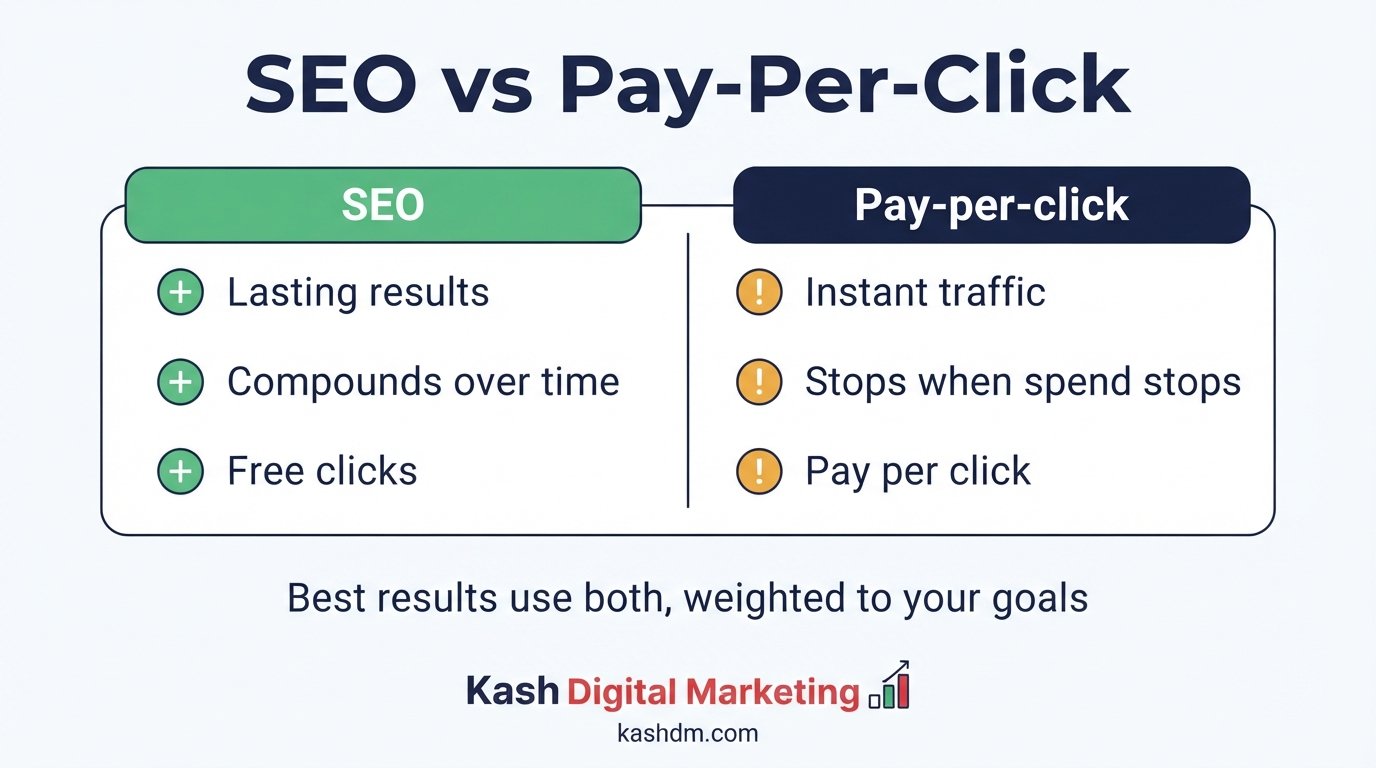
PPC produces traffic immediately but stops the moment spending stops. SEO takes longer to build momentum but keeps producing traffic and leads well after the initial investment, without an ongoing per-click cost. Neither is universally "better," they solve different problems.
When PPC makes sense first
A brand-new business needing leads immediately, a seasonal business needing a short-term surge, or a business testing a new service before committing to long-term content investment often benefits from starting with PPC while SEO builds in the background.
When SEO should be the priority
A business with a longer runway, an established business looking to lower its long-term cost per lead, or any business that wants to build a durable asset rather than rent attention indefinitely should prioritize SEO, ideally alongside at least a modest, well-targeted PPC effort to fill the gap while SEO ramps up.
| Factor | SEO | PPC |
|---|---|---|
| Time to results | Weeks to months | Immediate |
| Cost over time | Falls as authority builds | Stays constant or rises with competition |
| Durability | Continues after work slows | Stops immediately when spending stops |
| Best for | Long-term, compounding growth | Urgent or short-term lead needs |
Running SEO and PPC together for the best of both
The strongest approach for many small businesses is running a modest PPC campaign to cover immediate lead needs while SEO builds toward a lower, more sustainable cost per lead over time. As SEO rankings mature, PPC spend can often be scaled back, freeing budget for other growth priorities without sacrificing lead flow.
When to Hire an SEO Agency (and When Not To)
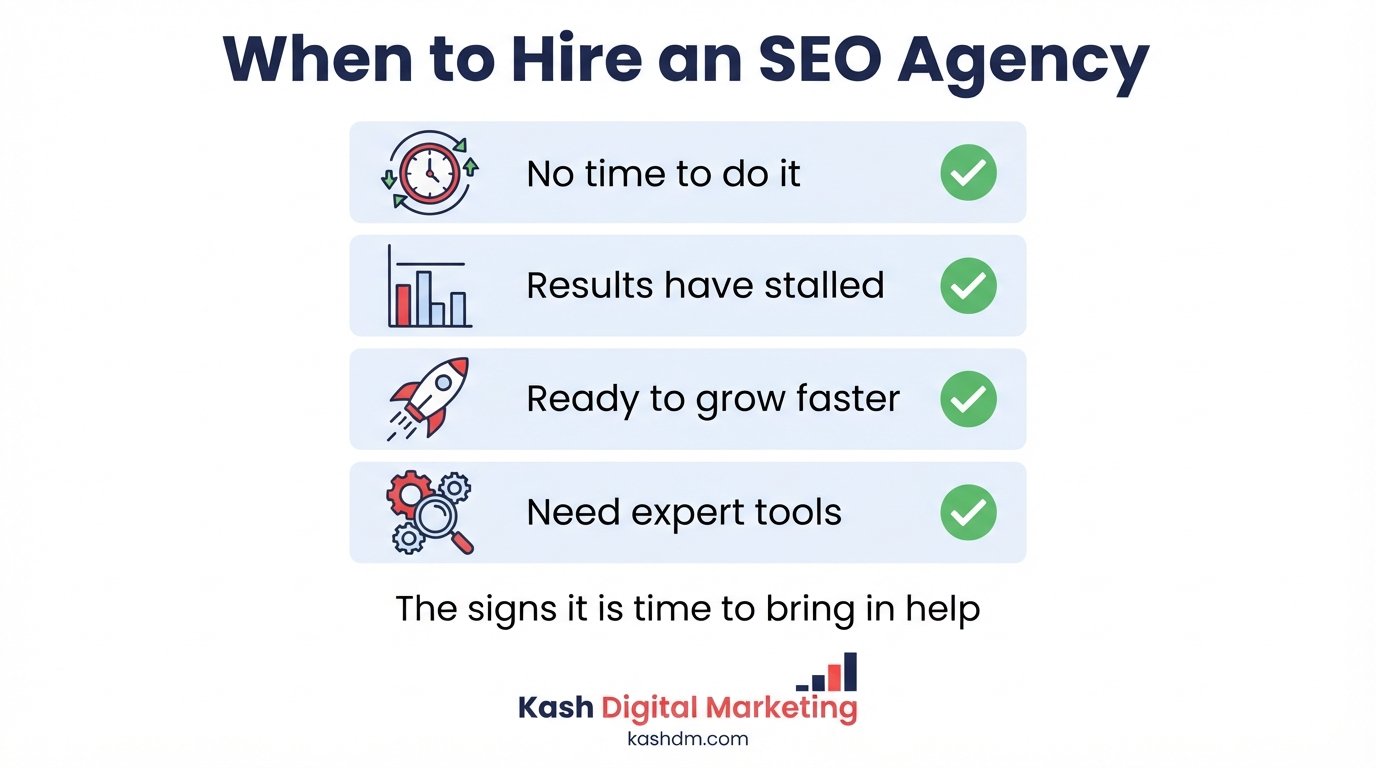
Hire an SEO agency once your own time and expertise become the limiting factor on growth, and not a moment before you're ready to commit to seeing it through. There's no universal right answer to when a small business should hire outside help, but a few clear signals make the decision easier.
Signs it's time to hire help
Consider hiring an agency when you've handled the basics, Google Business Profile, initial citations, review requests, yourself but growth has plateaued; when technical issues are beyond your comfort level to fix; when you simply don't have the hours to do the work consistently; or when competitors with professional help are visibly outpacing you in search.
Signs you might not be ready yet
If your business itself is still finding its footing, hasn't nailed down its core offering, or can't yet handle a meaningful increase in customer volume, it may be wiser to wait until the operational side is ready to support the growth SEO can bring. We'd rather have that honest conversation upfront than take on an engagement before it makes sense for your business.
What to look for when you are ready
Once you decide to hire, look for an agency that specializes in small business or local SEO specifically rather than treating you as a smaller version of an enterprise client, that's transparent about methods and pricing, that reports on real business outcomes, and that doesn't require a long contract before proving its value. Our best SEO services guide walks through this evaluation in more detail for any business comparing providers.
Making the transition smooth once you decide to hire
If you've been handling SEO yourself before bringing in an agency, a good provider should start by understanding and building on what you've already done, not dismissing it and starting over from scratch. We begin every takeover engagement by reviewing existing work, keeping what's working, and only changing what genuinely needs it. This respects the effort you've already put in and avoids the disruption and wasted history that comes from an agency insisting on a total rebuild simply because that's their default process rather than what your situation actually calls for.
How Kash Digital Marketing Structures Small Business SEO Engagements
We structure every small business engagement around a free audit, a prioritized plan, and transparent monthly execution, so you always understand what you're paying for and why. Our process is deliberately built to fit the realities of a small business budget and timeline, rather than a generic enterprise workflow scaled down.
Step one, the free audit and prioritized plan
We start by auditing your Google Business Profile, website, technical health, and current rankings, benchmarking you against your real local competitors, then building a plan that prioritizes the three or four highest-impact actions first. You receive this plan regardless of whether you choose to work with us.
Step two, foundation and early wins
We complete the foundational fixes, Google Business Profile optimization, technical corrections, citation cleanup, and target the longtail keywords most likely to produce results within the first couple of months, building early momentum and trust in the process.
Step three, scaling what works
As early wins prove out, we expand into content, local link building, and more competitive keywords, scaling your investment in line with the results it's producing rather than a fixed calendar. This keeps the engagement continually justified by real outcomes.
Transparent monthly reporting throughout
Every month you receive a clear report covering rankings, traffic, and, most importantly, the calls and leads generated, along with a plain-English explanation of what we did and what's next. You'll always have a real person to talk to who knows your business specifically.

Where to Go Next
Small business SEO overlaps with two other things people are usually deciding at the same time, and each has its own page here rather than a summary buried in this one.
If you are still choosing between agencies rather than choosing a strategy, our guide on how to choose the best SEO services covers the questions to ask, what a good answer sounds like, and the warning signs worth walking away from.
If what you actually need is map pack visibility, reviews and service-area coverage, that is local SEO, and the pillar page covers it properly.
And if the open question is budget, our SEO pricing guide publishes our starting range and explains exactly what moves the number up or down.
Why Small Businesses Choose Kash Digital Marketing
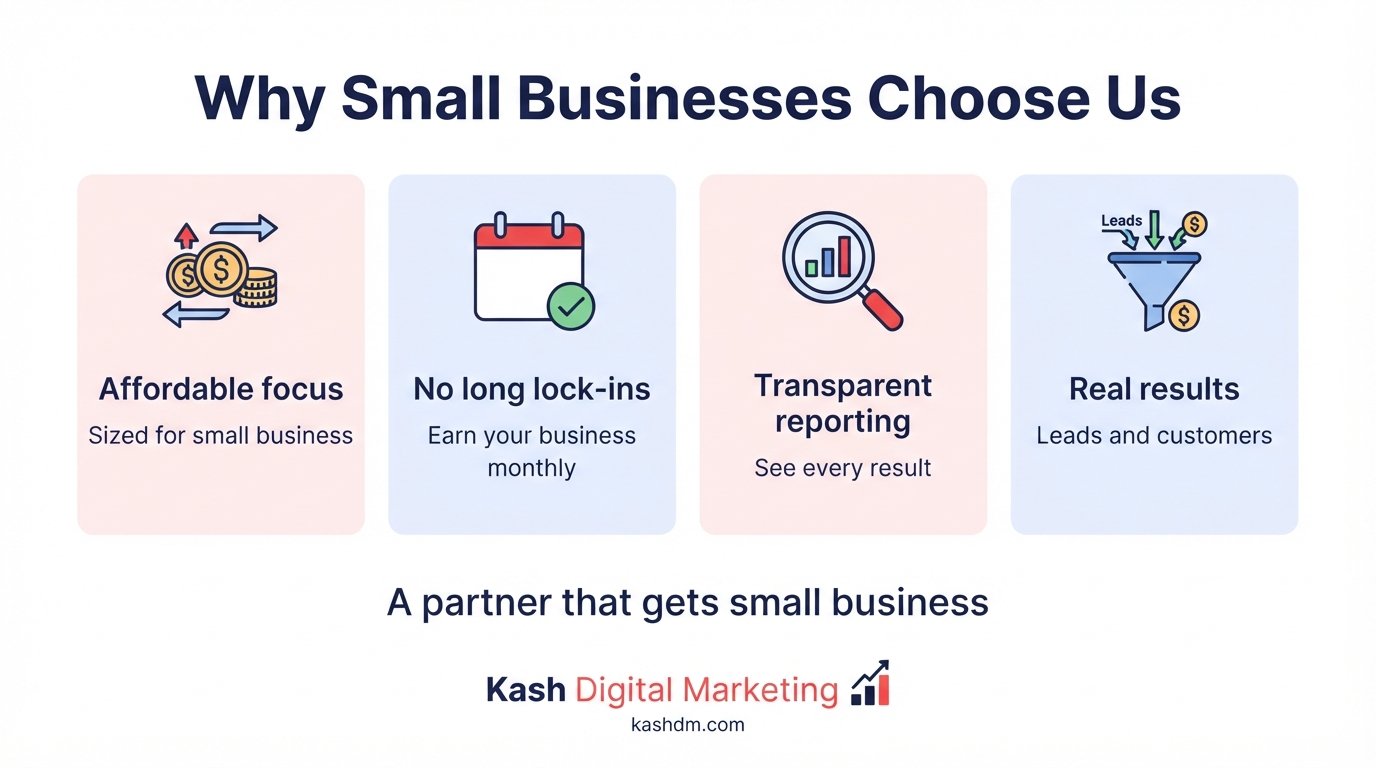
We built our small business SEO service around the exact frustrations small business owners have with typical agencies: opaque pricing, long contracts, and reports full of numbers that don't translate into customers. That's the standard we hold ourselves to on every engagement, and it's why small businesses across the US choose to work with us.
Specialization in small and local business
We focus specifically on small business and local SEO alongside social media marketing, rather than spreading across every marketing discipline. That focus means we understand the specific budget constraints, timelines, and priorities small business owners actually face, and we build strategy around them instead of a generic enterprise template.
No long contracts, transparent pricing
We don't lock clients into long-term contracts. We'd rather earn your business every month by delivering results you can see, which keeps us accountable in a way a locked-in contract never would. Our SEO pricing reflects this same transparency.
White-hat methods, always
Every tactic we use is white-hat and Google-compliant, protecting the rankings we build for you rather than risking them for a short-term boost. Your business is too important to gamble with shortcuts that could put your visibility at risk down the line.
A partner invested in your growth
We see ourselves as an extension of your team, genuinely invested in seeing your business grow, not a vendor executing a checklist. That mindset shapes how we prioritize, communicate, and adjust strategy as your business and market evolve, and it's what turns a first engagement into a lasting partnership for many of our small business clients.
Results measured the way you measure your own business
At the end of the day, we know a small business owner doesn't lie awake thinking about keyword rankings, they think about whether the phone is ringing and whether the bank account is growing. Every report, every strategy conversation, and every priority decision we make comes back to that same simple test: is this producing real customers for a real business. Keeping that question at the center of everything, rather than losing it in a sea of vanity metrics, is ultimately what we believe separates SEO that pays for itself from SEO that just looks good on paper.
Frequently Asked Questions About Small Business SEO
What are the best local SEO services for small business?
The best local SEO services for a small business combine Google Business Profile optimization, local keyword targeting, on-page content for core service pages, consistent citations, review generation, and basic technical health, sequenced to produce results quickly on a limited budget. Look for a provider that prioritizes based on your specific market rather than applying a generic template.
How much does small business SEO cost?
Cost depends on your market's competitiveness, your number of services and locations, and your current site condition, which is why we provide a free audit and a custom quote rather than a fixed price. See our pricing page for how we structure quotes.
How long does small business SEO take to work?
Google Business Profile improvements and easier longtail keywords can move within four to eight weeks. More competitive terms typically take three to six months to reach their full potential, with results compounding further from there.
Are cheap SEO services worth it?
Rock-bottom pricing is usually funded by shortcuts, spun content, spammy links, fake reviews, that risk a Google penalty. Affordable, value-driven SEO from a legitimate provider is worth it; the cheapest bid in the market almost always isn't.
Should I do SEO myself or hire an agency?
Basic tasks like completing your Google Business Profile and requesting reviews are DIY-friendly. Technical SEO, competitive content strategy, and link building typically require professional expertise and time most owners don't have. A hybrid approach often works best.
Is local SEO or PPC better for a small business?
They serve different needs. PPC produces immediate traffic but stops when spending stops; SEO takes longer to build but keeps producing leads at a falling cost per lead over time. Many small businesses benefit from running both together.
Can a brand-new business rank on Google?
Yes. New businesses that set up their Google Business Profile, citations, and website correctly from day one can begin ranking for lower-competition terms within the first couple of months, and every day earlier they start is a day of head start against competitors who delay.
What is a realistic small business SEO budget?
There's no single right number, it depends on your market and goals, but most small businesses see meaningful results by starting with a focused monthly investment concentrated on the highest-impact activities, then scaling as leads justify further spending.
Do I need a big website with lots of pages?
No. A small number of genuinely strong pages, your homepage, core service pages, and a helpful FAQ, generally outperform a large number of thin, low-value pages. Quality and relevance matter far more than sheer page count.
What happens during a free small business SEO audit?
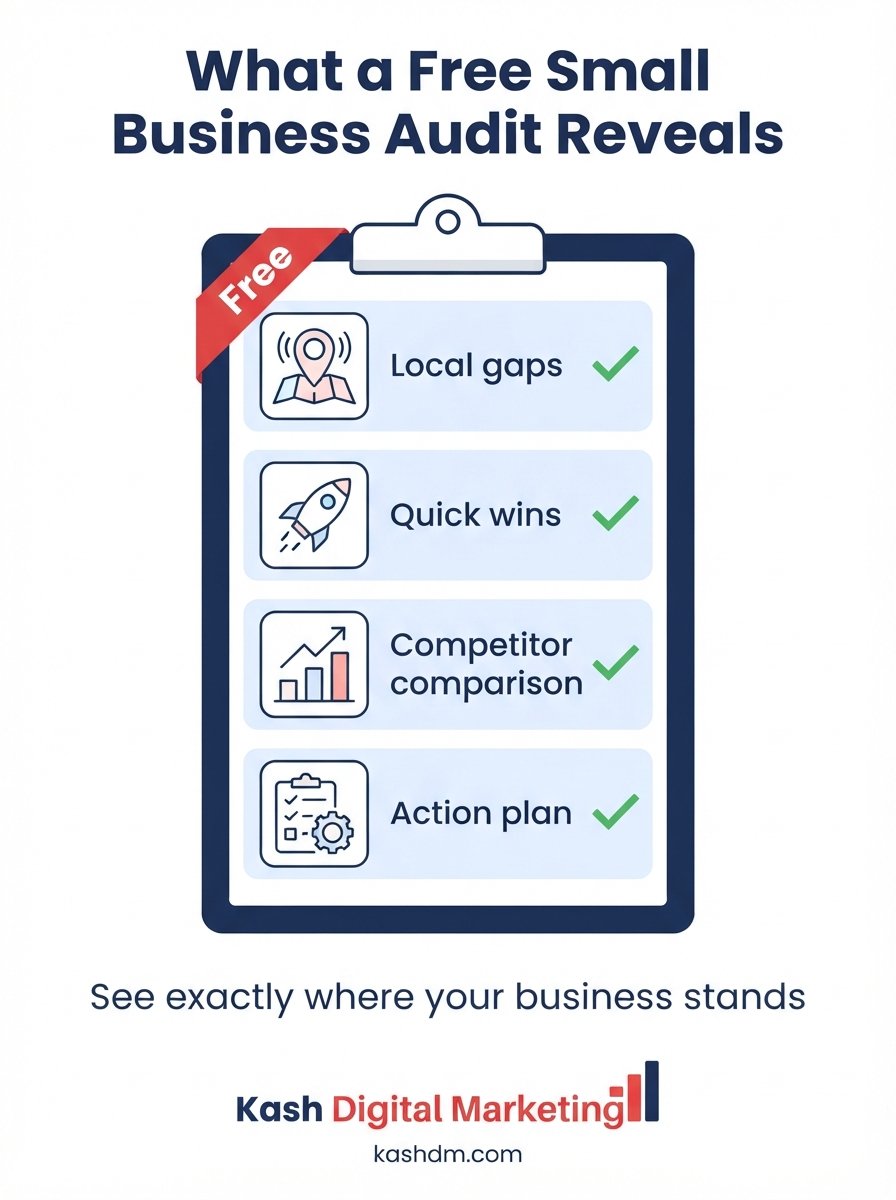
We review your Google Business Profile, website, technical health, citations, and current rankings, compare you against your real local competitors, and identify the highest-impact opportunities. You receive a clear, prioritized action plan to keep, whether or not you decide to work with us.
Get Your Free Small Business SEO Audit
Request Your Free SEO Audit
Prefer to talk it through? WhatsApp US +2135622433 or WhatsApp PK +92 348 3879366. We usually reply within an hour, and always within 8 hours.
Your free small business SEO audit shows exactly where you stand today and the fastest, most affordable path to more calls and customers. We review your Google Business Profile, website, technical health, citations, and rankings, benchmark you against the local competitors actually winning your searches, and hand you a clear, prioritized action plan, yours to keep, no obligation.
Ready to grow without overpaying or getting locked into a contract? Request your free audit and we'll usually reply within an hour, and always within 8 hours on business days.
- 💬WhatsApp: +2135622433
- ✉️Email: contact@kashdm.com
- 📝Free audit form: start here
Every month you wait is a month competitors, some of them smaller and less established than you, capture customers who could have found you first. Small business SEO done right doesn't require a massive budget, it requires the right priorities in the right order, done consistently. That's exactly what we build for every client, and the free audit is a risk-free way to see what it would look like for your business.
Kash Digital Marketing, affordable, honest SEO services for US small businesses. No spam. No long contracts. Just results.