Enterprise SEO services are specialized search optimization programs built for large websites, SaaS platforms, and B2B organizations where thousands of pages, multiple stakeholders, and complex technical infrastructure make growth far harder than it is for a small business site. At Kash Digital Marketing, our enterprise SEO services combine deep technical audits, scalable content systems, digital PR, and cross-functional process design into one program built to move organic revenue at the scale large organizations actually operate at.
If your organization runs a SaaS product, a marketplace, a multi-brand portfolio, or any site with tens of thousands of URLs, the rules that work for a five-page local business site simply don't apply. You're not fighting for one keyword, you're fighting for topical authority across an entire category, against competitors who have engineering teams, content teams, and years of accumulated domain authority. This page explains what enterprise and SaaS SEO actually involves, how it differs from smaller-scale SEO, what it costs, and how to get started with a free enterprise SEO audit.
Whether you're a VP of Marketing at a Series C SaaS company trying to reduce paid acquisition dependency, a Head of SEO at a marketplace juggling millions of listing pages, or a demand generation leader at a B2B enterprise trying to prove organic's contribution to pipeline, this guide walks through exactly how enterprise SEO drives measurable growth at scale. We've written it to be genuinely useful on its own, not just a sales pitch, so by the end you'll understand what a serious enterprise SEO program actually requires and be able to evaluate any provider, including us, against a real standard. If you'd rather skip straight to seeing where your site stands today, the free audit is the fastest way to find out.
⭐ 5.0 rating · ✅ Google & Meta certified · ⚡ Reply usually within an hour · 🛡️ 100% white-hat · 🇺🇸 Serving US enterprise and SaaS companies

What Enterprise SEO Services Actually Involve
Enterprise SEO services are the discipline of optimizing very large, complex websites, typically 10,000+ pages, multiple subdomains, and several stakeholder teams, for sustainable organic growth. Unlike small-business SEO, where a handful of pages and a single decision-maker keep things simple, enterprise SEO has to account for legacy technical debt, competing internal priorities, engineering sprint cycles, and content that spans dozens of product lines and personas.
Enterprise SEO works by treating the website as an interconnected system rather than a collection of individual pages. A change to a single template can affect fifty thousand URLs at once, for better or worse. Our enterprise SEO services are built around this reality: every recommendation is evaluated for its blast radius, every technical fix is prioritized by the revenue it touches, and every content initiative is designed to scale without collapsing into thin, templated noise.
Think of enterprise SEO as the difference between renovating a single-family home and managing infrastructure for a small city. In a small home, you can repaint a room without consulting anyone. In a city, moving one pipe can affect thousands of households, so every change goes through planning, prioritization, and careful sequencing. Enterprise SEO applies that same discipline, coordinating changes across templates, subdomains, and teams so that improvements compound instead of creating new problems elsewhere.
How enterprise SEO differs from small-business SEO
Small-business SEO optimizes a handful of pages for a single decision-maker who can approve changes in a day. Enterprise SEO optimizes thousands or millions of pages, often across multiple CMSs, subdomains, and international markets, where a change requires sign-off from engineering, legal, brand, and product before it ships. The strategy has to account for that friction from the start, which is why our enterprise SEO services include the technical SEO rigor and process design that smaller campaigns don't need.
Who needs enterprise SEO services
Organizations with large product catalogs, SaaS platforms with multiple product lines, marketplaces, B2B companies with complex sales cycles, and multi-brand portfolios all need enterprise SEO. If your site has more than a few thousand indexable URLs, or if your organic growth requires coordination across multiple teams and systems, you've outgrown a generalist approach and need a program built for scale. Smaller, single-location businesses are usually better served by local SEO, while single-storefront online sellers often fit best under ecommerce SEO.
Enterprise SEO as a cross-functional program, not a marketing task
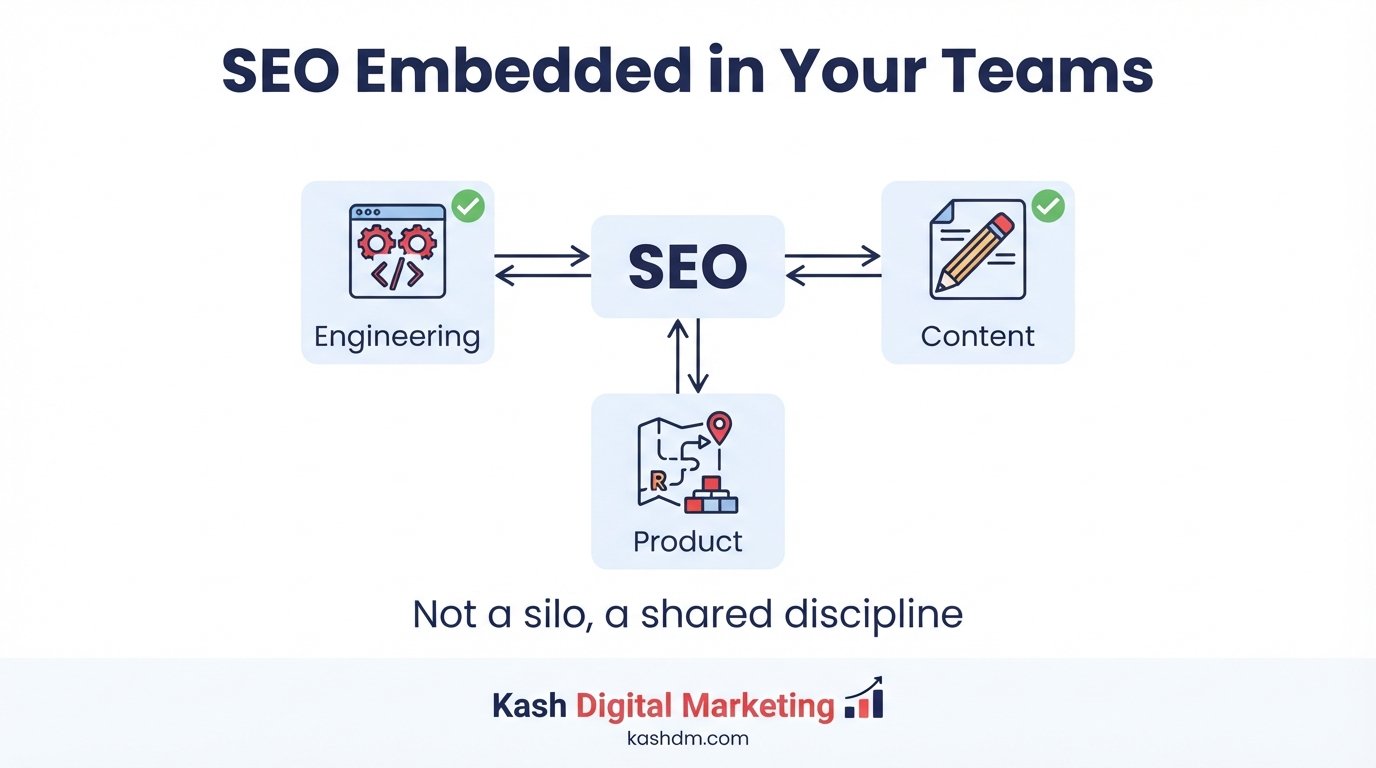
The single biggest misconception about enterprise SEO is that it's a task marketing can execute alone. In reality it's a cross-functional program that touches engineering, product, content, legal, and sales. A technical fix might require an engineering sprint. A new content vertical might need product marketing's input on positioning. A schema rollout might need legal review. Our enterprise SEO services are designed around this reality, we don't just hand you a list of recommendations, we help you build the internal process and stakeholder alignment that turns recommendations into shipped changes. This is why the enterprise SEO programs that succeed treat SEO as organizational infrastructure, not a checklist owned by one person in a silo.

Why Enterprise SEO Matters for Large Organizations
Enterprise SEO matters because organic search is one of the few acquisition channels that scales without a linear increase in cost, and at enterprise scale that difference determines whether growth is sustainable or dependent on ever-rising paid budgets. For large organizations, the economics of organic search compound in ways that paid channels structurally cannot.
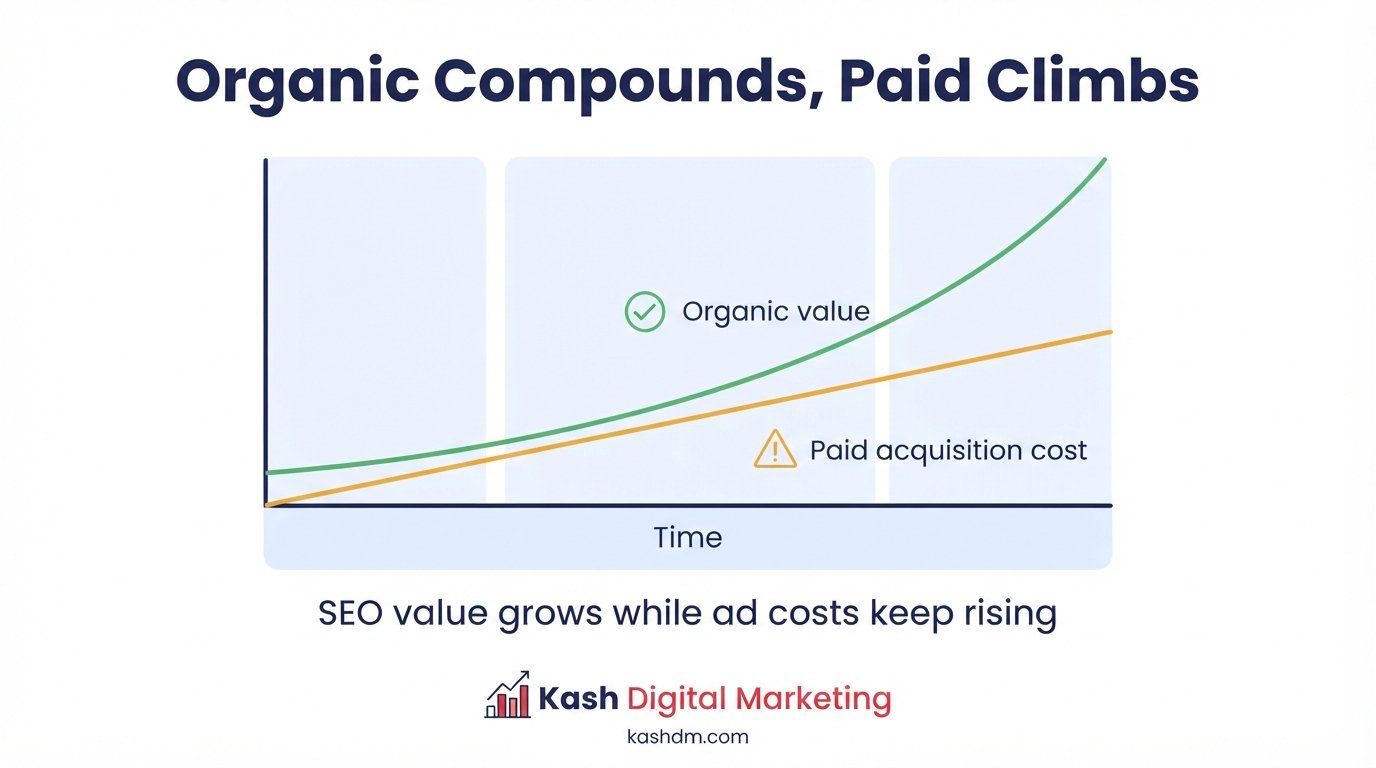
The math becomes compelling once you look at it honestly. A SaaS company spending heavily on paid search sees costs rise every year as competition and CPCs increase, while the same budget invested in enterprise SEO builds a growing library of ranking pages that keep generating demos, trials, and pipeline long after they're published. At scale, that compounding effect isn't a marginal improvement, it's the difference between a marketing function that scales with headcount and one that scales independently of it.
Organic search captures buyers earlier in complex B2B cycles
B2B and SaaS buying journeys often involve multiple stakeholders researching over weeks or months before a single demo request happens. Organic search is where most of that early research occurs, comparison articles, "best X software" roundups, integration guides, and educational content. A strong enterprise SEO program captures buyers at this early research stage, well before they're ready to talk to sales, and nurtures them through the funnel with the content strategy work described later on this page.
Enterprise SEO reduces dependency on paid acquisition
Every large organization eventually confronts the ceiling of paid acquisition: CPCs rise, auction competition intensifies, and the same budget buys fewer leads each year. Enterprise SEO builds a durable, compounding asset that reduces this dependency over time, protecting the business from platform policy changes, algorithm shifts in ad auctions, and rising costs that paid-only strategies can't escape. Our broader SEO pricing approach reflects this same principle of building lasting value rather than renting attention.
Scale creates both risk and opportunity that smaller sites never face
A large site has thousands of pages that can each rank, which is an enormous opportunity, but it also has thousands of pages that can each go wrong, orphaned URLs, duplicate content, crawl budget waste, and inconsistent internal linking, at a scale that can quietly bleed traffic for years before anyone notices. Enterprise SEO exists precisely to manage this dual reality: capturing the massive upside of scale while systematically closing the technical and content gaps that only appear once a site crosses a certain size.
Enterprise SEO underpins brand authority in the category
Ranking consistently across a category's most important terms doesn't just drive traffic, it signals market leadership. When a SaaS company consistently appears for the terms buyers use to evaluate solutions, comparison pages, integration guides, use-case content, that visibility reinforces the perception that the company is the category leader, which influences sales conversations even when the buyer found the company through another channel entirely.
What "Enterprise Grade" Actually Means in SEO
The phrase gets used loosely. In practice, an SEO engagement earns the label when four things are true.
It survives contact with your release cycle. Recommendations that assume you can change a template next week are not enterprise recommendations. Real work is specified as tickets your engineers can estimate, sequenced against a roadmap you do not control.
It is defensible to people outside marketing. Enterprise SEO budget gets approved by people who do not care about rankings. The work has to connect to pipeline, to assisted revenue, or to a cost that goes away, and the measurement has to hold up when finance looks at it.
It scales without proportional headcount. A hundred pages can be fixed by hand. A hundred thousand cannot. That means templates, rules, internal-link systems and automated quality checks rather than a longer task list.
It does not create risk. No tactic that could trigger a manual action. No migration without a redirect map and a rollback plan. No programmatic content that would embarrass you if a journalist read it.
If a proposal you are evaluating does not address all four, it is a small-business SEO engagement being sold at an enterprise price.
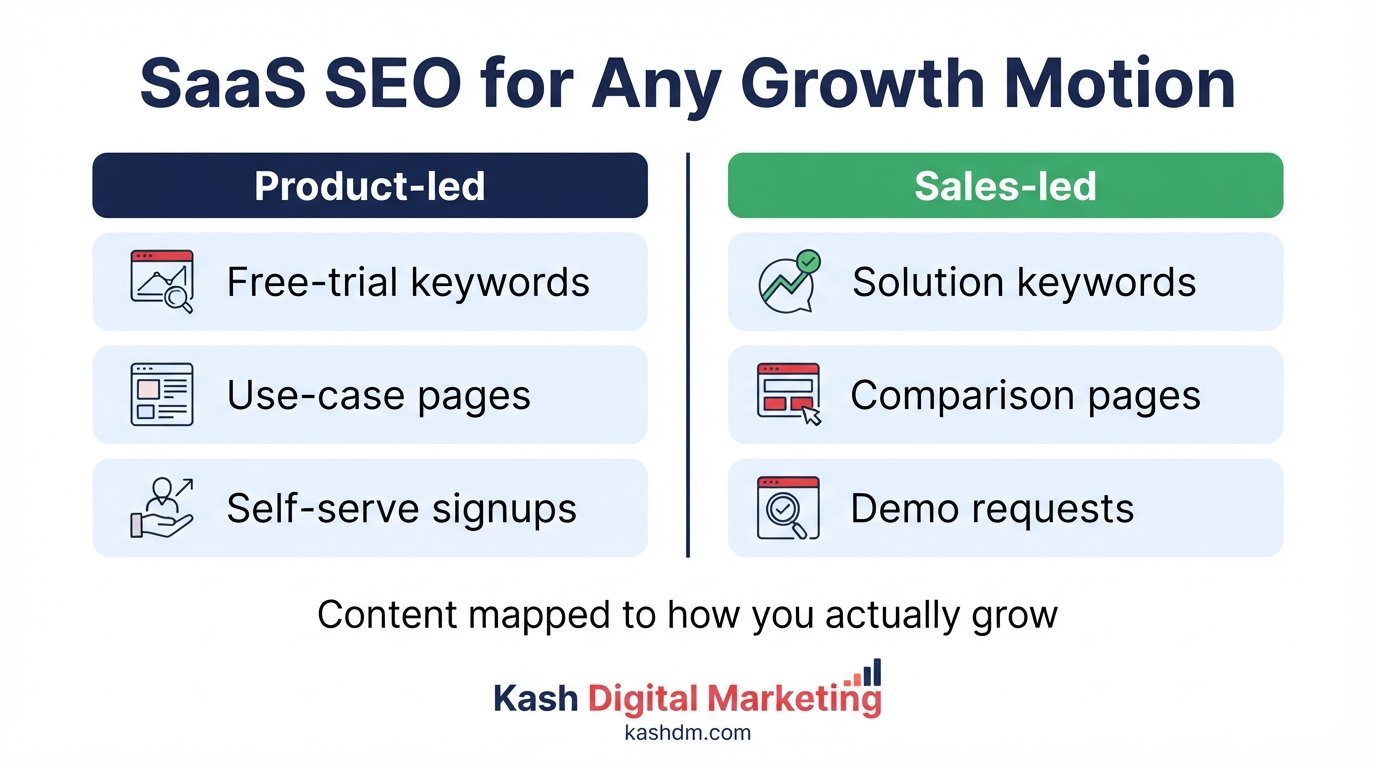
SaaS SEO Services Built for Product-Led and Sales-Led Growth
SaaS SEO services are search optimization programs tailored to software companies, where the buyer journey, the product itself, and the content that supports both require a fundamentally different approach than ecommerce or local SEO. Our SaaS SEO services are built around the two dominant growth models in software: product-led growth, where the product itself drives acquisition, and sales-led growth, where content nurtures buyers toward a sales conversation.
SaaS SEO succeeds by understanding that most SaaS buyers aren't searching for your brand name, they're searching for the problem your product solves, the alternatives they're considering, and the specific outcomes they need. We build keyword and content strategies around this problem-first mindset rather than assuming buyers already know your product exists.
Aligning SEO with product-led growth motions
For product-led SaaS companies, SEO needs to drive signups and free-trial activations, not just leads. We optimize landing pages, feature pages, and use-case content to convert organic visitors directly into product users, closing the loop between content and the in-product activation events that matter to PLG teams.
Aligning SEO with sales-led growth motions
For sales-led SaaS and enterprise software, SEO needs to generate qualified leads that sales can work, not just traffic. We build content that nurtures buyers through longer, more considered sales cycles, comparison pages, ROI calculators, and case studies, and align it with the stages of your actual sales funnel so marketing and sales share a consistent view of what "qualified" means.
SaaS-specific technical considerations
SaaS platforms often have app subdomains, in-product help centers, and marketing sites running on entirely different systems, each with different indexing behavior and crawl priorities. We audit each of these separately and make sure your help center, blog, and marketing pages aren't cannibalizing each other or competing for the same rankings, a problem unique to how SaaS companies structure their web presence.
B2B SEO Services That Align With Longer Sales Cycles
B2B SEO services optimize for buying journeys that often span weeks or months and involve multiple stakeholders, which means success looks different than it does for consumer-facing SEO. Our B2B SEO services are built around this reality, focusing on the full funnel rather than a single moment of conversion.
B2B buyers research extensively before ever engaging sales, comparing vendors, reading reviews, checking integrations, and building internal business cases. A B2B SEO program needs content for every stage of that research process, and it needs to track pipeline influence, not just clicks, because a single blog post rarely closes a six-figure deal on its own.
Mapping content to the B2B buying committee
B2B purchases often involve a buying committee: an economic buyer, a technical evaluator, an end user, and sometimes a security or procurement reviewer. We build content that speaks to each of these roles, ROI-focused content for economic buyers, technical documentation for evaluators, and workflow content for end users, so your organic presence supports the entire committee, not just one persona.
Longtail and bottom-of-funnel B2B keywords
B2B search volumes for head terms are often modest compared to consumer categories, but the buyer intent behind longtail and bottom-of-funnel B2B keywords is exceptionally high. Terms like "[category] software for enterprise teams" or "[competitor] alternative for mid-market companies" carry outsized value relative to their search volume. We prioritize these high-intent terms alongside broader category terms, because in B2B, a handful of highly qualified visitors often outperforms a much larger volume of unqualified traffic.
Attribution across long, multi-touch B2B journeys
Because B2B sales cycles often stretch across many touchpoints and weeks or months, attributing pipeline to SEO requires more than last-click tracking. We help set up multi-touch attribution models, connecting organic sessions to CRM pipeline stages, so you can see how organic content contributes across the entire journey, not just the final form fill. This is essential for proving SEO's value in a B2B context where the true impact of a single article might not show up in the CRM for months.
Enterprise Technical SEO: Managing Complexity at Scale
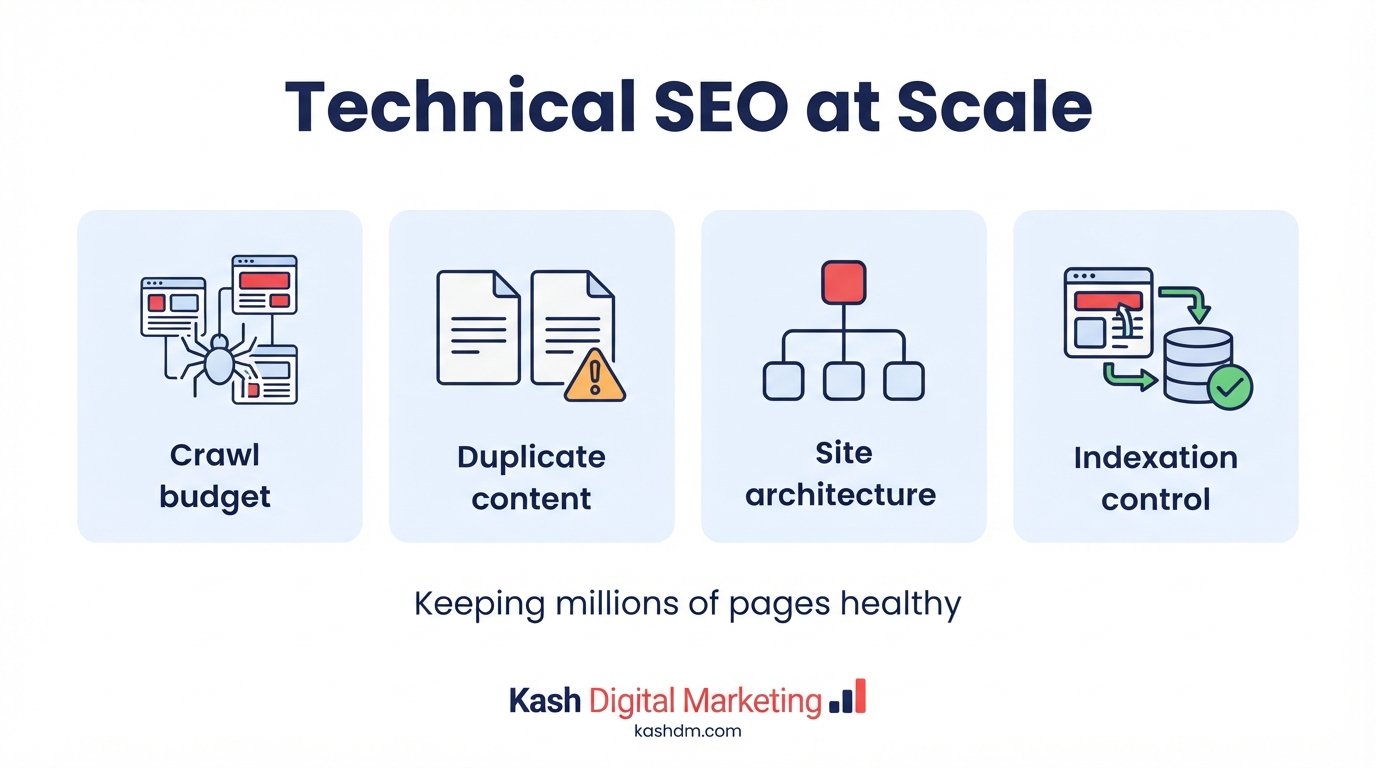
Enterprise technical SEO is the discipline of keeping massive, complex websites crawlable, indexable, and fast, a problem that grows exponentially harder as page count and system complexity increase. Our enterprise technical SEO services address the issues that only appear at scale, issues a five-page site will never encounter but a fifty-thousand-page site encounters constantly.
At enterprise scale, small technical issues multiply. A single template bug can create duplicate content across tens of thousands of URLs overnight. A misconfigured robots.txt directive can accidentally block an entire section of the site from crawling for months before anyone notices the traffic decline. This is why enterprise technical SEO leans heavily on monitoring and systematic auditing rather than one-time fixes, the same rigor we bring through our dedicated technical SEO services applied at enterprise scale.
Crawl budget management for large sites
Google allocates a finite crawl budget to every site, and on a large site, wasted crawl budget means important pages get crawled less frequently, or not at all. We audit crawl patterns, eliminate low-value URLs from the crawl queue (faceted navigation, session parameters, thin duplicate pages), and redirect that crawl budget toward the pages that actually drive revenue.
Managing duplicate content and canonicalization at scale
Large sites almost always generate duplicate or near-duplicate content, through faceted filters, print versions, tracking parameters, or regional variants. We implement systematic canonicalization rules, not page-by-page fixes, but template-level solutions that prevent duplication from recurring every time a new page is created.
Site architecture and internal linking for massive URL counts
A site with hundreds of thousands of pages needs a deliberate architecture so link equity flows to the pages that matter most. We design hub-and-spoke structures, category hierarchies, and internal linking rules that ensure your highest-value pages, not just your newest ones, receive the strongest internal signals.
Monitoring and alerting for technical regressions
At enterprise scale, technical SEO can't be a quarterly audit, it needs continuous monitoring. We set up automated alerts for indexation drops, crawl anomalies, and Core Web Vitals regressions, so problems are caught within days rather than discovered three months later in a quarterly business review, by which point the traffic damage is already significant.
Structured data at scale
Large sites benefit enormously from structured data, product schema, article schema, FAQ schema, organization schema, but implementing it manually across thousands of templates is impractical. We build structured data into the template layer itself, so every new page inherits correct markup automatically, and we run ongoing validation to catch the schema errors that creep in as templates evolve and content teams make well-intentioned edits that accidentally break markup.
Managing subdomains and multi-CMS environments
Enterprise organizations frequently run their marketing site, blog, help center, and app on entirely different platforms and subdomains, each with its own crawl behavior, sitemap, and indexing quirks. We audit each environment individually while also considering how they interact, ensuring the help center doesn't outrank the marketing site for commercial terms, and that authority flows sensibly between subdomains rather than fragmenting.
| Enterprise Technical SEO Issue | Why It's Different at Scale | Our Approach |
|---|---|---|
| Duplicate content | One bug affects thousands of URLs | Template-level canonicalization |
| Crawl budget waste | Low-value pages starve high-value pages of crawl | Crawl audits and directive cleanup |
| Orphaned pages | Easy to lose track of pages across large architectures | Automated internal link audits |
| Site speed | Small regressions compound across millions of page views | Continuous Core Web Vitals monitoring |
| Indexation bloat | Thin or parameterized pages dilute site quality signals | Systematic noindex and consolidation rules |
SEO at Scale: Systems Over One-Off Fixes
SEO at scale means solving problems at the template and system level rather than the individual page level, because on a large site, fixing one page at a time is mathematically impossible to keep up with. Our approach to SEO at scale is built around this principle from the very first audit.
When a site has thousands of product pages generated from the same template, an on-page issue in that template exists on every single page it powers. Fixing it once, at the template level, resolves the issue everywhere instantly. This systems-first mindset is what separates enterprise SEO from smaller-scale work, and it's the lens through which we evaluate every recommendation we make.
Template-level thinking versus page-level thinking
We audit templates, not just individual pages, identifying the patterns that repeat across your site's architecture. A single fix to a product page template, a category page template, or a blog post template can improve thousands of pages simultaneously, delivering far more impact per hour of work than any page-by-page optimization ever could.
Building repeatable processes instead of one-off projects
SEO at scale requires processes that repeat reliably as your site grows: a content brief template that scales to hundreds of writers, a technical QA checklist that runs before every new template ships, and a link-building process that doesn't require reinventing the outreach strategy for every campaign. We build these repeatable systems so your SEO program scales with your business instead of requiring proportionally more manual effort every time you grow.
Prioritization frameworks for enormous backlogs
Large sites generate enormous backlogs of potential SEO improvements, more than any team could execute in a year. We build prioritization frameworks that score opportunities by estimated impact, effort required, and dependency on other teams, so your limited engineering and content resources go toward the changes that move revenue, not the changes that happen to be easiest to justify in a meeting.
Programmatic SEO: Scaling Content Without Sacrificing Quality
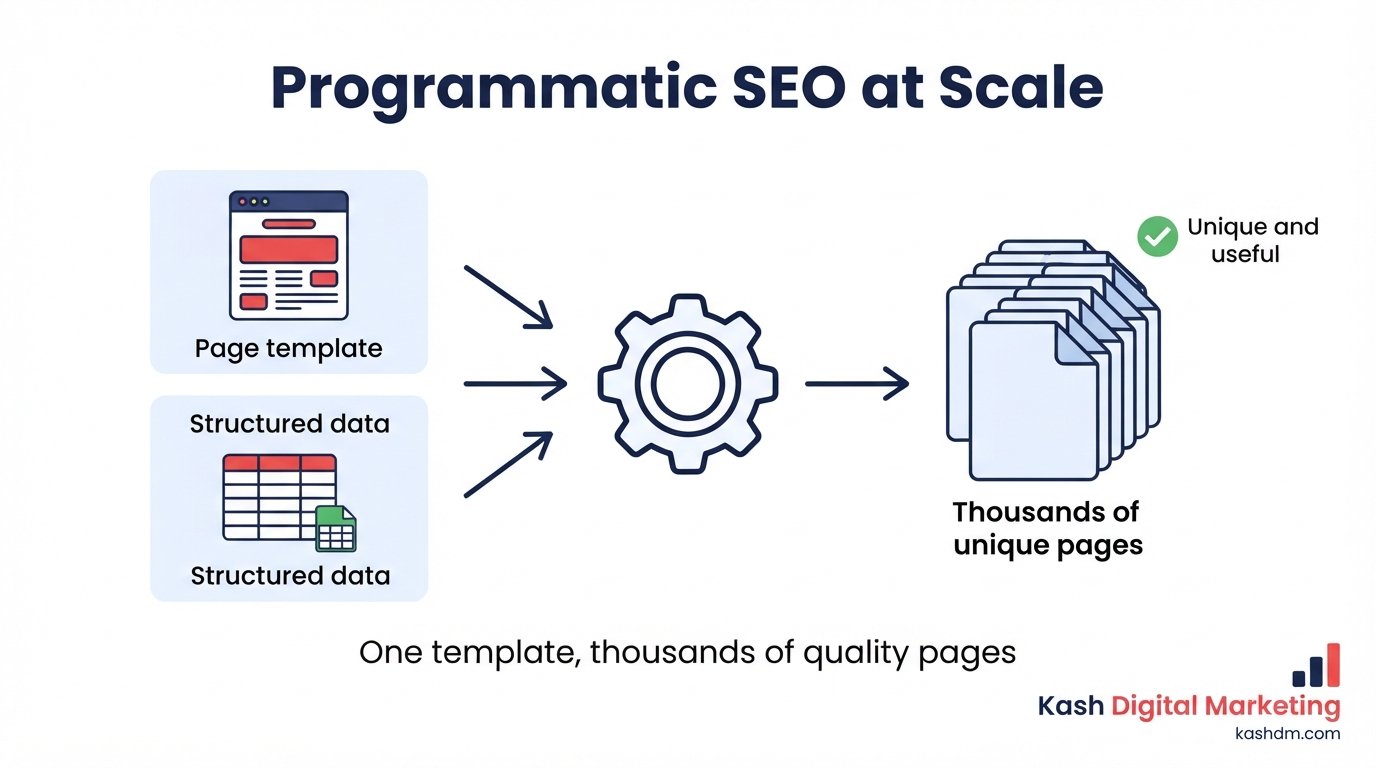
Programmatic SEO is the practice of generating large numbers of pages from structured data and templates, capturing longtail search demand at a scale manual content creation could never match. Our programmatic SEO services help enterprises and SaaS companies build these page sets the right way, avoiding the thin, low-value pages that trigger Google's Helpful Content system.
Done well, programmatic SEO can turn a single dataset, cities, integrations, industries, use cases, into thousands of genuinely useful pages, each answering a real search query with real, specific value. Done poorly, it produces exactly what Google's quality systems are designed to catch: thin, templated pages with little differentiation. The difference lies entirely in execution.
Choosing the right data sets for programmatic pages
Not every dataset makes a good foundation for programmatic SEO. We identify data your organization already has, integrations, industries served, comparison data, location coverage, that maps naturally to genuine search demand, and we validate real search volume before building a single page.
Building genuine uniqueness into every template
The single biggest risk in programmatic SEO is producing pages that are functionally identical with only a variable swapped out. We design templates with enough genuine, data-driven variation, unique statistics, unique comparisons, unique use-case detail, that each page provides real value distinct from its siblings, protecting the entire page set from quality penalties.
Quality control and pruning at scale
Programmatic page sets need ongoing quality control, because not every page in a large template-generated set will perform equally. We monitor performance across the set, prune or consolidate pages that never gain traction, and continuously improve the templates that underperform, treating the page set as a living portfolio rather than a one-time launch.
International SEO Services for Global Enterprises
International SEO services optimize a website to rank in multiple countries and languages, a discipline that combines technical precision with genuine cultural and linguistic localization. Our international SEO services help enterprises expand organic visibility into new markets without the common mistakes that quietly sabotage global campaigns.
International SEO is unforgiving of shortcuts. A machine-translated page, an incorrectly implemented hreflang tag, or a single global sitemap trying to serve twelve countries can each independently cause an entire market's rankings to underperform, often without any obvious error message pointing to the cause.
Choosing the right URL structure for international expansion
Country-code domains, subdomains, and subdirectories each carry different tradeoffs for authority consolidation, hosting, and ease of management. We assess your organization's resources, existing domain authority, and growth plans to recommend the structure that will serve your international strategy best, rather than defaulting to whatever's easiest to set up.
Genuine localization versus translation
A translated page and a localized page are not the same thing. Genuine localization adapts currency, measurement units, cultural references, local competitors, and even keyword targeting, because the way people search for the same concept often differs meaningfully between markets and languages. We build content and keyword strategies specific to each target market rather than translating a single source page.
Managing international technical SEO at scale
International sites face compounding technical complexity: hreflang implementation across dozens of language and country pairs, region-specific sitemaps, geotargeting settings, and CDN configuration that affects page speed differently in each market. We manage this complexity systematically, because a single hreflang error can quietly serve the wrong language to an entire country for months.
Multilingual and Hreflang SEO Done Correctly
Multilingual and hreflang SEO ensures Google serves the right language version of your content to the right audience, a technical implementation that is deceptively easy to get wrong and expensive when it is. Our hreflang SEO services get this implementation right the first time and monitor it continuously afterward.
Hreflang errors are among the most common technical SEO problems we find on large international sites, and they're also among the most damaging, because they're invisible in a normal site audit unless you're specifically checking for them. A single missing return tag or a mismatched language code can silently prevent an entire language version from ranking correctly.
Common hreflang mistakes that quietly cost rankings
Missing reciprocal (return) tags, incorrect ISO language and country codes, hreflang tags that don't match the canonical tag, and inconsistent implementation across a sitemap versus on-page tags are the most frequent errors we find. Each one individually can cause Google to ignore the hreflang cluster entirely, defaulting to showing the wrong language version to searchers.
Implementing hreflang at scale via sitemaps
For large multilingual sites, we implement hreflang through XML sitemaps rather than on-page tags alone, because sitemap-based implementation is more reliable and easier to audit and maintain across thousands of URL pairs, reducing the chance of the silent errors that plague page-by-page implementations.
Ongoing validation and monitoring
Hreflang implementations degrade over time as new pages are added and old ones are removed without updating their language pairs. We build ongoing validation into your technical SEO monitoring, so hreflang errors are caught and fixed within days rather than accumulating silently for months, the same continuous-monitoring philosophy we apply across all enterprise technical SEO work.

Enterprise Content Strategy Built for Scale
Enterprise content strategy is the system that governs how a large organization plans, produces, and maintains content across dozens of contributors and thousands of pages without losing quality or consistency. Our enterprise content strategy services build this system from the ground up, or refine one that's already partially in place.
Without a deliberate system, enterprise content operations tend to drift toward inconsistency: different writers producing wildly different quality, content that duplicates existing pages because no one checked what already existed, and a growing backlog of outdated content that no one owns. Our content and copywriting expertise, applied at enterprise scale, prevents this drift.
Content governance and ownership
We help establish clear ownership for every content category, so every piece of content has an accountable owner responsible for its accuracy and performance over time, not just at launch. Without this, large content libraries inevitably decay as products change and information goes stale.
Scalable content briefs and quality standards
We build content brief templates and quality standards that scale across internal teams, freelance writers, and subject matter experts, ensuring consistent quality regardless of who's producing the content. This consistency is what lets an enterprise content program scale output without scaling quality-control overhead proportionally.
Content refresh and pruning programs
Large content libraries accumulate outdated, underperforming, and redundant pages over time. We build systematic content audit and refresh programs that identify which existing content to update, consolidate, or remove, often unlocking significant ranking gains from content that already exists rather than requiring net-new production.
Topic Clusters and Pillar Strategy for Category Authority
Topic clusters and pillar strategy organize your content around core topics rather than isolated keywords, building the comprehensive topical authority that Google increasingly rewards over individually optimized pages. This page itself is an example of the pillar model we build for enterprise clients: a comprehensive hub page supported by focused cluster content that links back to it.
A pillar page covers a broad topic comprehensively, while cluster pages each dive deep into a specific subtopic and link back to the pillar, creating a web of internal links that signals topical depth to Google and gives users a clear path to explore related content.
Identifying pillar topics that map to your business
We identify the handful of core topics that matter most to your business and your buyers, then map every relevant keyword and subtopic underneath them. This mapping prevents the common enterprise mistake of publishing dozens of loosely related articles that never build coherent authority around any single topic.
Structuring internal links between pillars and clusters
The internal linking between pillar and cluster pages is what makes the model work. We build deliberate linking patterns, every cluster page links up to its pillar, and the pillar links down to its most important clusters, concentrating link equity and signaling topical relationships clearly to search engines.
Measuring topical authority over time
We track not just individual keyword rankings but the aggregate visibility of an entire topic cluster, because topical authority often shows up as a rising tide that lifts every page in the cluster simultaneously, a signal that individual keyword tracking alone can miss.

Product-Led SEO: Turning Feature Pages Into Growth Engines
Product-led SEO optimizes the pages where your product itself does the selling, feature pages, integration pages, and use-case pages, so organic search drives signups and activations directly rather than routing everyone through a lead form. Our product-led SEO services are built specifically for SaaS companies where the free trial or freemium tier is the primary conversion path.
Product-led SEO requires a different content approach than traditional lead-gen SEO. Instead of gating value behind a form, the goal is to demonstrate the product's value clearly enough within the content itself that the reader wants to try it immediately.
Feature and use-case pages that convert to signups
We build feature pages and use-case pages that speak directly to the specific job a searcher is trying to accomplish, showing exactly how your product solves it, with clear, low-friction paths to a free trial or signup rather than a gated content download.
Integration pages as an underused SEO opportunity
For SaaS companies with an integration ecosystem, individual integration pages ("[Your Product] + [Popular Tool]") capture highly specific, high-intent searches from users already invested in a particular workflow. We build and optimize these pages systematically, often uncovering an entire category of untapped organic demand.
Aligning product marketing and SEO content
Product-led SEO works best when it's tightly coordinated with product marketing, so feature pages reflect accurate, current product capabilities and positioning. We work directly with your product marketing team to keep this content synchronized as the product evolves, preventing the common problem of SEO pages that describe features the product abandoned two releases ago.
SaaS Keyword Research: Jobs-to-Be-Done and Bottom-of-Funnel Terms
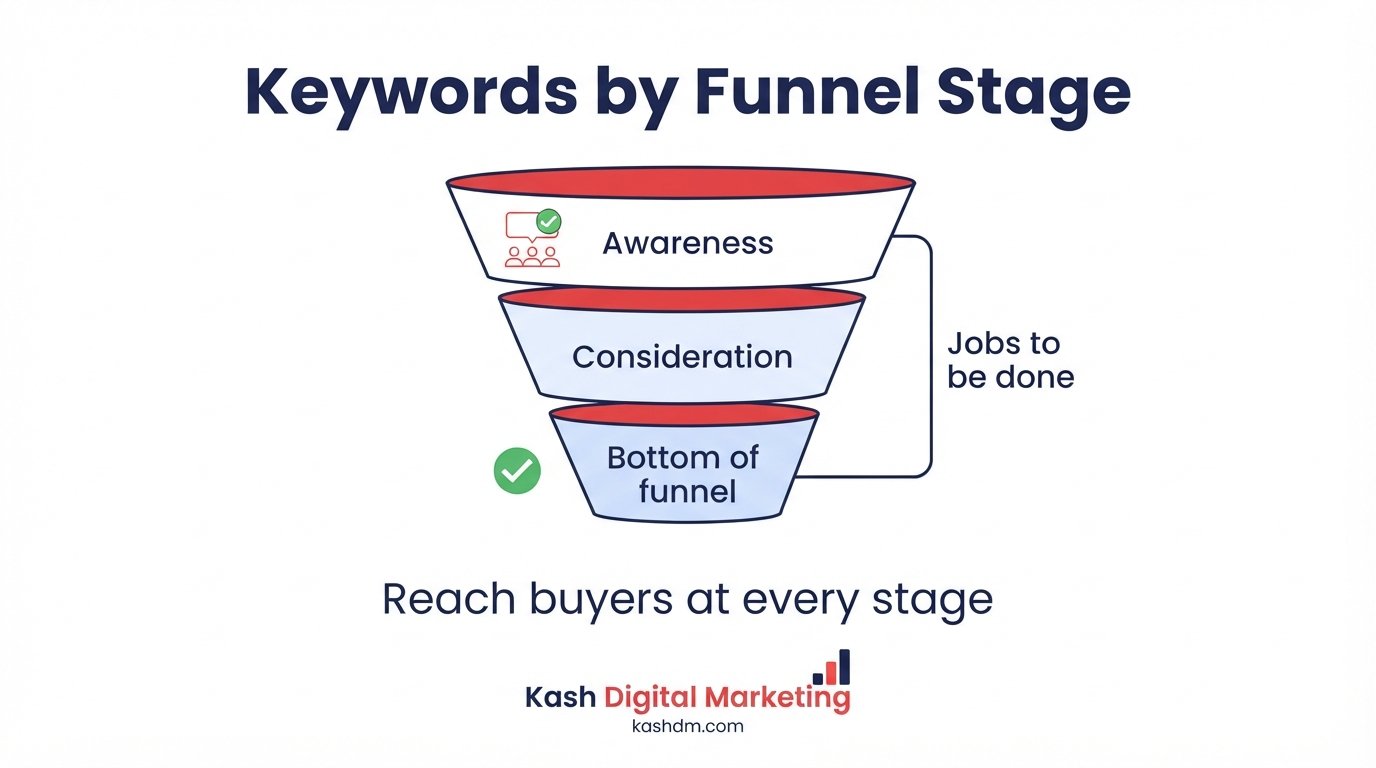
SaaS keyword research goes beyond search volume to map keywords against the jobs your buyers are trying to get done, because in software, the same underlying job often gets searched a dozen different ways depending on the buyer's role and familiarity with the category. Our SaaS keyword research process is built around this jobs-to-be-done lens.
Bottom-of-funnel SaaS keywords, comparisons, alternatives, pricing, and "best X for Y" terms, often carry the highest conversion rates of any keyword category, even when their search volumes look modest next to broad, top-of-funnel terms.
Mapping keywords to jobs-to-be-done, not just topics
We research the actual outcomes your buyers are trying to achieve, then map keywords to those jobs rather than to surface-level topics. A buyer searching "how to automate customer onboarding" and one searching "customer onboarding software" may be doing the same underlying job at different points in their journey, and we build content that serves both.
Comparison and alternative keywords
"[Your Product] vs [Competitor]" and "[Competitor] alternatives" searches represent some of the highest-intent traffic in SaaS, capturing buyers who are actively evaluating and close to a decision. We build honest, genuinely useful comparison content that respects the searcher's need for real information, which both ranks better and converts better than one-sided marketing copy.
Pricing and bottom-of-funnel keyword targeting
Pricing-related searches signal strong purchase intent, and we ensure your pricing page and supporting content are optimized to capture this demand, along with related bottom-of-funnel terms like "[category] software for [industry]" that indicate a buyer is close to shortlisting vendors.
| SaaS Keyword Category | Funnel Stage | Example Intent |
|---|---|---|
| Problem/job-based | Top of funnel | "how to automate [task]" |
| Category/solution | Middle of funnel | "[category] software" |
| Comparison/alternative | Bottom of funnel | "[competitor] alternatives" |
| Pricing/vendor evaluation | Bottom of funnel | "[category] software pricing" |
| Integration/workflow | Product-led signup | "[product] + [tool] integration" |
Enterprise Link Building and Digital PR
Enterprise link building and digital PR earn the kind of authoritative, high-domain-authority links that move rankings meaningfully for competitive B2B and SaaS categories, using strategies that operate at a scale small businesses simply can't access. Our enterprise link building draws on the same white-hat foundation as our link building services, applied to enterprise budgets and ambitions.
At the enterprise level, link building shifts from directory listings and local sponsorships toward original research, data journalism, executive thought leadership, and genuine digital PR campaigns that earn coverage in industry publications and major media outlets.
Original research and data-driven digital PR
We help enterprises turn proprietary data, product usage trends, survey results, industry benchmarks, into original research that journalists and industry publications want to cite and link to. This kind of data-driven digital PR consistently earns the highest-authority links available, because it gives publications something genuinely newsworthy rather than another pitch.
Executive thought leadership and guest contributions
Placing executives as bylined contributors in respected industry publications builds both authoritative links and genuine brand credibility. We identify the right publications, develop the pitch angles, and manage the placement process, turning your leadership team's expertise into a sustained link-earning asset.
Digital PR campaigns tied to product launches and milestones
Major product launches, funding announcements, and company milestones are natural digital PR opportunities. We build campaigns around these moments that earn coverage and links while the news is genuinely timely, capturing attention that's far harder to earn once the news cycle has moved on.
Link earning at the scale enterprise sites require
A large enterprise site often needs a substantially bigger link profile than a small business site to compete for its most valuable terms. We build a systematic, ongoing digital PR and outreach program rather than a series of one-off campaigns, so your link profile keeps growing in proportion to your content output and competitive ambitions.
Enterprise Local SEO for Multi-Location Brands
Enterprise local SEO manages location-based search visibility across dozens, hundreds, or thousands of physical locations simultaneously, a fundamentally different scale of problem than optimizing a single storefront. Our enterprise local SEO services build the systems that keep every location's presence accurate and competitive without requiring manual work per location.
Multi-location brands face a unique challenge: each location needs to rank in its own local market without cannibalizing sibling locations, while all of them need to stay consistent with brand standards and update simultaneously when corporate information changes.
Location page architecture that scales
We build a location page template and architecture that scales cleanly from ten locations to ten thousand, avoiding both the duplication risk of thin, near-identical pages and the operational burden of manually maintaining each one individually. This connects directly to the deeper location-page principles covered in our local SEO pillar.
Managing Google Business Profiles at scale
Enterprise brands need bulk management tools and processes for updating hours, categories, and information across every location's Google Business Profile simultaneously, along with monitoring for the profile hijacking and inconsistencies that become inevitable at large scale.
Franchise and multi-brand coordination
For franchise organizations, we coordinate SEO between corporate and individual franchisee-level efforts, ensuring consistent brand standards while still letting each location compete effectively in its own local market, a balance that requires both centralized governance and local flexibility.
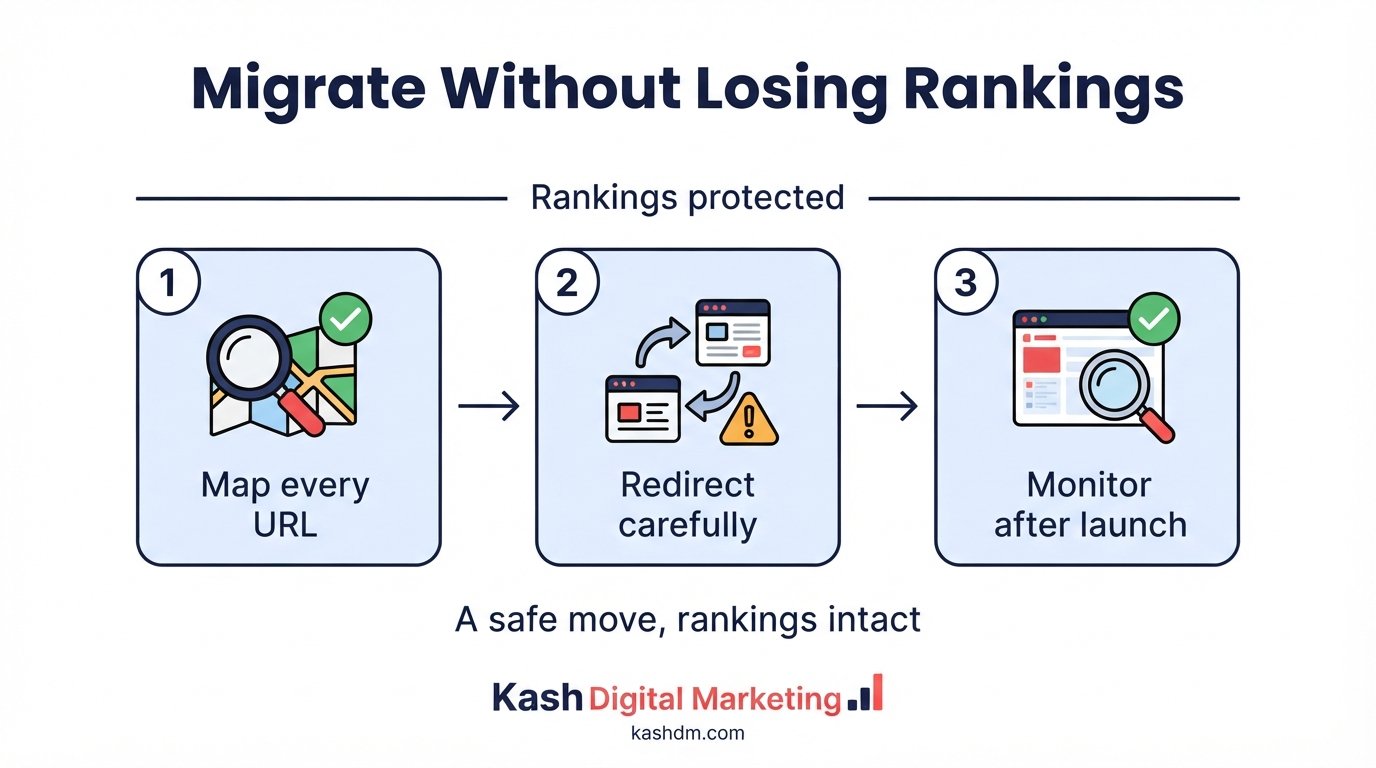
Site Migration SEO: Protecting Rankings Through Major Changes
Site migration SEO protects your organic traffic and rankings when you replatform, redesign, rebrand, or consolidate domains, moments that carry enormous risk if handled without a rigorous, methodical process. Our site migration SEO services have guided enterprise sites through replatforming and redesigns without the traffic collapse that under-planned migrations routinely cause.
A poorly executed migration can wipe out years of accumulated organic authority within days. The most common cause isn't some obscure technical mystery, it's simply skipping careful pre-migration planning under the pressure of a launch deadline.
Pre-migration audit and URL mapping
Before any migration, we audit every existing URL, its rankings, traffic, and backlinks, and build a complete mapping to its new destination. Every URL that currently earns organic value needs an intentional plan, not an assumption that the new site's structure will somehow handle it.
Redirect strategy and implementation
We implement 301 redirects for every mapped URL, verify them systematically, and monitor for redirect chains and loops that dilute link equity. A single missed redirect on a high-traffic page can cost more organic revenue than months of new content production would recover.
Post-migration monitoring and rapid response
The weeks immediately following a migration are critical. We monitor rankings, indexation, and crawl behavior daily during this window, ready to identify and fix issues within hours rather than weeks, because the difference between catching a problem on day two versus day thirty can be the difference between a minor dip and a serious traffic loss.
Enterprise SEO Audit: What a Real Audit Covers
An enterprise SEO audit is a comprehensive diagnostic of a large site's technical health, content quality, and competitive position, deep enough to surface the issues that only appear at scale and specific enough to prioritize what to fix first. Our enterprise SEO audit process goes far beyond the automated tool reports that pass for audits at many agencies.
A genuinely useful enterprise audit combines automated crawling with manual review, because the most damaging issues on large sites are often exactly the kind that automated tools miss or misclassify, template-level content quality problems, subtle cannibalization between similar pages, and crawl budget waste hidden in URL parameters.
Technical foundation audit
We audit crawlability, indexation, site speed, Core Web Vitals, mobile experience, structured data, and international configuration, identifying not just individual issues but the systemic patterns causing them across your template architecture.
Content and competitive gap analysis
We analyze your existing content against competitors' topical coverage, identifying gaps where competitors rank and you don't, cannibalization where multiple pages compete against each other, and outdated content dragging down otherwise strong topic clusters.
Prioritized roadmap, not just a findings list
The output of our audit isn't a long list of every issue found, it's a prioritized roadmap scored by estimated impact and implementation effort, so your team knows exactly what to tackle first and why, and can defend that prioritization to stakeholders who control the budget and engineering time.
Log File Analysis at Scale
Log file analysis examines your server logs to see exactly how search engine crawlers behave on your site, revealing crawl patterns that no other SEO tool can show because log files capture what actually happened, not what a simulated crawl predicts. Our log file analysis services are a core part of enterprise technical SEO, especially for sites large enough that crawl budget genuinely constrains visibility.
Log files reveal the ground truth of how Googlebot allocates its attention across your site: which pages get crawled frequently, which are ignored for months, and which low-value URLs are quietly consuming crawl budget that should be going to your most important pages.
What log files reveal that crawl tools can't
Simulated crawls show what could be crawled; log files show what actually was crawled, by which bot, how often, and with what response codes. This distinction matters enormously at scale, because a page can be perfectly crawlable in theory while Googlebot simply never visits it in practice.
Identifying crawl budget waste
We analyze logs to find the URL patterns consuming disproportionate crawl budget relative to their value, faceted navigation combinations, parameter variations, and low-value pages, then work with engineering to eliminate or deprioritize them, freeing up crawl budget for pages that drive revenue.
Ongoing log monitoring for large sites
For sites large enough to warrant it, we set up ongoing log file monitoring rather than one-time analysis, tracking crawl trends over time so we can catch emerging problems, a section of the site losing crawl frequency, a spike in error responses, before they translate into meaningful ranking losses.
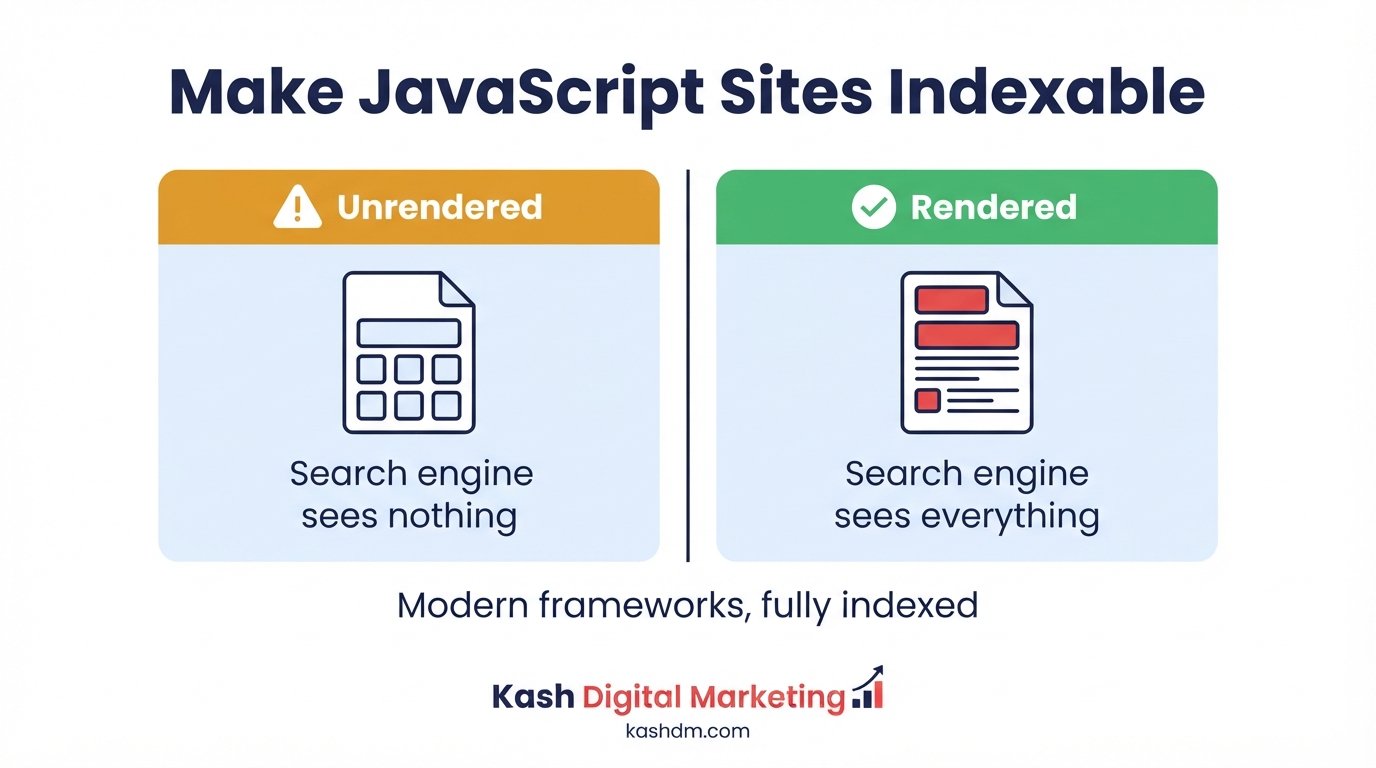
JavaScript and Headless SEO for Modern Web Applications
JavaScript and headless SEO ensures content built with modern frameworks, React, Vue, Angular, or a headless CMS architecture, renders and indexes correctly, a genuinely different technical challenge than optimizing a traditional server-rendered site. Our JavaScript SEO expertise is essential for the SaaS and enterprise sites increasingly built on modern JavaScript frameworks.
Google can render JavaScript, but rendering happens on a delay and with real limitations, and other search engines and social platforms often render JavaScript poorly or not at all. A site that relies entirely on client-side rendering without proper handling can see significant portions of its content missed or delayed in indexing.
Rendering strategy: SSR, SSG, and hydration
We assess whether server-side rendering, static site generation, or a hybrid rendering approach best fits your framework and content needs, because the right rendering strategy prevents indexing problems before they start rather than requiring workarounds after launch.
Auditing JavaScript-rendered content for indexability
We test how search engines actually render your JavaScript-heavy pages, comparing rendered output against what's served to users, to catch discrepancies where critical content, links, or metadata fail to appear in the rendered version search engines index.
Headless CMS and API-driven content architecture
For sites built on a headless CMS with content delivered via API, we ensure the front-end presentation layer properly implements metadata, structured data, and canonical tags, since a headless architecture separates content from presentation in ways that can accidentally drop SEO-critical elements if not deliberately engineered.
SEO for Marketplaces and Multi-Vendor Platforms
SEO for marketplaces manages the unique challenge of ranking a platform where much of the content, listings, reviews, and vendor pages, is generated by third parties rather than the platform itself. Our marketplace SEO services address the scale, quality control, and duplicate content challenges that are specific to two-sided platforms.
Marketplaces face a structural tension: they need enormous numbers of listing pages to capture longtail search demand, but user-generated listings vary wildly in quality and often duplicate each other closely, creating exactly the kind of thin-content risk that quality-focused programmatic SEO has to solve for.
Managing quality across user-generated listing pages
We build systems, minimum content requirements, quality scoring, and consolidation rules, that keep listing pages above the quality bar search engines expect, without placing an unreasonable content burden on individual vendors or sellers.
Category and search page optimization
Marketplace category and internal search result pages often carry more aggregate search value than any individual listing. We optimize these aggregation pages carefully, including how faceted filters are indexed, since marketplace filter combinations can otherwise generate enormous volumes of low-value duplicate URLs.
Balancing vendor SEO needs with platform SEO needs
Individual vendors often want their listings optimized for their own visibility, while the platform needs its category and aggregate pages to rank strongest overall. We help marketplaces strike this balance, building guidelines and tools that help vendors improve their listings in ways that also strengthen the platform's broader authority.
Enterprise SEO Reporting and Attribution
Enterprise SEO reporting connects organic search performance to the business metrics leadership actually cares about, pipeline, revenue, and customer acquisition cost, not just rankings and traffic. Our enterprise SEO reporting is built to survive scrutiny in an executive quarterly business review, not just look impressive in a marketing dashboard.
At the enterprise level, SEO has to compete for budget against every other channel in the organization, and that competition is won or lost on the strength of attribution. A channel that can clearly show its contribution to revenue gets funded; one that can only show traffic and rankings gets cut in the next budget cycle.
Connecting organic traffic to pipeline and revenue
We integrate organic search data with your CRM and marketing attribution systems, so leadership can see not just how much traffic organic drives, but how much pipeline and closed revenue it influences across the full customer journey, the evidence that protects and grows SEO budget over time.
Segmenting reporting by business unit and product line
For enterprises with multiple product lines or business units, we segment SEO reporting accordingly, so each stakeholder sees the performance relevant to their area rather than a single undifferentiated organic traffic number that obscures where the real growth and the real problems are.
Executive-level dashboards versus operational dashboards
We build two layers of reporting: a concise executive dashboard focused on business outcomes for leadership, and detailed operational dashboards for the SEO and content teams doing the day-to-day work, so each audience gets the level of detail it actually needs without wading through the other's data.
Incrementality and holdout testing at scale
For enterprises with enough traffic volume, we design incrementality tests, geo holdouts or page-level experiments that isolate SEO's true causal contribution from the growth that would have happened anyway. This kind of rigorous testing is rarely available to smaller sites, but at enterprise scale it produces the most defensible proof of SEO's value, evidence that stands up even to a skeptical CFO comparing every channel's marginal return side by side.

| Reporting Layer | Audience | Focus |
|---|---|---|
| Executive dashboard | Leadership, CMO, CFO | Pipeline, revenue, ROI, budget justification |
| Operational dashboard | SEO and content teams | Rankings, technical health, content performance |
| Business unit reports | Product/BU leaders | Segment-specific traffic and conversion |
Enterprise SEO Team Structure and Process
Enterprise SEO team structure and process determine whether recommendations actually ship, because at large organizations, the biggest obstacle to SEO success is rarely a lack of knowledge, it's a lack of process for turning knowledge into shipped changes. We help enterprise clients build the team structure, workflows, and stakeholder alignment that make SEO recommendations actionable.
Many enterprise SEO programs fail not because the strategy is wrong but because the organization has no reliable mechanism for getting SEO changes into engineering sprints, content calendars, or design reviews. We treat this organizational challenge as seriously as the technical and content work itself.
Embedding SEO into engineering and product workflows
We help establish processes, an SEO checklist in the definition of done, a review step before major releases, a direct channel to the engineering team, that ensure SEO considerations are built into new features and pages from the start, rather than retrofitted after launch when it's far more expensive to fix.
Building internal SEO champions and stakeholder buy-in
We work with your internal team to build stakeholder buy-in across departments, translating SEO priorities into language that resonates with each function, revenue impact for leadership, user experience for product, efficiency for engineering, so recommendations get support rather than resistance.
In-house team, agency, or hybrid model
We help clients decide the right structure for their situation, whether that's building a fully in-house SEO team, relying on an agency partner like us for execution, or, most commonly at enterprise scale, a hybrid model where an in-house strategist directs the program and an agency provides specialized execution capacity that would be expensive to hire and retain internally.
Running effective SEO stand-ups and sprint rituals
We help set up lightweight recurring rituals, a biweekly SEO sync with content and engineering, a shared backlog visible to every stakeholder, and clear async reporting, so the program keeps moving between formal quarterly reviews. These small process habits are often what separates an enterprise SEO program that ships consistently from one that stalls every time a champion changes roles or priorities shift elsewhere in the organization.
Measuring Enterprise SEO ROI
Measuring enterprise SEO ROI requires connecting organic search investment to business outcomes with enough rigor to survive scrutiny from finance and leadership, not just showing that traffic and rankings went up. Our approach to measuring enterprise SEO ROI is built to answer the question every CFO eventually asks: what did we actually get for this investment?
Enterprise SEO ROI calculations need to account for the compounding nature of organic search, a piece of content published this quarter may still be generating leads two years from now, which means simple month-over-month cost comparisons understate the true return.
Building an ROI model that accounts for compounding value
We build ROI models that project the ongoing value of published content and technical improvements over their realistic lifespan, not just their performance in the month they launched, giving leadership a more accurate picture of organic search's true return relative to channels that stop producing the moment spend stops.
Comparing organic SEO cost per acquisition to paid channels
We calculate blended and channel-specific cost per acquisition, showing how organic SEO's cost per lead or customer typically declines over time as content and authority compound, in direct contrast to paid channels where cost per acquisition typically rises as competition intensifies.
Setting realistic ROI expectations and timelines
Enterprise SEO ROI takes longer to materialize than paid channels but ultimately produces a better return once it compounds. We set realistic expectations upfront about the ramp-up period, typically six to twelve months before ROI becomes clearly positive at enterprise scale, so leadership evaluates the program against an honest timeline rather than judging month-one results against paid-channel expectations.
Large Website SEO: Managing Millions of Pages
Large website SEO addresses the specific challenges that emerge once a site crosses into the hundreds of thousands or millions of pages, a scale where entirely new categories of problems appear that simply don't exist on smaller sites. Our experience managing large website SEO covers the operational and technical realities unique to this scale.
At millions of pages, even a small percentage of technical issues represents an enormous absolute number of affected URLs, and manual review of individual pages becomes completely impractical, requiring sampling methodologies and automated monitoring instead.
Sampling and statistical approaches to auditing
At this scale, we audit representative samples across your template types and URL patterns rather than attempting to review every page individually, applying statistical rigor to identify systemic issues efficiently without wasting resources on exhaustive manual review that wouldn't scale anyway.
Indexation strategy for enormous URL counts
Not every URL on a massive site deserves or benefits from indexation. We build deliberate indexation strategies, what to index, what to noindex, what to consolidate, ensuring Google's resources and your site's quality signals concentrate on the URLs that genuinely deserve to rank.
Infrastructure and hosting considerations
Site speed and server response time become critical at massive scale, since slow response times compound crawl budget problems and directly affect Core Web Vitals. We work with engineering teams on infrastructure and CDN considerations that specifically support search engine crawling efficiency alongside user experience.
Enterprise SEO Services by Industry
Enterprise and SaaS organizations span many industries, each with its own competitive dynamics and buyer behavior, and our enterprise SEO services adapt to the specific realities of your sector.
B2B SaaS and software companies
Software companies benefit from the full range of SaaS-specific strategies covered throughout this page, product-led SEO, jobs-to-be-done keyword research, and comparison content that captures buyers deep in evaluation. Combined with our technical SEO expertise, this covers the modern JavaScript frameworks most SaaS marketing sites are built on.
Financial services, fintech, and regulated industries
Financial services and fintech companies operate under compliance requirements that shape what content can claim and how. We build enterprise SEO programs that generate genuine organic growth while respecting the regulatory review processes and accuracy standards these industries require.
Enterprise ecommerce and large retail catalogs
Large retailers and ecommerce enterprises combine the technical challenges of enterprise SEO with the catalog-specific needs covered on our ecommerce SEO page, faceted navigation, product page templates, and seasonal demand at a scale that requires the same systems-first approach described throughout this page.
Healthcare, legal, and professional services enterprises
Large healthcare systems, law firms, and professional services organizations need enterprise-scale technical and content programs while maintaining the trust, accuracy, and compliance standards these fields demand, combining the discipline covered here with an understanding of expertise and trustworthiness signals that matter especially in these sectors.
Our Enterprise SEO Process, Step by Step
We believe enterprise SEO should be transparent and collaborative, not a black box handed off to an outside team with no visibility into how decisions get made.
Discovery, audit, and stakeholder alignment
We start with a comprehensive audit alongside stakeholder interviews across marketing, engineering, and product, understanding not just the technical and content landscape but the organizational constraints that will shape what's realistically achievable and on what timeline.
Strategy, prioritization, and roadmap development
We build a prioritized roadmap scored by impact and effort, sequenced around your engineering sprint cycles and content production capacity, so the plan is genuinely executable rather than an idealized wish list that ignores organizational reality.
Execution and cross-functional coordination
We execute directly where we have the access and expertise, technical fixes, content production, digital PR, and coordinate closely with your internal teams on the changes that require their systems or approval, functioning as an extension of your team rather than an outside vendor working in isolation.
What to expect in your first 90 days
The first three months typically follow a clear arc. In month one, we complete the comprehensive audit, align on priorities with stakeholders, and begin the highest-impact, lowest-effort technical fixes. In month two, we launch the first content initiatives and digital PR campaigns while continuing technical remediation, and early wins on longtail and technical fixes typically begin appearing. By month three, the roadmap is fully in motion, reporting infrastructure is connecting organic performance to pipeline, and the foundation for compounding growth over the following year is solidly in place.
Ongoing optimization and quarterly strategic reviews
Enterprise SEO is never finished, competitors evolve, algorithms update, and your own business and product change. We conduct quarterly strategic reviews to reassess priorities, expand into new opportunities, and ensure the program keeps compounding rather than plateauing, the same continuous-improvement discipline that runs through every service on this page.

How Much Do Enterprise SEO Services Cost
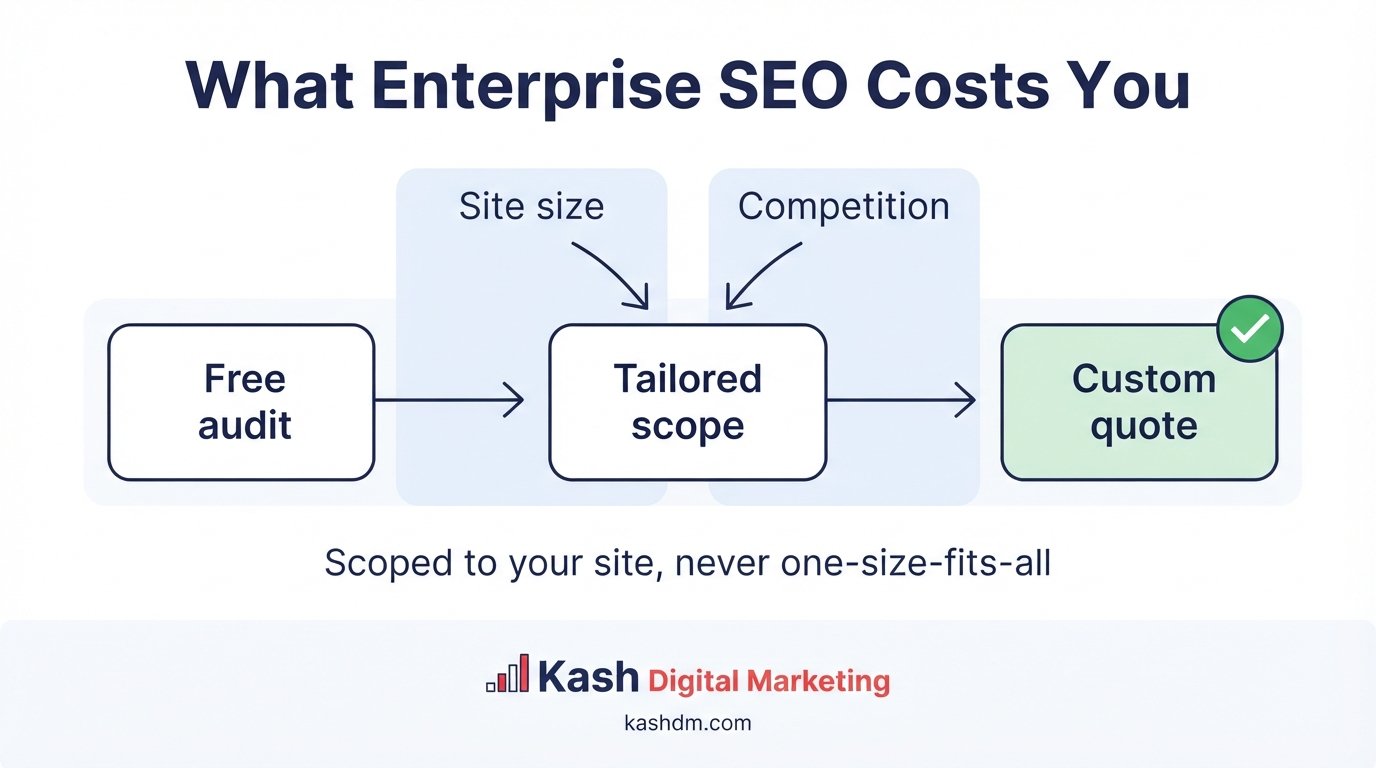
The honest answer is that enterprise SEO pricing depends heavily on site size, technical complexity, competitive category, and the scope of content and digital PR needed, which is why we start with a free audit and build a custom scope rather than offering a misleading flat-rate package.
What determines enterprise SEO investment level
Larger, more technically complex sites and more competitive B2B and SaaS categories require greater investment in engineering coordination, content production, and digital PR. See our full SEO pricing page for how our custom scoping process works across all service tiers, including enterprise engagements.
Thinking about enterprise SEO cost as a compounding investment
The real measure of enterprise SEO's cost is the pipeline and revenue it generates relative to the cost of achieving the same volume through paid channels. Because organic search compounds while paid spend must be sustained indefinitely to maintain results, an enterprise SEO investment that looks expensive in isolation frequently proves to be the most efficient acquisition channel in the marketing mix once measured over eighteen to twenty-four months.
How Long Do Enterprise SEO Services Take to Show Results
Enterprise SEO is a compounding investment that takes longer to ramp than smaller-scale campaigns, but the scale of the eventual return is proportionally larger.
Realistic timelines for enterprise SEO
Technical fixes and quick-win longtail content often show measurable movement within two to three months, while the full impact of a content and digital PR program on competitive head terms typically takes six to twelve months to reach its potential, with continued compounding well beyond that window as topical authority builds.
Why enterprise SEO rewards sustained commitment
The organizations that see the strongest enterprise SEO results are the ones that commit to the program for at least a year, because technical foundations, content libraries, and link authority all compound, and each subsequent quarter's results build on everything that came before rather than starting from zero. Enterprise sites that treat SEO as a short-term project rarely see it reach its real potential before the initiative gets deprioritized, while those that sustain the investment consistently pull ahead of competitors still treating organic search as an afterthought.

Common Enterprise SEO Mistakes to Avoid
Part of our value is helping you avoid the costly mistakes that quietly sabotage enterprise SEO programs.
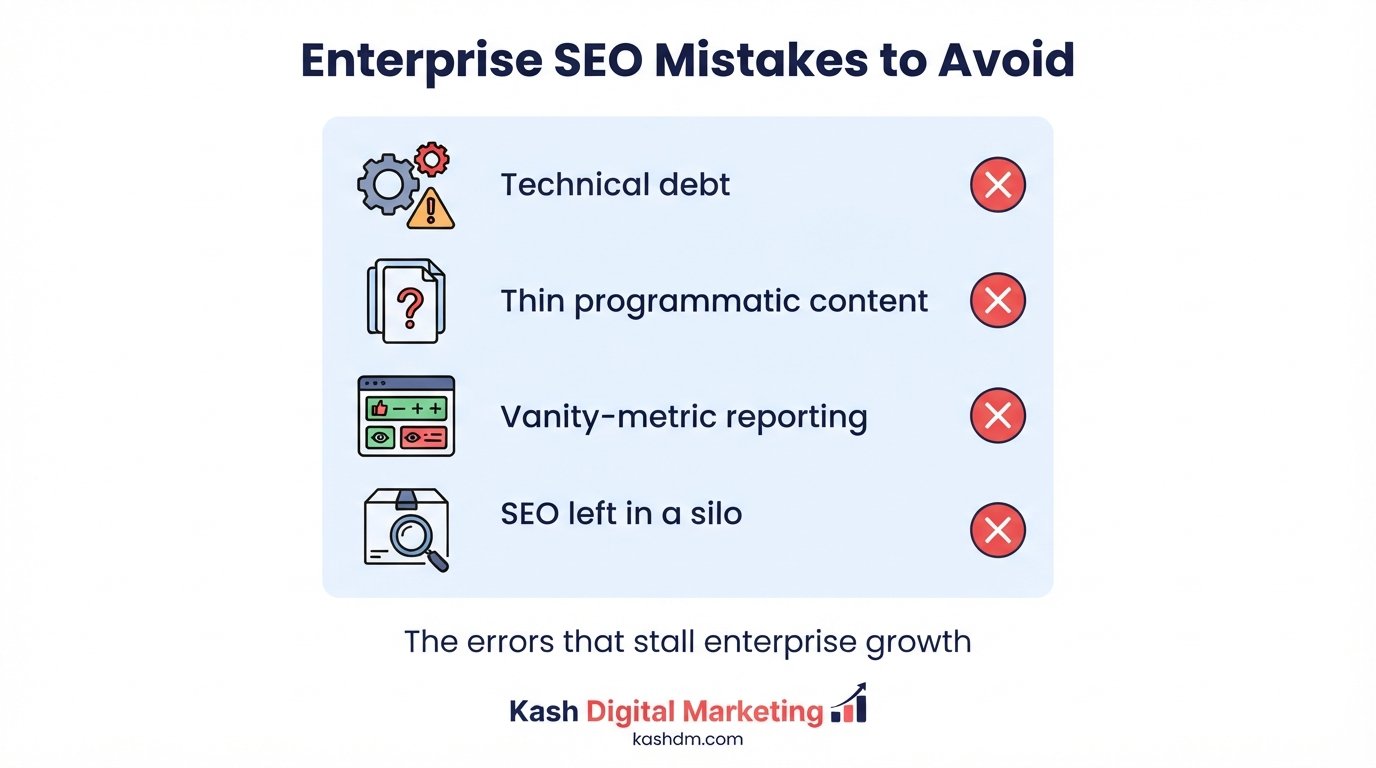
The mistakes that drain enterprise SEO budgets
- Treating SEO as a marketing-only initiative with no engineering buy-in
- Launching programmatic content without genuine differentiation between pages
- Migrating or replatforming a site without a rigorous URL mapping and redirect plan
- Ignoring hreflang and international technical configuration until rankings drop
- Reporting only traffic and rankings with no connection to pipeline or revenue
- Letting content libraries grow indefinitely without a refresh or pruning process
- Underinvesting in crawl budget and log file analysis on very large sites
We build every enterprise campaign to avoid these traps from the start, so your investment goes toward sustainable, compounding growth rather than expensive cleanup later. Many enterprise clients come to us after one or more of these mistakes has already caused real damage, and a meaningful part of the early engagement is often diagnosing and reversing it before new growth work can take full effect.
How to spot a risky enterprise SEO provider
Be cautious of any provider who promises rankings without understanding your technical stack, proposes programmatic content without discussing quality safeguards, can't explain how they'll work with your engineering team, or reports only vanity metrics disconnected from pipeline. Enterprise SEO requires genuine technical depth and organizational fluency, and any legitimate provider will happily walk you through their process in detail.
Enterprise SEO Agency, Consultants, and Choosing the Best Provider
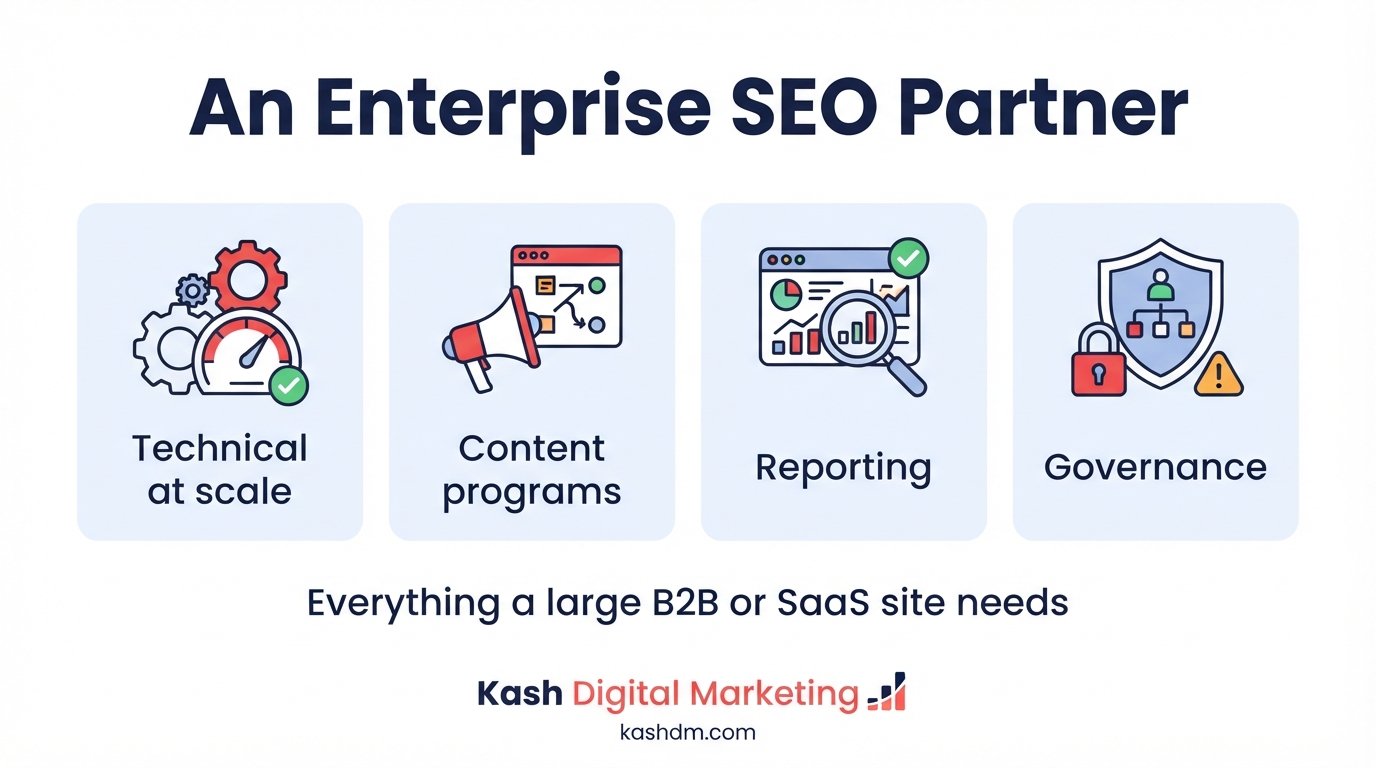
An enterprise SEO agency delivers technical SEO, content, and authority building at scale for large sites and B2B brands, and the best providers prove their value with data-driven strategy and transparent reporting. However you searched, for an enterprise SEO consultant, enterprise SEO companies, or the best enterprise SEO services, here is what enterprise SEO includes and how to choose a provider.
Enterprise SEO agency, consultant, or specialist: who does the work
Whether you searched for an enterprise SEO agency, enterprise SEO consultant, enterprise SEO firms, or an enterprise SEO expert, enterprise SEO demands a team, not a single specialist, because it spans technical SEO at scale, content programs, and authority building. As a full enterprise SEO company, we bring specialists across each discipline together with clear ownership, so you get consulting-level strategy and hands-on execution from one accountable partner. That is what large sites need to move rankings across thousands of pages.
What are enterprise SEO services, and what is included?
Enterprise SEO services, sometimes called enterprise-level or corporate enterprise SEO services, are scaled SEO programs for large websites, B2B companies, and SaaS brands. What is included typically covers enterprise technical SEO and audits, site architecture and large-scale migrations, programmatic and content-at-scale strategy, enterprise link building, multilingual and international SEO, competitive analysis, and enterprise SEO reporting with custom dashboards. It is SEO built for scale, governance, and cross-team coordination, not a small-site playbook stretched thin.
Best enterprise SEO services: how to choose the most trusted provider
When you compare the best enterprise SEO services or look for the most trusted provider, judge firms on evidence: results with large sites, a data-driven strategy, transparent reporting, and the ability to work with your dev and content teams. The top enterprise SEO services fit your CMS, your scale, and your governance needs. There is no single best provider for every enterprise, which is why a provider comparison and a scoped audit matter more than awards. For a full framework, see our guide to choosing the best SEO services.
Enterprise technical SEO, WordPress, and AI-powered SEO at scale
Enterprise growth lives and dies on technical health, so we deliver enterprise technical SEO services and audits covering crawl budget, indexation, site speed, and structured data across huge sites, including enterprise WordPress SEO for large publishing platforms. We also apply AI the right way: enterprise AI SEO uses AI and modern search tools to analyze and optimize at a scale humans cannot match, guided by experts, and we optimize for AI-driven and chat-based search so your brand stays visible as search evolves. This builds on our core technical SEO work.
Enterprise SEO vs traditional SEO, and fully managed, ROI-driven programs
Enterprise SEO differs from traditional SEO mainly in scale, complexity, and coordination, thousands of pages, multiple stakeholders, and higher stakes, which is why process and governance matter so much. We offer fully managed, ROI-driven enterprise SEO services, and for teams that prefer to keep strategy in-house, outsourced execution that plugs into your workflow. Everything ties to measurable business outcomes rather than vanity metrics, with pricing scoped to your scale.
Enterprise and SaaS SEO across the USA, B2B, and key verticals
We provide enterprise SEO services USA-wide, so a company searching for enterprise SEO services near me gets a senior team in any market. We specialize in B2B and SaaS enterprise SEO and support demanding verticals like financial services and media, where compliance and authority are critical. For subscription and product-led growth, this pairs with our ecommerce SEO and content programs, and you can explore coverage on our locations page.
Why Choose Kash Digital Marketing for Enterprise and SaaS SEO
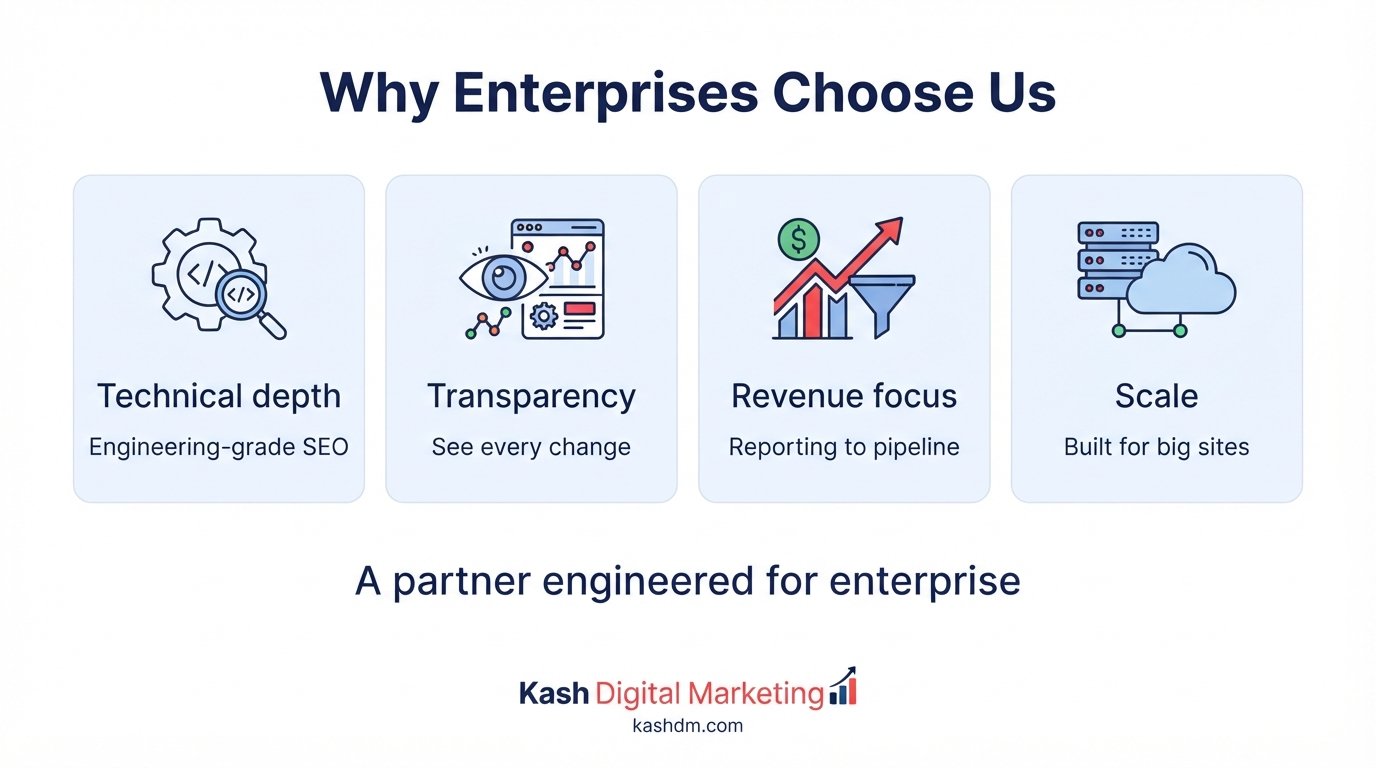
Plenty of agencies claim enterprise SEO experience. Here's what sets us apart: we combine deep technical SEO expertise with scalable content strategy, enterprise link building, and reporting built to survive an executive review, all delivered with the transparency and white-hat discipline that runs through every service we offer.
Technical depth that matches enterprise complexity
Enterprise SEO fails when the provider's technical knowledge doesn't match the complexity of the site. We bring genuine expertise in crawl budget management, log file analysis, JavaScript rendering, and international technical configuration, the specialized knowledge that separates real enterprise SEO from generalist SEO applied to a big website.
A true growth partner, not a vendor
We see ourselves as an extension of your team, genuinely invested in helping organic search become a durable, compounding growth channel for your business. We take time to understand your product, your buyers, and your internal constraints, then build a program calibrated to what will actually move the needle inside your organization, not a generic enterprise SEO template applied blindly.
Our commitment to you
Every engagement is backed by clear commitments: transparent, prioritized roadmaps; white-hat methods only; reporting connected to pipeline and revenue, not vanity metrics; and genuine collaboration with your internal stakeholders rather than recommendations delivered into a vacuum. Start with a free audit, see exactly where your site stands, and decide for yourself.
Enterprise SEO Tools and Technology Stack
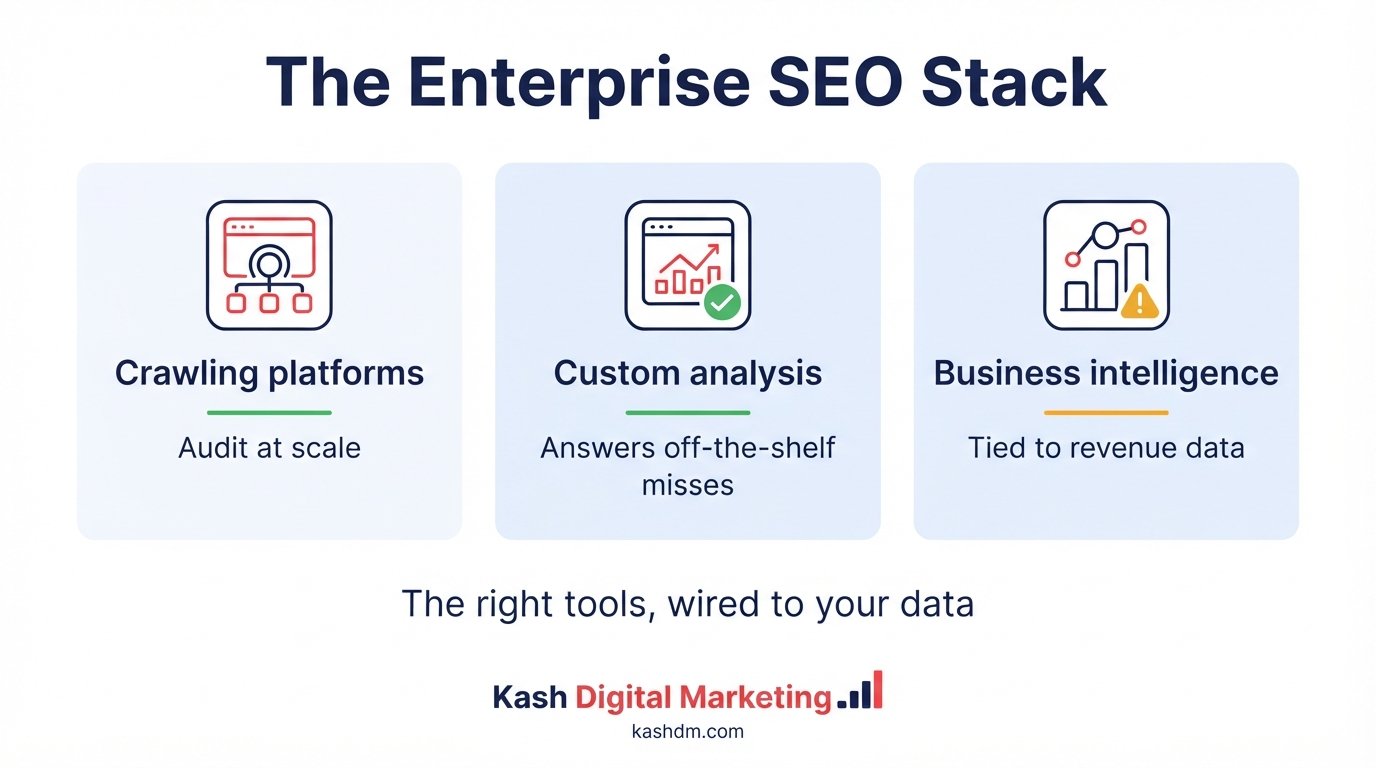
Enterprise SEO at scale requires a technology stack capable of monitoring, crawling, and analyzing sites far too large for manual review, and our approach combines enterprise-grade platforms with custom analysis built for each client's specific architecture.
Enterprise crawling and monitoring platforms
We use enterprise-grade crawling tools capable of handling millions of URLs, combined with continuous rank tracking and technical health monitoring that flags regressions as they happen rather than at the next scheduled audit.
Custom analysis for unique enterprise architectures
Off-the-shelf tools rarely capture everything a complex enterprise architecture needs. We build custom scripts and analyses, log file parsing, template-level audits, internal linking analysis, tailored to each client's specific CMS, subdomain structure, and technical stack.
Integrating SEO data with business intelligence systems
We connect SEO and organic search data into the same business intelligence and CRM systems your leadership already trusts, so organic performance sits alongside every other channel's metrics in a format executives are already accustomed to reviewing.
Data governance and access across large teams
Enterprise SEO tooling often needs to serve dozens of stakeholders across marketing, product, and engineering, each with different access needs and technical fluency. We set up role-appropriate views and permissions so a content writer sees the keyword and brief data they need, while an engineering lead sees the crawl and performance data relevant to their sprint, without either group drowning in dashboards built for someone else's job.
## H2 32A. Case Study Patterns: What Enterprise SEO Success Looks Like
Enterprise SEO success rarely arrives as a single dramatic win, it typically shows up as a steady, compounding pattern across technical health, content velocity, and pipeline contribution that becomes unmistakable over several quarters. Understanding this pattern helps set the right expectations before a program even begins.
A.1 - The typical shape of a successful enterprise SEO program
In the strongest programs we've run, technical fixes produce the first visible traffic recovery within the first quarter, new content and digital PR begin contributing meaningfully by the second and third quarters, and by the end of the first year, organic search has become a top-three acquisition channel by pipeline contribution, often at a materially lower cost per lead than paid channels.
A.2 - Signals that a program is on track versus off track
We watch for leading indicators, indexation rates, crawl efficiency, content velocity, and early keyword movement on longtail terms, well before lagging indicators like head-term rankings and pipeline show up. A program that isn't moving these leading indicators within the first sixty to ninety days needs course correction long before the quarterly business review, which is why continuous monitoring matters more than periodic check-ins alone.
A.3 - Why patience and consistency outperform sporadic bursts
Enterprise SEO programs that stop and restart, a burst of activity followed by months of neglect when budget tightens, consistently underperform programs that maintain steady, sustained investment even at a more modest pace. Search engines and competitors both reward consistency: a steady cadence of technical improvement and content publication compounds, while a stop-start pattern forces you to rebuild momentum from scratch every time the program restarts, losing much of the ground gained in the pause. We encourage clients to think of enterprise SEO as an ongoing operating capability rather than a campaign with a defined end date, because that mindset is what ultimately produces the compounding results this page has described throughout.
Enterprise SEO Platforms and Where an Agency Fits
Enterprise teams evaluating SEO usually run into the same question early: do we buy a platform, hire an agency, or both. They solve different problems, and buying one expecting it to do the other job is where budget gets wasted.
An enterprise SEO platform is monitoring and workflow infrastructure. It tracks rankings at scale, watches for technical regressions across large site sections, models opportunity, and gives several teams a shared view. What it does not do is decide what to fix first, write the content, negotiate crawl-budget changes with your engineering team, or run a migration.
An agency supplies the diagnosis and the execution. What it does not supply is continuous monitoring infrastructure that your own product, content and engineering teams can log into.
Most enterprises that get real results run both: the platform for visibility and alerting, people for judgement and delivery. Some run the platform with an internal team and bring in an agency only for migrations and technical remediation, which are the two moments where getting it wrong is most expensive.
We do not sell software. We work inside whatever stack you already have, your platform, your Search Console, your analytics and your ticketing system, rather than asking you to adopt ours. If you have not bought a platform yet and are not sure you need one, we will tell you honestly whether your site is large enough to justify the licence, because for a lot of sites under a few thousand pages it is not.
Frequently Asked Questions About Enterprise and SaaS SEO
What makes enterprise SEO different from regular SEO?
Enterprise SEO addresses the scale and complexity of very large sites, thousands or millions of pages, multiple stakeholders, legacy technical debt, and cross-functional coordination requirements, that small and mid-sized sites never encounter. It requires systems-level thinking rather than page-by-page optimization.
How much do enterprise SEO services cost?
It depends on site size, technical complexity, competitive category, and scope of content and digital PR needed, which is why we start with a free audit and a custom scope. See our pricing page for how our engagements are structured.
How long does enterprise SEO take to show results?
Technical fixes and longtail content often show movement within two to three months, while competitive head terms and full category authority typically take six to twelve months, with continued compounding beyond that as topical authority builds.
Do you work with SaaS companies specifically?
Yes, SaaS is one of our core specialties. We build both product-led and sales-led SEO programs, jobs-to-be-done keyword research, comparison content, feature and integration pages, and align reporting with signup and pipeline metrics that matter to SaaS leadership.
Can you handle a site migration without losing our rankings?
Yes. Our site migration SEO process includes comprehensive pre-migration URL mapping, redirect implementation and verification, and intensive post-launch monitoring designed specifically to protect existing rankings through replatforming, redesigns, and domain consolidations.
Do you offer international and multilingual SEO?
Yes. We handle URL structure decisions, genuine localization beyond translation, and technical hreflang implementation and ongoing validation for enterprises expanding into new countries and languages.
How do you prove enterprise SEO's ROI to our leadership team?
We connect organic search data to your CRM and attribution systems to show pipeline and revenue contribution, not just traffic and rankings, and we build both executive-level and operational dashboards so every stakeholder sees the metrics relevant to their role.
Will you work directly with our engineering and product teams?
Yes, this is central to how we operate. Enterprise SEO recommendations only create value once they ship, so we work directly with engineering on technical implementation and with product marketing on content accuracy, functioning as an extension of your internal team.
Is programmatic SEO safe, or will it get penalized?
Programmatic SEO is safe when executed with genuine page-to-page differentiation and real search demand behind each template. It becomes risky only when pages are thin, near-duplicate, or built without validating actual user value, which is exactly what our programmatic SEO quality controls are designed to prevent.
What happens during the free enterprise SEO audit?
The free audit is a no-obligation review of your site's technical health, content landscape, and competitive position. We analyze crawlability, indexation, Core Web Vitals, content gaps against competitors, and identify your highest-impact opportunities, then deliver a clear, prioritized roadmap that's yours to keep whether or not you decide to work with us.
Do you sell enterprise SEO software?
No. We are an agency, not a software vendor. We work inside whatever platform you already use, or with Search Console, your analytics and your log files if you have not bought one. If you are weighing up whether an enterprise SEO platform is worth the licence cost for your site, we are happy to give you a straight answer, including when the answer is no.
What does enterprise SEO pricing depend on?
Site size, technical complexity, how many teams have to be coordinated, and whether the engagement includes content production or only strategy and technical work. A hundred-thousand-page marketplace with a headless front end and three regional teams is a fundamentally different engagement from a two-thousand-page SaaS site with one marketing owner. Enterprise work sits well above our local starting range, and we scope it after an audit rather than from a list.
Can you work with our in-house SEO team rather than replacing them?
Yes, and that is often the better arrangement. In-house teams usually have the product and business context; what they lack is capacity for deep technical work and the leverage of an outside voice when engineering priorities are being set. We are comfortable being the specialist resource rather than the owner.
Get Your Free Enterprise SEO Audit
Request Your Free SEO Audit
Prefer to talk it through? WhatsApp US +2135622433 or WhatsApp PK +92 348 3879366. We usually reply within an hour, and always within 8 hours.
See exactly where your site stands and what it will take to grow. Your free enterprise SEO audit reveals your technical health, your content and topical gaps against competitors, your biggest quick-win opportunities, and a clear, prioritized roadmap, yours to keep, no obligation.
Ready to scale your organic growth? Request your free audit and we'll usually reply within an hour, and always within 8 hours on business days.
- 💬WhatsApp: +2135622433
- ✉️Email: contact@kashdm.com
- 📝Free audit form: start here

The audit itself typically takes our team one to two weeks to complete thoroughly, depending on site size and the depth of the technical crawl required, and we'll walk you through the findings live rather than simply emailing over a static document you have to interpret alone. That conversation is often where the real value emerges, because a roadmap is only as useful as your team's shared understanding of why each priority matters and what it will take to execute.
Every quarter your enterprise site underperforms technically or leaves topical authority on the table is a quarter your competitors capture buyers who could have found you first. Those searches are happening right now, from B2B and SaaS buyers actively researching solutions. The good news is that with the right enterprise SEO program, closing that gap and building a durable, compounding growth channel is entirely achievable, and the free audit is a risk-free way to start. Let's get your organic search program built for the scale your business actually operates at.
Kash Digital Marketing, enterprise SEO services that help SaaS and B2B companies scale organic growth across thousands of pages. No spam. No long contracts. Just results.