SEO, search engine optimization, is the practice of improving a website so it ranks higher in Google and other search engines, earning more free, qualified traffic without paying for ads. At Kash Digital Marketing, we believe every business owner deserves to understand SEO in plain English before they hire anyone to do it, so this guide walks through what SEO is, how it actually works, every major type of SEO, how Google ranks pages, and how to measure whether it's working, all in one place.
This isn't a sales page dressed up as an article. It's the guide we wish every client had read before their first SEO conversation, because an informed client makes better decisions and gets better results, whether they hire us, hire someone else, or start learning to do it themselves. If you finish this page and want a second opinion on where your own site stands, our free SEO audit is the fastest way to find out, no obligation.
Whether you're a small business owner trying to understand what you're paying for, a marketer building your first SEO strategy, or someone simply curious how Google decides what to show, this guide is written to be genuinely useful standing alone. We'll cover the fundamentals first, then go deep into each major discipline: technical SEO, on-page SEO, off-page SEO and link building, and local SEO, before covering measurement, myths, and a full glossary of terms you'll hear used correctly and incorrectly across the industry.
⭐ 5.0 rating · ✅ Google & Meta certified · ⚡ Reply usually within an hour · 🛡️ 100% white-hat · 🇺🇸 Serving US local businesses

What Is SEO?
SEO stands for search engine optimization, the practice of improving a website's visibility in unpaid, organic search results. When someone types a question into Google, an algorithm sorts billions of pages and decides which handful appear first. SEO is everything you do, on your site and off it, to convince that algorithm your page deserves one of those top spots for the searches that matter to your business.
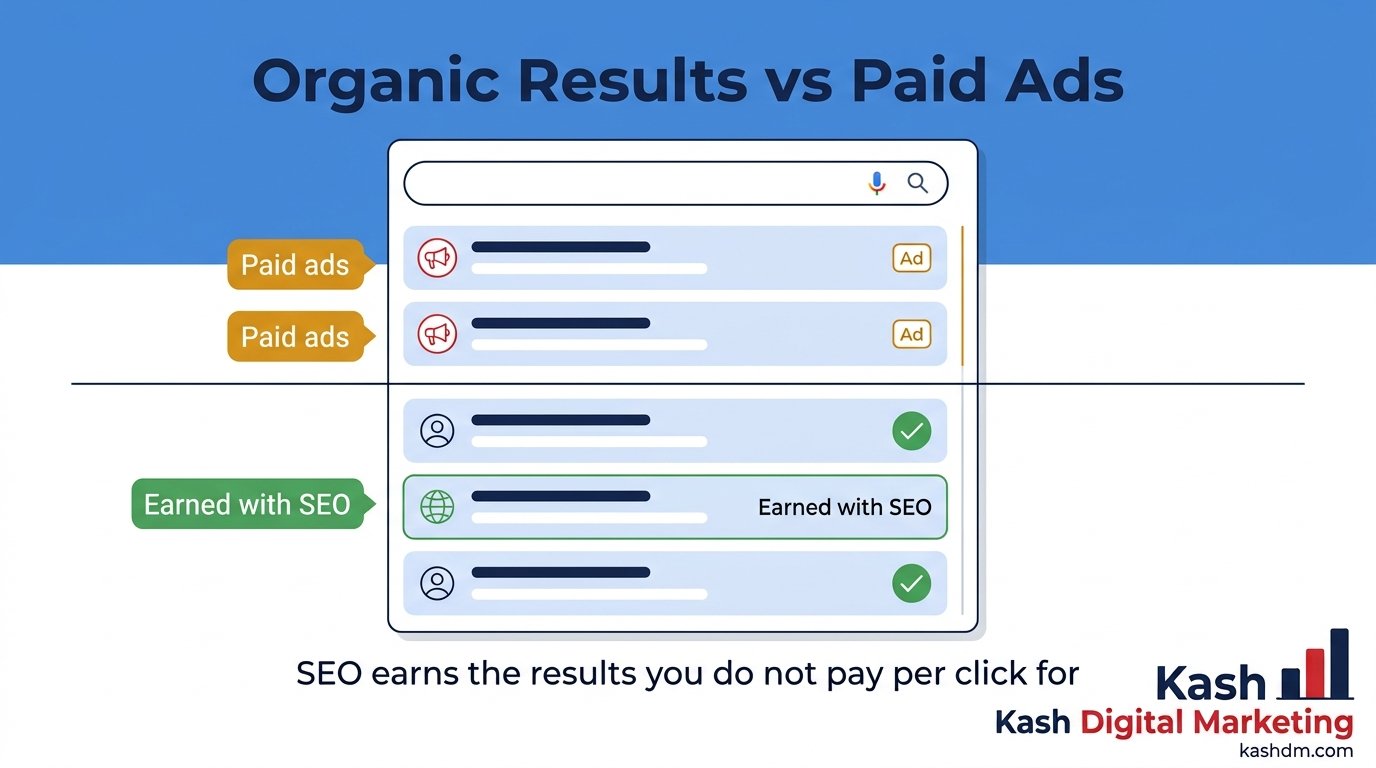
Unlike paid advertising, where you pay for every click and the traffic stops the moment you stop paying, SEO earns visibility. It takes longer to build, but the traffic keeps arriving without an ongoing per-click cost, which is why SEO is often described as building a marketing asset rather than renting attention.
SEO in one sentence
If you strip away every acronym, SEO comes down to this: make your website the best, clearest, most trustworthy answer to a question someone is typing into a search engine, and make sure the search engine can find, understand, and trust that your page is that answer.
Organic search versus paid search
Search results are split into two categories: paid results (ads, usually labeled "Sponsored") and organic results (the unpaid listings ranked by relevance and authority). SEO is entirely about the organic side. You can learn more about how the two compare later in this guide, and see our full breakdown on the SEO vs PPC section below.
Why "SEO" actually covers several disciplines
Many people think of SEO as one activity, like writing blog posts with keywords in them. In reality, SEO is an umbrella term covering several distinct disciplines working together: technical SEO (can search engines crawl and read your site), on-page SEO (is your content the best answer), off-page SEO (does the rest of the web vouch for you), and local SEO (do you show up for nearby searches). We cover each of these in depth later in this guide, and our local SEO and technical SEO pages go even deeper into two of the most important.
A brief history of how SEO has evolved
SEO in the late 1990s and early 2000s was largely a game of keyword density and link volume, and it was relatively easy to manipulate. Over the following two decades, Google's algorithms grew dramatically more sophisticated, incorporating natural language understanding, machine learning, and increasingly nuanced quality signals like E-E-A-T. Tactics that worked in 2010 can actively hurt a site in 2026. Understanding this trajectory matters because it explains why so much outdated SEO advice still circulates online, and why the discipline rewards fundamentals over shortcuts more today than at any point in its history.
What SEO is not
SEO is not a way to force Google to rank a low-quality or irrelevant page. It's not a one-time technical fix, and it's not a guarantee, no legitimate practitioner can promise a specific ranking, because no agency controls Google's algorithm. SEO also isn't purely a writing exercise or purely a technical exercise; it's the combination of both, plus the trust signals that come from the rest of the web. Setting realistic expectations about what SEO can and can't do is one of the most valuable things a business owner can do before starting any campaign.
How Does SEO Work?
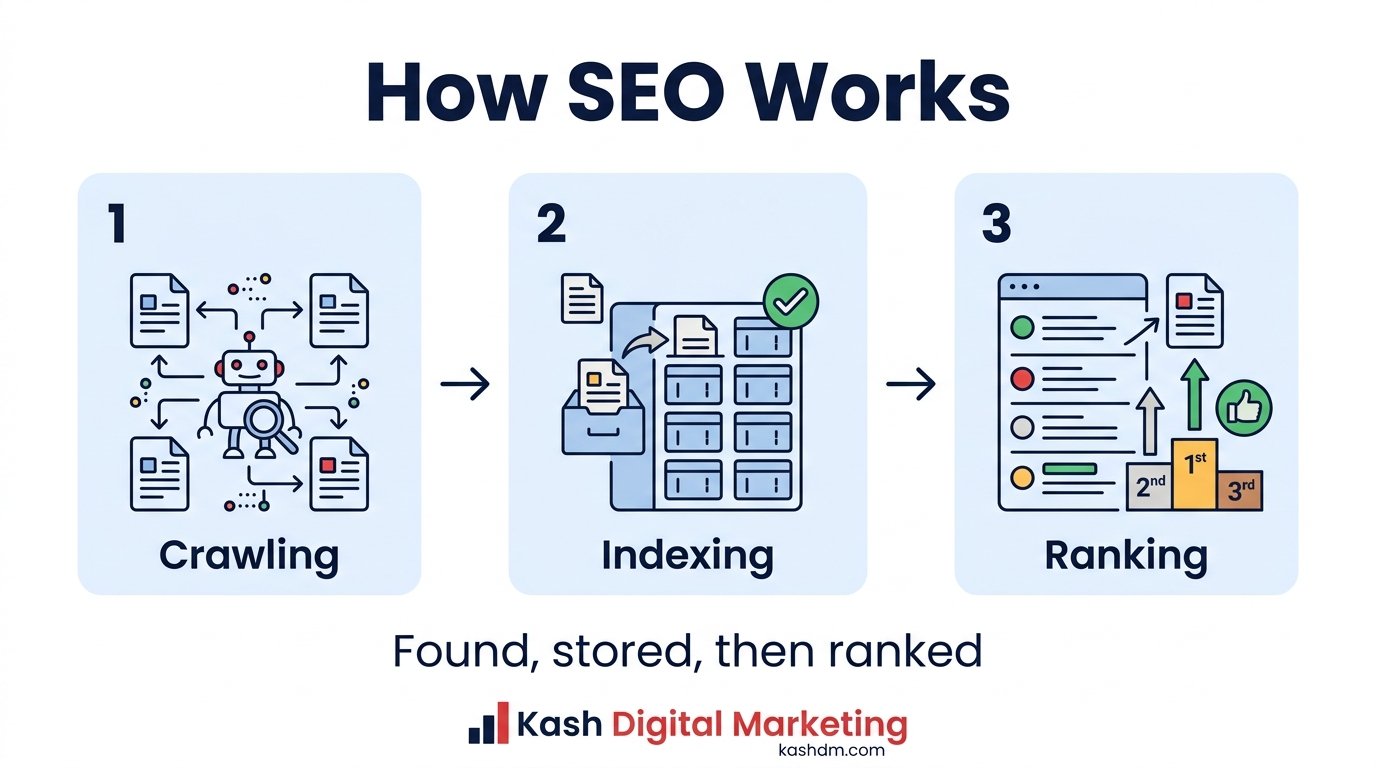
SEO works by aligning your website with what search engines look for when they decide which pages deserve to rank: crawlability, relevance, and trust. Search engines like Google use automated programs to discover pages, store what they find in a massive index, and then run ranking algorithms that sort those pages for every single search query, all in a fraction of a second.
Think of it as a three-stage pipeline. First, Google has to find your page (crawling). Second, it has to understand what your page is about and store it correctly (indexing). Third, when someone searches, Google has to decide where your page belongs among all the competing pages (ranking). SEO work touches every one of those three stages, and a weakness in any one of them caps how well you can perform in the others.
The three stages: crawl, index, rank
A page that isn't crawled can't be indexed, and a page that isn't indexed can't rank, no matter how well-written it is. This is why technical SEO, which ensures crawlability and indexing, is the non-negotiable foundation everything else builds on.
Signals Google uses to rank pages
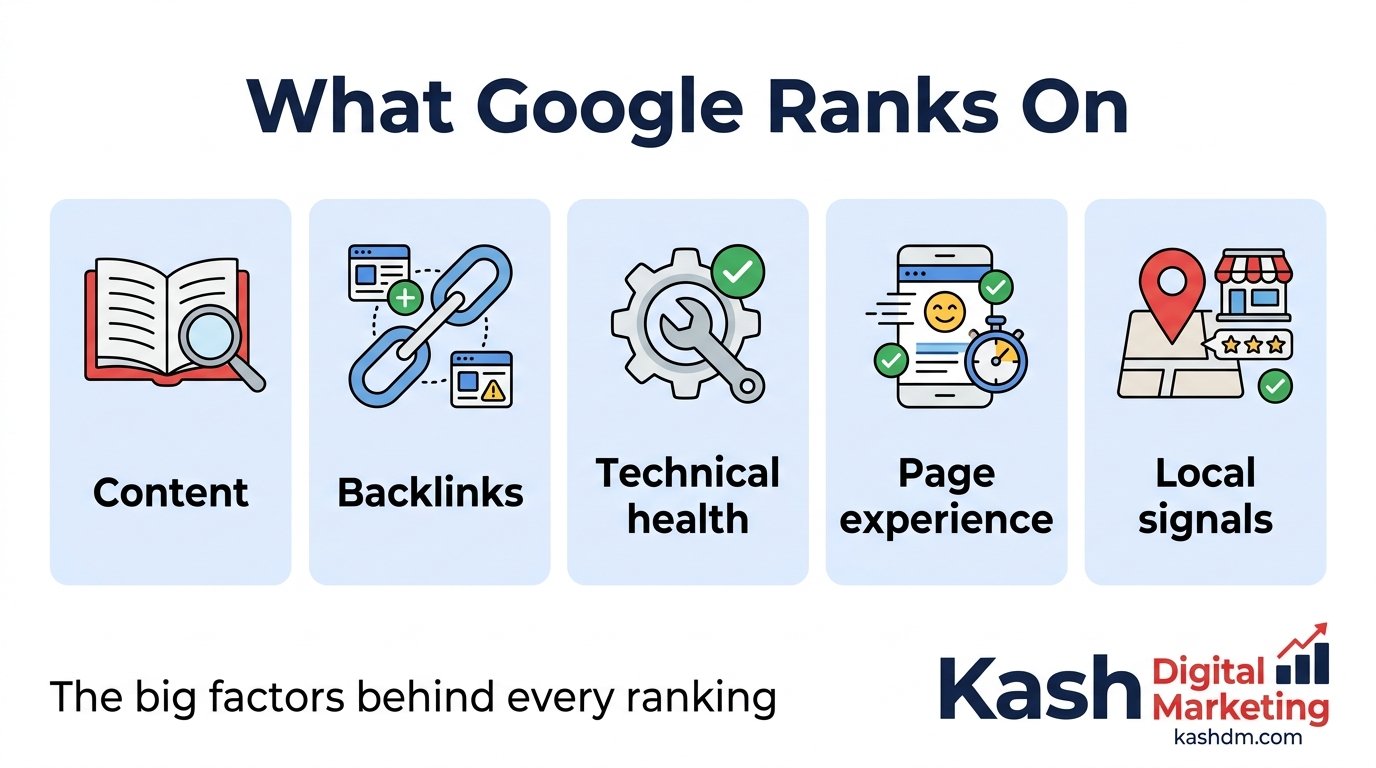
Google's ranking systems weigh hundreds of signals, but they cluster into a few major categories: content relevance and quality, technical health and page experience, backlinks and authority, and for many searches, location. We break each of these down individually later in this guide.
Why SEO is never "finished"
Search engines update their algorithms constantly, competitors publish new content, and user behavior shifts. SEO is a continuous process of maintaining and improving your position, not a project with a finish line. This is the same principle behind why our local SEO services are structured as ongoing programs rather than one-time setups.
A simple analogy for how SEO works
Imagine a librarian responsible for recommending the single best book on a topic out of millions on the shelves. First, the librarian has to know the book exists (crawling). Second, the librarian has to have read and cataloged it accurately (indexing). Third, when a patron asks a question, the librarian has to decide which book among thousands of candidates answers it best (ranking). SEO is the work of making sure your book is easy to find, clearly cataloged, and genuinely the best answer on the shelf, so the librarian keeps recommending it.
How algorithm updates fit into this picture
Search engines regularly refine the rules their ranking systems use, sometimes in small, unannounced tweaks and sometimes in large, named updates that reshuffle results across entire industries. These updates are Google's ongoing attempt to get closer to rewarding genuinely helpful, trustworthy content and demoting manipulative or low-quality pages. A site built on solid fundamentals typically rides out these updates with minor fluctuations, while a site relying on shortcuts or thin content often sees sharp, sudden drops when an update finally catches up with it.
Why Is SEO Important for a Business?
SEO is important because it puts your business in front of people at the exact moment they're actively searching for what you offer, with no per-click cost once you rank. Search is one of the few marketing channels where the customer comes to you already expressing intent, rather than you interrupting their day with an ad.
Search is where buying decisions start
Most purchase journeys, whether buying a product, hiring a contractor, or choosing a restaurant, now start with a search engine. A business that doesn't appear in those results is effectively invisible to a huge share of potential customers, no matter how good the product or service actually is.
SEO builds a compounding asset
Every piece of quality content, every earned backlink, and every technical improvement adds to your site's authority permanently, unlike an ad campaign that stops producing the moment the budget runs out. Over time, this compounding effect is what makes SEO deliver a lower cost per lead than most paid channels, a dynamic we cover in more detail in the SEO pricing guide.
SEO builds trust that advertising can't buy
Consumers instinctively trust organic results more than ads, because they know a top organic ranking had to be earned rather than purchased. Ranking well is itself a credibility signal that makes visitors more likely to trust and choose your business over a competitor who only shows up in the sponsored slots.
The Four Main Types of SEO
There are four main types of SEO: technical SEO, on-page SEO, off-page SEO, and local SEO, and a strong overall strategy needs all four working together. Skipping any one of them creates a bottleneck that limits how well the others can perform.
| Type of SEO | What It Focuses On | Why It Matters |
|---|---|---|
| Technical SEO | Crawlability, indexing, site speed, security | Lets Google find and understand your site |
| On-page SEO | Content, keywords, titles, headings | Makes your pages the best answer to a query |
| Off-page SEO | Backlinks, brand mentions, digital PR | Builds authority and trust from the wider web |
| Local SEO | Google Business Profile, citations, reviews | Ranks you for nearby, location-based searches |
Why you need all four, not just one
A site with brilliant content but broken technical infrastructure won't get crawled properly. A technically flawless site with thin content won't satisfy searchers. And a great site with zero backlinks or local signals will struggle to outrank established competitors. These four types are interdependent, which is exactly why our own service pages, technical SEO, SEO content writing, link building, and local SEO, are built to work as one coordinated system rather than four separate products.
How the four types map to your priorities
Most businesses don't need to weight all four equally at once. A brand-new site typically needs technical fixes and content first; an established site with good content but few links usually needs off-page work; a local business needs to prioritize local SEO alongside the basics. A good SEO strategy diagnoses which type is your biggest bottleneck and fixes that first.

How Does Google Work? Crawling, Indexing and Ranking Explained
Google works by continuously crawling the web with automated bots, storing what it finds in an index, and running ranking algorithms every time someone searches. Understanding this pipeline demystifies most of SEO, because nearly every SEO tactic exists to influence one of these three stages.
Crawling: how Google discovers your pages
Google uses a program called Googlebot to follow links from page to page across the web, discovering new and updated content. Your XML sitemap, internal links, and robots.txt file all influence what Googlebot finds and how often it comes back. A page with no links pointing to it and no sitemap entry may never be discovered at all.
Indexing: how Google stores what it finds
Once a page is crawled, Google analyzes its content and, if it meets basic quality standards, adds it to the index, an enormous database of pages eligible to appear in search results. A page can be crawled but still excluded from the index if it's low-quality, duplicate, or blocked by a "noindex" tag.
Ranking: how Google sorts the index for each search
When someone searches, Google doesn't search the live web in real time. Instead, it searches its index and runs ranking algorithms that score and sort matching pages based on relevance, quality, and authority signals. This entire process happens in a fraction of a second, for billions of searches every day.
Why this pipeline matters for your SEO strategy
If your rankings are disappointing, the cause is almost always somewhere in this pipeline: a crawlability problem, an indexing problem, or a ranking (relevance and authority) problem. Diagnosing which stage is failing is the first step of any real SEO audit, which is exactly what we start with in our own free SEO audit process.

How Does Google Rank Websites? Core Ranking Factors
Google ranks websites using hundreds of signals, but they cluster into a handful of major categories: content quality and relevance, backlinks and authority, technical health and page experience, user engagement, and for many queries, location. No single factor guarantees a top ranking; Google weighs them together, and their relative importance shifts depending on the type of search.
| Ranking Factor Category | Examples | Rough Role |
|---|---|---|
| Content relevance and quality | Keyword match, depth, originality, E-E-A-T | Determines if the page answers the query well |
| Backlinks and authority | Number and quality of linking domains | Signals trust and importance |
| Technical health | Crawlability, indexing, HTTPS, mobile-friendliness | Gatekeeper, must pass to compete at all |
| Page experience | Core Web Vitals, intrusive interstitials | Affects rankings and user satisfaction |
| User engagement | Click-through rate, dwell time (indirect signal) | Reinforces or undermines other signals |
| Local signals | Proximity, Google Business Profile, reviews | Dominant for "near me" and local searches |
Content is the foundation, not the whole picture
Content that thoroughly and accurately answers the query is the baseline requirement, but content alone rarely wins competitive rankings without supporting authority and technical health. See our on-page SEO section below for how to build content that actually competes.
Why backlinks still matter so much
Despite years of speculation that links would matter less, backlinks remain one of the strongest ranking signals Google uses, because a link from another site is still one of the clearest votes of confidence the web can offer. We cover this in depth in the off-page SEO section and on our dedicated link building page.
No single "trick" replaces the fundamentals
Every year, new shortcuts and hacks circulate promising to game Google's algorithm. Nearly all of them either stop working within months or, worse, trigger penalties. The sites that rank durably are the ones built on the fundamentals covered throughout this guide, not shortcuts.
Why ranking factors are weighted differently for different queries
Google doesn't apply a single fixed formula to every search. For a query like "what time does the store close," proximity and a quick, accurate Google Business Profile answer matter enormously. For a query like "best surgical technique for a torn ACL," expertise, sourcing, and depth carry far more weight, and E-E-A-T becomes central to how the page is evaluated. Understanding that ranking factors shift by query type is why a genuinely good SEO strategy studies what's actually ranking for your specific keywords rather than applying a generic template to every page.
What Are Keywords and Search Intent?
Keywords are the words and phrases people type into search engines, and search intent is the underlying goal behind that search, what the person actually wants to find, buy, or learn. Understanding both is the starting point of every SEO strategy, because targeting the wrong keyword or misreading intent means creating content nobody who searches it actually wants.
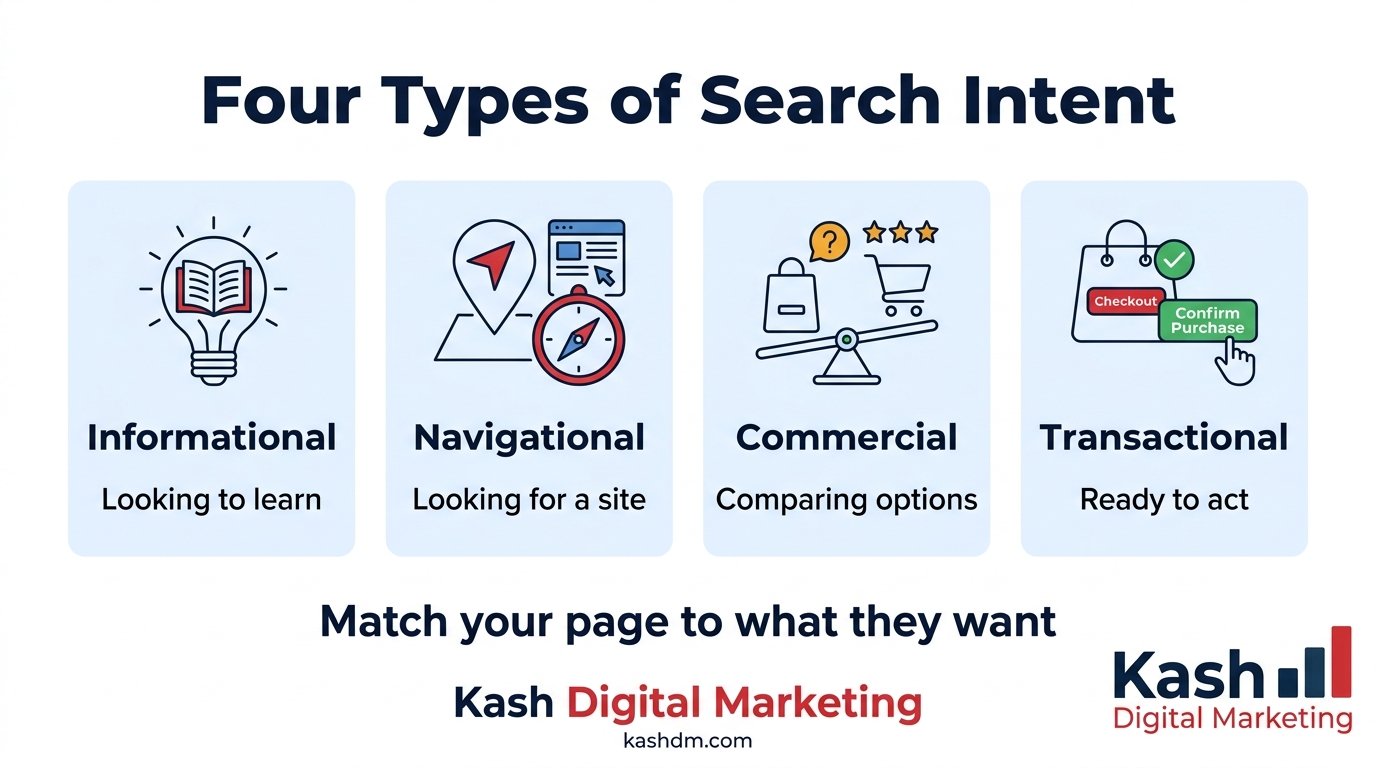
The four types of search intent
Search intent generally falls into four buckets: informational (learning something, "what is seo"), navigational (looking for a specific site, "kashdm login"), commercial investigation (comparing options, "best seo agency"), and transactional (ready to act, "hire seo agency near me"). Matching your content type to the right intent is often more important than the keyword itself.
Head terms versus longtail keywords
Head terms are short, high-volume, highly competitive phrases ("seo"). Longtail keywords are longer, more specific phrases with lower volume but higher intent and far less competition ("what is seo for a small law firm"). Most successful strategies target longtail keywords first to build early wins, then expand toward head terms as authority grows.
Why matching intent beats matching keywords exactly
Google has become remarkably good at understanding intent even when the exact keyword isn't present. A page that perfectly satisfies what a searcher actually wants will often outrank a page that repeats the keyword but misses the intent. This is why keyword stuffing, once a common tactic, now actively hurts rankings rather than helping them.
How search intent can be mixed within a single query
Some searches carry more than one intent at once, which makes them harder to target well. A search like "seo pricing" might be partly informational (someone wants to understand typical costs) and partly commercial investigation (they're evaluating whether to hire someone). The strongest pages for mixed-intent queries address both angles: educating the reader honestly while also making a clear, low-pressure path to the next step, which is exactly the approach behind our own SEO pricing page.
How to Do Keyword Research
Keyword research is the process of identifying the exact words and phrases your potential customers use in search engines, so you can build content and pages around demand that actually exists. Skipping this step means guessing, and guessing wastes time on content nobody searches for.
Starting with seed keywords and expanding
Begin with a handful of broad "seed" terms describing your business, then expand outward using Google's autocomplete, the "People Also Ask" box, and related-search suggestions at the bottom of results pages. This surfaces the actual language your customers use, which often differs from internal industry jargon.
Using data to prioritize
Search volume, competition level, and relevance to your business should all factor into which keywords you prioritize. A keyword with modest volume but low competition and high buying intent is often more valuable than a high-volume term you have little realistic chance of ranking for anytime soon.
Mapping keywords to pages
Every keyword should map to one specific page, never split across several competing pages, which causes keyword cannibalization and confuses Google about which page to rank. Building this map before writing a single word of content is what separates a coherent SEO strategy from a pile of disconnected blog posts. This same rigorous process underlies our own SEO content writing services.
Competitor keyword analysis
Studying which keywords your top-ranking competitors already rank for reveals proven demand and highlights gaps you can fill. If three competitors rank for a term you haven't targeted at all, that's often the clearest kind of opportunity available.
Avoiding keyword cannibalization
Keyword cannibalization happens when two or more pages on the same site unintentionally target the same keyword, splitting ranking signals between them instead of consolidating authority on one strong page. This is a surprisingly common problem on sites that have published content for years without a clear keyword map, and fixing it often involves merging pages, redirecting weaker ones, or clearly differentiating each page's target intent. Diagnosing and resolving cannibalization is frequently one of the fastest wins available on an established site, because it doesn't require any new content, just a smarter structure for what already exists.

What Is On-Page SEO?
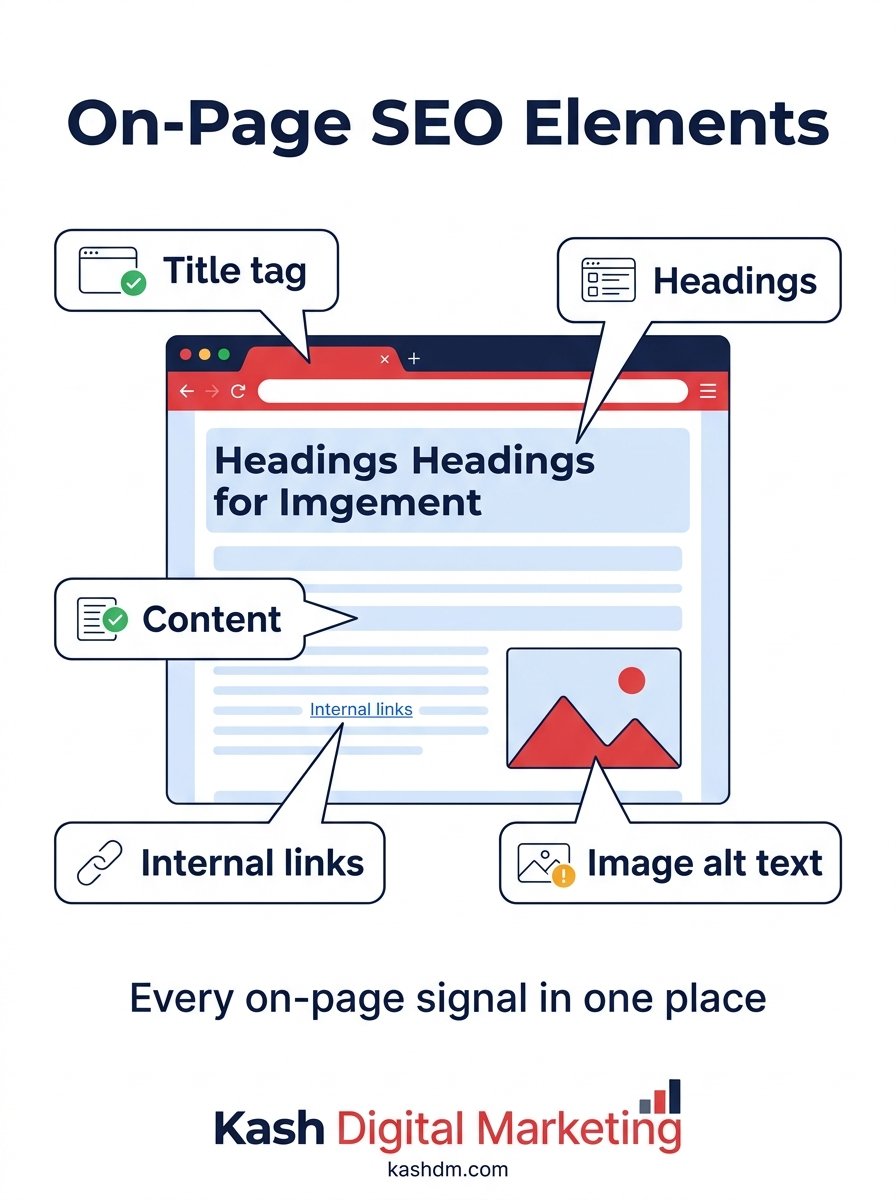
On-page SEO is the practice of optimizing the content and HTML elements of an individual page, titles, headings, body content, images, and internal links, so it's both relevant to a target keyword and genuinely useful to the reader. It's the discipline most people picture when they hear the word "SEO."
Title tags and meta descriptions
The title tag is the clickable headline shown in search results, and while the meta description doesn't directly affect rankings, both heavily influence whether a searcher clicks your result over a competitor's. Strong on-page SEO writes both to be accurate, compelling, and naturally inclusive of the target keyword.
Headings and content structure
Clear H1, H2, and H3 headings help both readers and search engines understand a page's structure and the questions it answers. Well-organized content with logical headings also tends to perform better in AI-generated answers and featured snippets, because it's easier for machines to parse and extract.
Content depth and quality
Google favors content that thoroughly answers a query over content that only skims the surface. This doesn't mean padding pages with filler; it means genuinely covering the subtopics a searcher cares about, backed by real expertise. Our SEO content writing page goes deep into how we build this kind of content.
Internal linking
Links between your own pages help Google understand your site's structure, distribute ranking authority across your content, and help visitors find related information. A well-linked site keeps both users and search engines moving deeper into your content instead of hitting dead ends.
Image optimization and alt text
Compressed images with descriptive file names and alt text improve page speed and accessibility, and they give Google additional context about the page's content, occasionally earning traffic from image search as a bonus.
Writing for readers first, algorithms second
The most durable on-page SEO practice is also the simplest: write for the human reader first, and let the technical optimization support that content rather than dictate it. Pages written primarily to satisfy an algorithm tend to read stiffly and convert poorly, even on the rare occasion they rank. Pages written to genuinely help a specific reader, with the right keywords and structure layered in naturally, tend to both rank and convert, because they're solving the same problem Google's ranking systems are ultimately trying to solve: finding the best possible answer for the person searching.
What Is Technical SEO?
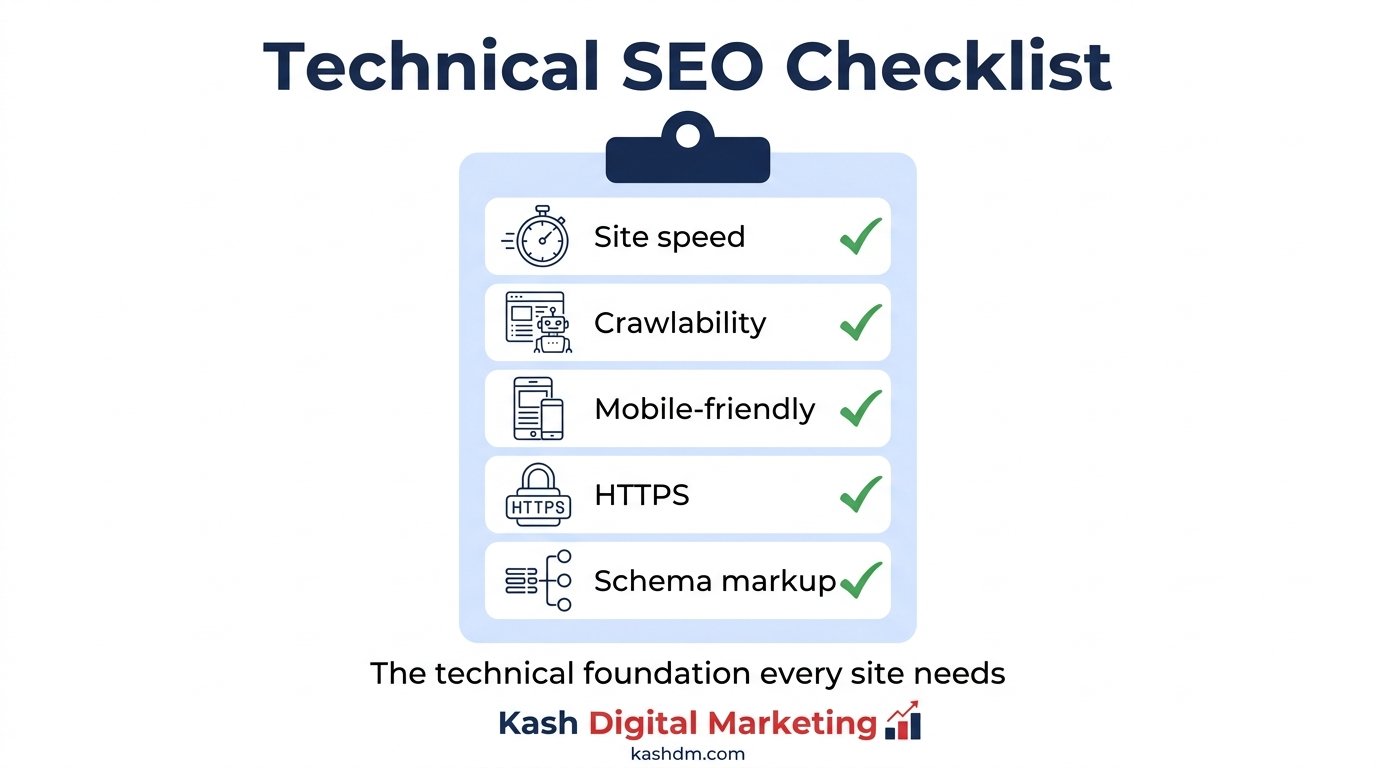
Technical SEO is the practice of optimizing a website's infrastructure, speed, crawlability, mobile-friendliness, and security, so search engines can efficiently access, understand, and index it. It's invisible to most visitors, but without it, even the best content and links can't reach their full ranking potential.
Site speed and Core Web Vitals
Slow-loading pages frustrate visitors and can hold back rankings, particularly on mobile. We cover Core Web Vitals in detail later in this guide, and our dedicated technical SEO page covers the full technical program.
Crawlability and indexing
A clean site architecture, an accurate XML sitemap, and a properly configured robots.txt file ensure search engines can find and index every page that should rank, and avoid wasting crawl budget on pages that shouldn't.
Mobile-friendliness
Google evaluates and indexes most sites primarily using the mobile version of the page, so a site that isn't fully functional and readable on a phone is fighting an uphill battle regardless of how good its desktop version looks.
Site security (HTTPS)
HTTPS encrypts data between a visitor's browser and your server, and it's been a baseline ranking consideration for years. Beyond rankings, it's simply table stakes for user trust in 2026.
Structured data (schema markup)
Schema markup is code added to a page that explicitly tells search engines what the content means, a review, a product, a business address, an FAQ. It doesn't guarantee better rankings, but it can unlock rich results in search that improve click-through rates, and it helps AI systems understand and cite your content accurately.
Why technical SEO is often invisible until something breaks
Technical SEO rarely gets credit when it's working, because a healthy technical foundation simply lets everything else function as expected. It gets noticed the moment something breaks: a site migration that quietly drops thousands of pages from the index, a broken robots.txt file that accidentally blocks the entire site, or a plugin update that tanks page speed overnight. Regular technical audits catch these issues before they cost months of lost rankings, which is why we treat technical health as an ongoing monitoring process rather than a one-time checklist to complete and forget.
What Is Off-Page SEO and Link Building?
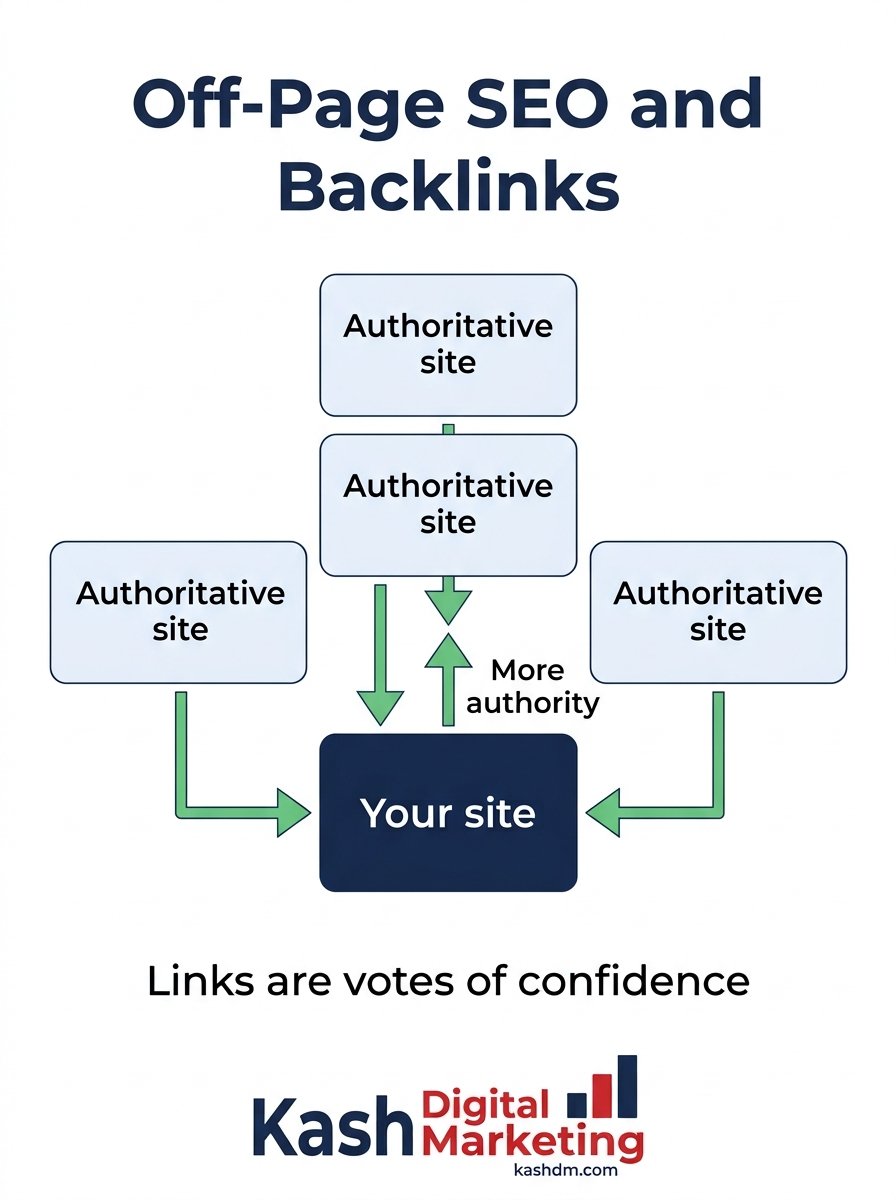
Off-page SEO covers everything that happens away from your own website that still influences your rankings, most importantly backlinks, but also brand mentions, reviews, and social signals. It's how the rest of the web vouches for your credibility.
Why backlinks matter
A backlink is a link from another website to yours. Google treats each quality backlink as a vote of confidence, and pages with more high-quality backlinks from relevant, authoritative sites tend to outrank pages without them, all else being equal.
Quality over quantity
One link from a respected, relevant, high-authority site is worth far more than dozens of links from low-quality or unrelated sites. Modern link building focuses on earning fewer, better links rather than accumulating large volumes of weak ones, a principle explained fully on our link building page.
How links are earned
Legitimate link building involves creating genuinely link-worthy content, digital PR outreach to journalists and industry sites, guest contributions, partnerships, and organic mentions that come from being genuinely useful or newsworthy. None of it involves buying links or joining link schemes, tactics that risk serious Google penalties.
Brand mentions and digital PR
Even unlinked mentions of your brand across the web contribute to the broader trust and prominence signals search engines associate with your business, which is one reason digital PR has become a bigger part of modern off-page SEO than it was a decade ago.
Anchor text and link diversity
The clickable text of a backlink, called anchor text, gives Google additional context about what the linked page is about. A natural link profile has a diverse mix of anchor text, brand names, generic phrases like "click here," and occasional keyword-rich phrases, because that's how genuine, organic linking behaves in the real world. A profile stuffed with the exact same keyword-rich anchor text across dozens of links is a red flag Google's algorithms are specifically trained to detect, and it's a common fingerprint of a purchased or manipulated link scheme.
What Is Local SEO?
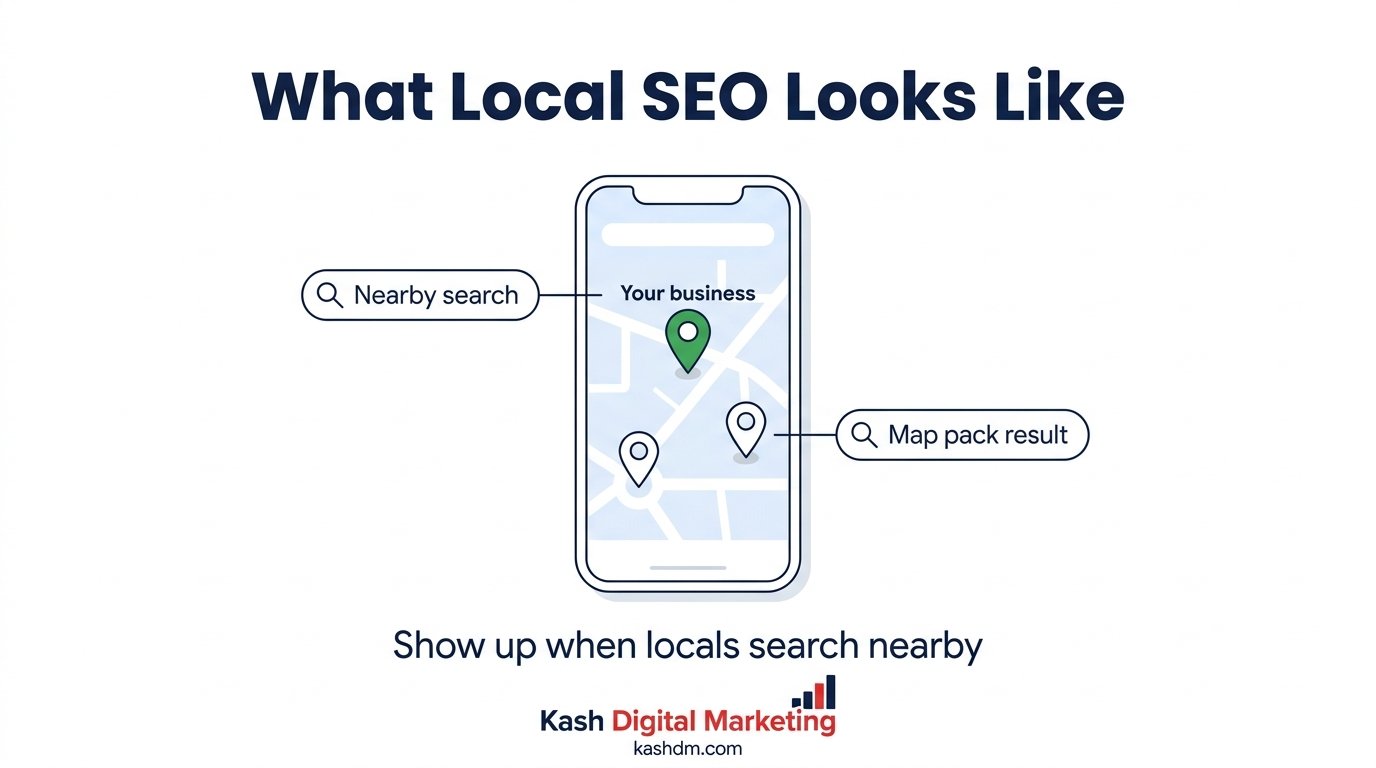
Local SEO is the process of optimizing your online presence so nearby customers find your business in Google's map pack and local search results. It layers additional signals, proximity, Google Business Profile optimization, citations, and reviews, on top of the standard SEO fundamentals.
Why local SEO is its own discipline
Local search results are ranked partly by different criteria than standard organic results, most notably distance from the searcher and the strength of your Google Business Profile. A business can rank well organically but poorly in the map pack, or vice versa, which is why local SEO deserves dedicated attention.
The core components of local SEO
Local SEO typically includes Google Business Profile optimization, citation building across directories, review generation and management, local link building, and location-specific content. Our full local SEO pillar page covers every one of these components in depth, including exactly how the map pack ranking algorithm works.
Who needs local SEO
Any business serving customers within a specific geographic area, home services, healthcare, restaurants, retail, professional services, needs local SEO as a core part of its strategy, often even more than traditional organic SEO.
The overlap between local SEO and the rest of SEO
Local SEO doesn't replace the fundamentals covered elsewhere in this guide, it adds to them. A local business still needs solid technical health, genuinely useful on-page content, and off-page authority; it just also needs the additional layer of local-specific signals to compete for map pack visibility. Businesses that treat local SEO as a completely separate discipline from "regular" SEO often end up with a well-optimized Google Business Profile sitting on top of a technically weak, thin website, which caps how far the local signals alone can carry them.
What Is E-E-A-T and Why Does It Matter?
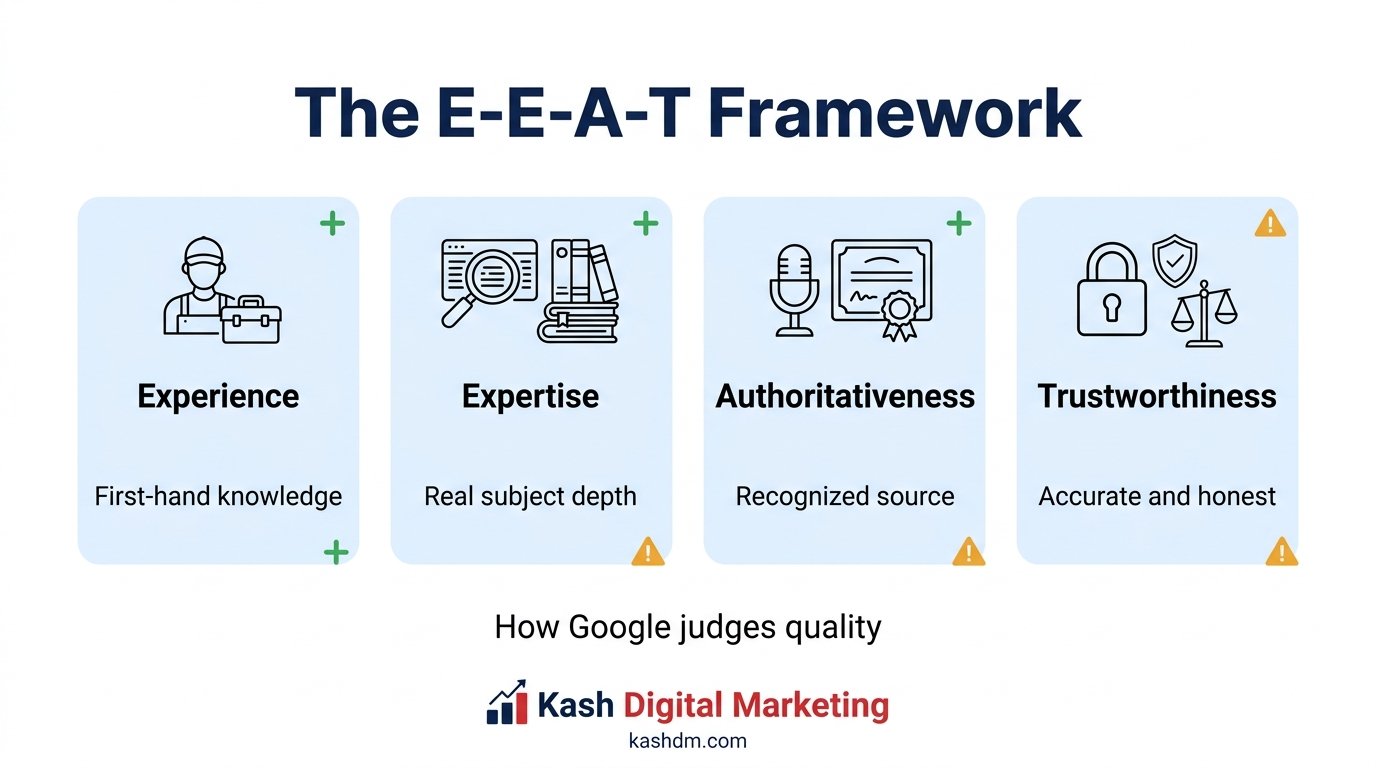
E-E-A-T stands for Experience, Expertise, Authoritativeness, and Trustworthiness, a framework Google's quality raters use to evaluate whether content, and the people and sites behind it, deserve to rank, especially for topics that affect health, finances, or safety. While E-E-A-T isn't a single measurable ranking factor, it strongly influences the systems that decide what qualifies as quality content.
The four components explained
Experience reflects whether the content creator has actually done or experienced the thing they're writing about. Expertise reflects relevant knowledge or credentials. Authoritativeness reflects whether the site or author is recognized as a go-to source on the topic. Trustworthiness, considered the most important of the four, reflects the accuracy, honesty, and safety of the content and the site itself.
Why E-E-A-T matters more for "Your Money or Your Life" topics
Google applies especially strict scrutiny to content that could impact someone's health, financial stability, or safety, often called YMYL (Your Money or Your Life) content. Medical, legal, and financial pages need to demonstrate genuine expertise and trustworthiness far more rigorously than, say, a recipe blog.
How to build E-E-A-T signals
Clear author bios with real credentials, accurate and well-sourced content, transparent business information, genuine customer reviews, and a track record of published, cited work all contribute to E-E-A-T. It's built over time through consistent, honest practice, not through a single page edit.
What Are Core Web Vitals?
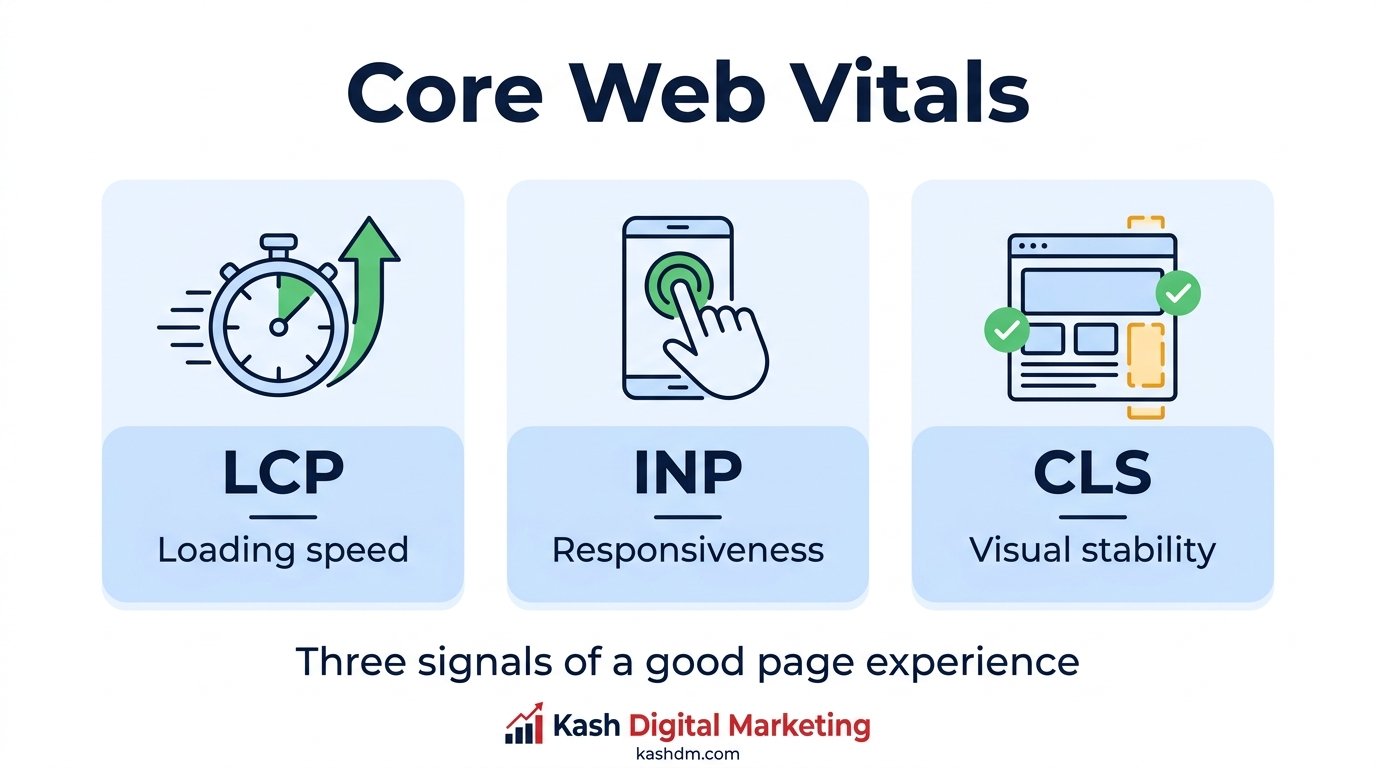
Core Web Vitals are a set of specific, measurable metrics Google uses to evaluate the real-world user experience of a webpage: loading speed, interactivity, and visual stability. They're part of the broader page experience signals that factor into rankings, particularly as a tiebreaker between otherwise similar pages.
| Core Web Vital | What It Measures | Good Target |
|---|---|---|
| Largest Contentful Paint (LCP) | How fast the main content loads | Under 2.5 seconds |
| Interaction to Next Paint (INP) | How quickly the page responds to interaction | Under 200 milliseconds |
| Cumulative Layout Shift (CLS) | How much the page visually shifts while loading | Under 0.1 |
Why Core Web Vitals matter beyond rankings
Even setting rankings aside, a page that loads fast, responds instantly, and doesn't jump around as it loads keeps visitors engaged instead of bouncing back to the search results. Poor Core Web Vitals quietly bleed away conversions even on pages that technically "rank fine."
Common causes of poor Core Web Vitals
Unoptimized images, bloated JavaScript, render-blocking resources, and poorly coded ads or pop-ups are the most common culprits. Fixing these is a core part of our technical SEO work.
SEO vs PPC: What's the Difference?
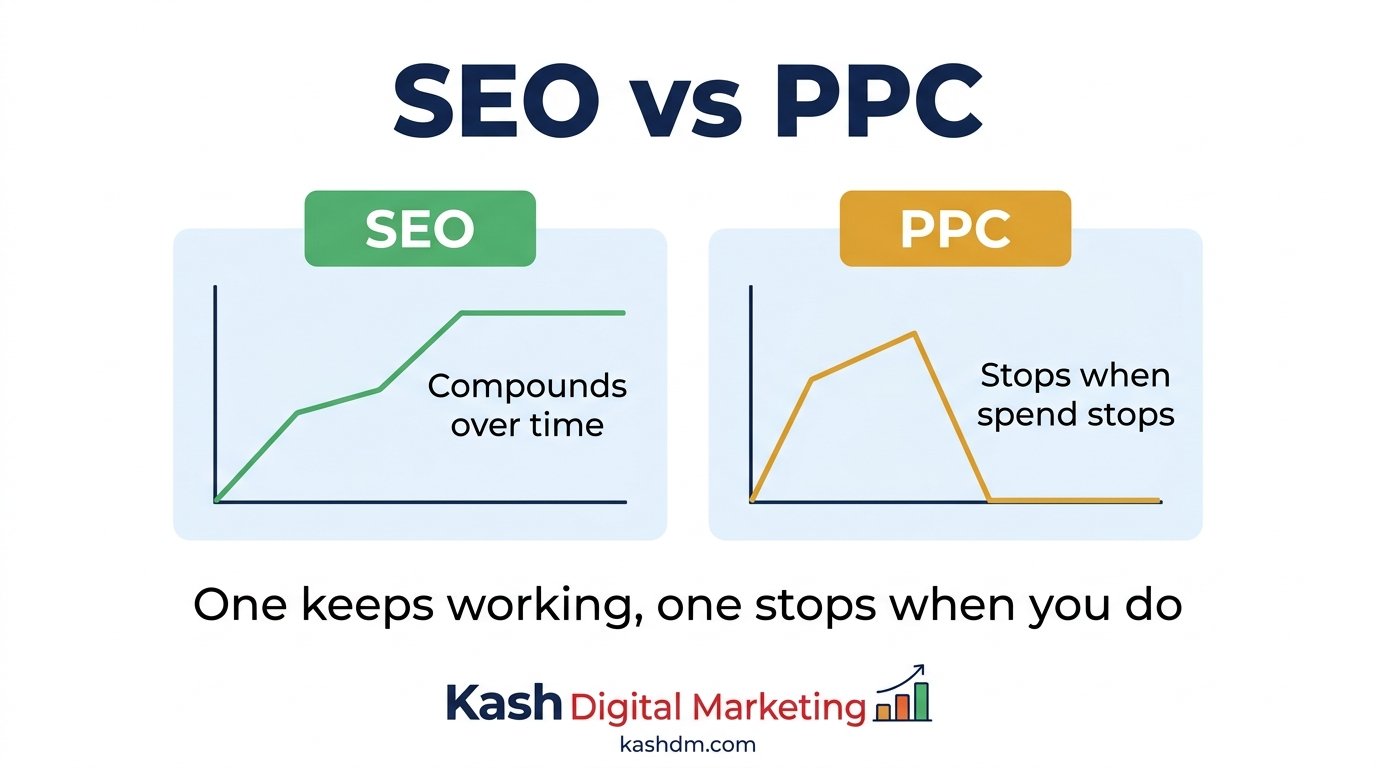
SEO earns free organic traffic over time, while PPC (pay-per-click advertising) buys immediate, paid placement at the top of search results, and the smartest strategies use both together. Understanding when to lean on each is one of the most common questions business owners have.
| SEO | PPC | |
|---|---|---|
| Cost model | Time and effort investment | Pay per click, ongoing |
| Speed to results | Weeks to months | Immediate |
| Longevity | Compounds, keeps working | Stops when budget stops |
| Trust perception | Higher, seen as earned | Lower, seen as an ad |
| Best for | Long-term, sustainable growth | Immediate needs, testing, promotions |
When PPC makes more sense
PPC is the right tool when you need traffic immediately, are testing which keywords convert before investing in content, or are running a time-limited promotion. It's fast, but the traffic disappears the moment you stop paying.
When SEO makes more sense
SEO is the right tool for sustainable, long-term growth, and it typically delivers a lower cost per lead over time as your authority compounds. Most established businesses find SEO becomes their most cost-efficient channel within the first year.
Why the best strategies use both
PPC can validate which keywords convert before you invest in SEO content, and it can fill the gap while your SEO rankings build. Running both together, rather than treating them as competitors for budget, is usually the smartest approach for a business that can afford it.
How Long Does SEO Take to Work?
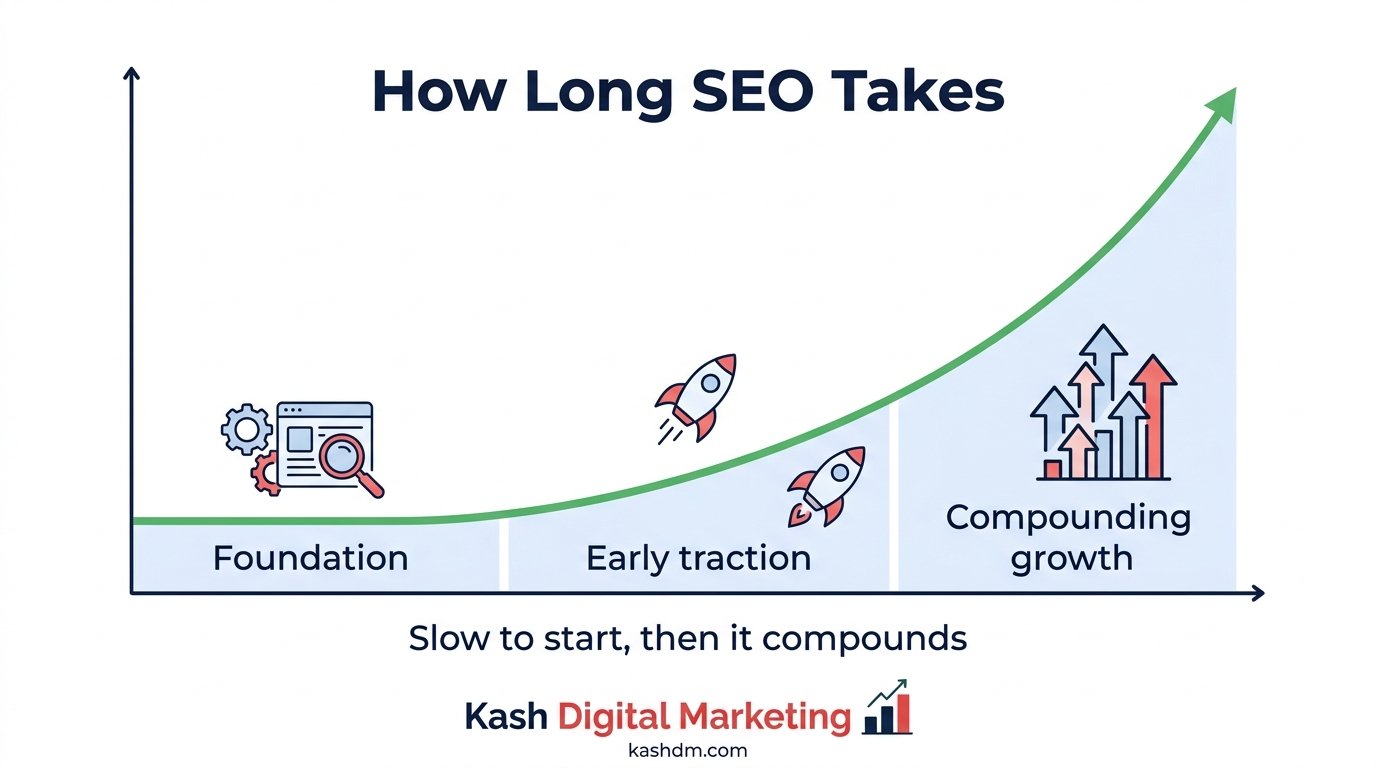
Most businesses start seeing meaningful movement within three to six months, with the strongest results building over six to twelve months, because SEO is a compounding process rather than an instant switch. Anyone promising guaranteed rankings in days or weeks is either misunderstanding how search engines work or planning to use risky tactics.
What happens in the first 90 days
Early months typically focus on technical fixes, foundational content, and low-competition longtail keywords, which can show movement within four to eight weeks. This mirrors the process we walk clients through in our own local SEO work.
Why competitive terms take longer
Highly competitive keywords are contested by sites with years of accumulated authority. Overtaking them requires sustained content, technical, and link-building work, often six months or more before meaningful ranking gains appear for the most valuable, high-volume terms.
Why SEO results accelerate over time
Unlike linear effort, SEO tends to accelerate: as your site earns more authority, each new page and link produces a bigger effect than it would have on a brand-new site. Businesses that stay consistent for a year or more often find their second year of results dramatically outpaces the first.
Why "how long" is the wrong single question to ask
Business owners naturally want a single number, but SEO timelines depend heavily on your starting point, your competition, and your industry. A brand-new site in a low-competition local niche can see meaningful results faster than a plateaued national brand trying to break into an already crowded market. A more useful question than "how long will it take" is "what does progress look like month by month, and how will I know it's working," which is exactly the kind of transparent reporting cadence we build into every campaign.
How to Measure SEO Success: KPIs and Metrics
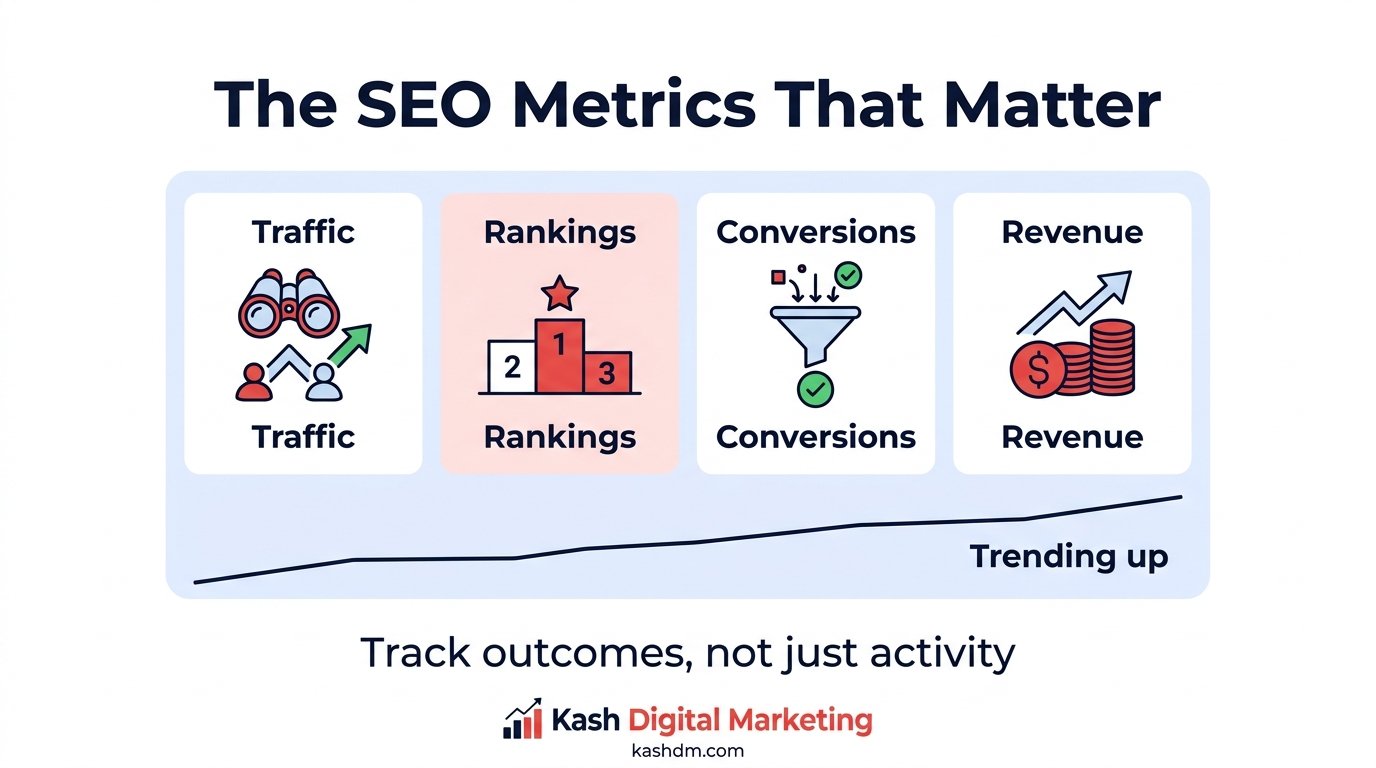
SEO success should be measured by business outcomes, leads, calls, sales, and revenue, not just by rankings or traffic in isolation. Rankings and traffic are useful diagnostic metrics, but they're means to an end, not the end itself.
| Metric | What It Tells You |
|---|---|
| Organic traffic | Overall visibility trend |
| Keyword rankings | Position for specific target terms |
| Organic conversion rate | How well traffic turns into leads or sales |
| Leads / calls / sales from organic | The actual business impact |
| Backlinks and referring domains | Growth of off-page authority |
| Core Web Vitals scores | Technical and user-experience health |
| Bounce rate and dwell time | Content relevance and engagement |
Leading indicators versus lagging indicators
Rankings and organic traffic are leading indicators; they tend to move first. Leads, calls, and revenue are lagging indicators; they confirm whether that visibility is actually translating into business value. A healthy SEO program tracks both, but reports on the lagging indicators as the real measure of success.
Setting up proper tracking from day one
Without call tracking, conversion tracking, and clean analytics, it's impossible to know what your SEO investment is actually producing. This is one of the most overlooked steps businesses take on their own, and one of the first things we set up for every client.
Avoiding vanity metrics
Impressions, follower counts, and keyword counts can look impressive in a report while having little connection to revenue. A disciplined SEO program keeps the focus on metrics tied directly to business outcomes.
Building a simple monthly reporting habit
Even without an agency, a business owner can build a simple monthly habit of checking a handful of numbers: organic traffic trend, top keyword movements, and leads or calls attributed to organic search. Reviewing these consistently, even briefly, makes it far easier to catch problems early and understand which content and pages are actually earning their keep, rather than discovering a slow decline only after it has compounded for months.
Common SEO Myths, Debunked
Misinformation about SEO is everywhere, and believing the wrong myth can waste months of effort or even get a site penalized. Here are the most persistent myths worth clearing up.
- Myth: SEO is a one-time task. Reality: it's an ongoing process; algorithms and competitors keep moving.
- Myth: Keyword stuffing helps rankings. Reality: it now actively hurts them; natural language and intent matter more.
- Myth: More content is always better. Reality: quality and relevance beat volume; thin content can dilute a site.
- Myth: Meta keywords tag still matters. Reality: Google stopped using it over a decade ago.
- Myth: Buying backlinks is a shortcut. Reality: it's a black-hat tactic that risks penalties.
- Myth: SEO and PPC are interchangeable. Reality: they're complementary channels, not substitutes.
- Myth: You need to submit your site to hundreds of search engines. Reality: Google finds sites through crawling and links, not manual submission spam.
- Myth: Rankings are guaranteed. Reality: no legitimate provider can guarantee a specific ranking, since Google's algorithm isn't controlled by any agency.
Why myths persist in the SEO industry
SEO changes constantly, and outdated advice lingers online long after it stops being true. Tactics that worked a decade ago can now actively harm a site, which is why it's worth verifying advice against current, reputable sources rather than assuming older content is still accurate.
How to spot bad SEO advice
Be skeptical of anyone promising guaranteed rankings, instant results, or a single "secret trick." Legitimate SEO is grounded in fundamentals that take time and consistent effort, not shortcuts.

White Hat vs Black Hat SEO: What's the Difference?
White hat SEO follows search engine guidelines and builds rankings through genuine quality and effort, while black hat SEO uses manipulative tactics that violate those guidelines and risk severe penalties. Understanding the difference protects your business from providers who trade short-term gains for long-term risk.
| White Hat SEO | Black Hat SEO | |
|---|---|---|
| Method | Quality content, earned links, technical excellence | Keyword stuffing, bought links, cloaking |
| Risk | Low, aligned with guidelines | High, can trigger manual or algorithmic penalties |
| Longevity | Durable, compounds over time | Often short-lived, can collapse overnight |
| Example tactic | Digital PR earning a genuine backlink | Buying links from a private blog network |
Why black hat tactics are tempting, and dangerous
Black hat tactics can produce fast, dramatic ranking jumps, which is exactly why they're tempting to an impatient business owner or an unscrupulous agency chasing quick results. The problem is that when Google detects them, and detection has become increasingly sophisticated, the resulting penalty can wipe out rankings overnight and take months or years to recover from.
Gray hat tactics and why they're still risky
Some tactics sit in a gray area, technically against guidelines but common enough that they sometimes go undetected for a while. Relying on gray hat tactics is still gambling with your business's long-term visibility, and it's not a strategy Kash Digital Marketing uses under any circumstances.
Why white hat is the only sustainable choice
A white hat approach takes longer to show results, but those results are durable and compound rather than collapsing under the next algorithm update. Every service we offer, from local SEO to link building, is built exclusively on white hat methods.

SEO Best Practices Checklist
A strong SEO foundation comes down to a manageable set of best practices, applied consistently rather than perfectly all at once. Use this checklist as a starting point for auditing your own site or briefing an agency.
- Ensure your site is crawlable and indexed correctly in Google Search Console
- Target keywords that match real search intent, not just search volume
- Write unique, descriptive title tags and meta descriptions for every page
- Use clear, logical heading structure (H1, H2, H3)
- Publish genuinely useful, in-depth content that reflects real expertise
- Optimize images with compression and descriptive alt text
- Build internal links between related pages
- Earn backlinks through genuine outreach and link-worthy content
- Keep your site fast, secure (HTTPS), and mobile-friendly
- Set up and maintain your Google Business Profile if you serve local customers
- Track rankings, traffic, and conversions consistently
- Avoid black-hat shortcuts entirely
Prioritizing the checklist for your situation
Not every item carries equal weight for every site. A brand-new site should prioritize technical fundamentals and initial content; an established site with good content should prioritize link building and conversion optimization. A proper audit identifies which items on this list matter most right now for your specific site.
How often to revisit this checklist
SEO best practices aren't a one-time box to check and forget. Search behavior, competitor content, and Google's own systems shift continuously, so a site that was fully optimized a year ago may already have drifted out of alignment with what's currently working. Revisiting this checklist on a quarterly basis, rather than only when something visibly breaks, catches small issues while they're still cheap and easy to fix, long before they compound into a real ranking problem.

How to Do SEO Yourself: The Basics
It's entirely possible to handle basic SEO yourself, especially for a small site, by focusing on a handful of high-impact fundamentals rather than trying to do everything at once. Here's a realistic starting sequence.
Step 1: Claim and optimize your Google Business Profile
If you're a local business, this single step often delivers the fastest visible results, and it costs nothing but time. See our local SEO guide for exactly what to optimize.
Step 2: Fix the technical basics
Make sure your site loads reasonably fast, works properly on mobile, uses HTTPS, and has an XML sitemap submitted to Google Search Console. These are foundational, and free tools like Google Search Console and PageSpeed Insights will surface the biggest issues.
Step 3: Do basic keyword research and write helpful content
Identify a handful of realistic, longtail keywords relevant to your business, and write genuinely helpful, specific content around them, rather than vague, generic pages.
Step 4: Earn a handful of quality backlinks
Reach out to local partners, industry contacts, and relevant publications for genuine mentions and links. A small number of quality links will outperform a large number of low-quality ones.
Step 5: Track what's happening
Set up Google Search Console and Google Analytics so you can see what's actually working, rather than guessing. Consistent tracking is what turns DIY SEO from a hobby into a real strategy.
Realistic expectations for a DIY approach
DIY SEO can absolutely produce real results, but it's worth being honest about the trade-off: it takes time to learn, time to execute, and time to stay current, time that's being pulled away from running the actual business. Many owners find that DIY SEO works well for the first, foundational layer, the free wins like Google Business Profile setup and basic technical fixes, and that bringing in outside expertise makes more sense once the strategy needs to get more competitive or move faster than a part-time effort allows.

When to Hire an SEO Agency
It's usually time to hire an SEO agency when your time is worth more than the learning curve, when your competition is already investing professionally, or when DIY efforts have stalled. SEO can absolutely be learned, but for most business owners, time spent running the business is better spent than time spent learning a specialized discipline from scratch.
Signs it's time to bring in help
If your rankings have plateaued, your competitors consistently outrank you, you don't have the time to stay current with algorithm changes, or you simply want faster, more reliable results, an experienced agency can compress months of trial and error into a proven process.
What to look for in an SEO agency
Look for transparency about methods, a white-hat-only commitment, reporting tied to real business outcomes rather than vanity metrics, and clear communication. Our best SEO services guide covers exactly what separates a great agency from a mediocre one, including the specific questions worth asking before you sign anything.
Weighing cost against the value of your time and the results
A reasonable SEO investment should pay for itself many times over through the customers it generates, and understanding realistic SEO pricing helps you evaluate whether a quote is fair. If the math works, an agency's expertise often gets you results faster and more safely than a DIY approach, freeing your time for the parts of the business only you can run.
What changes once you bring in an agency
Hiring an agency doesn't mean handing over control and hoping for the best. The best engagements remain collaborative: you continue to bring the deep knowledge of your customers, your services, and your market, while the agency brings the technical execution, ongoing algorithm awareness, and dedicated time that a busy owner rarely has to spare. A good agency explains what it's doing and why, in plain language, so you stay an informed partner in the strategy rather than a passive client waiting on a report you don't fully understand.

SEO for Different Business Types
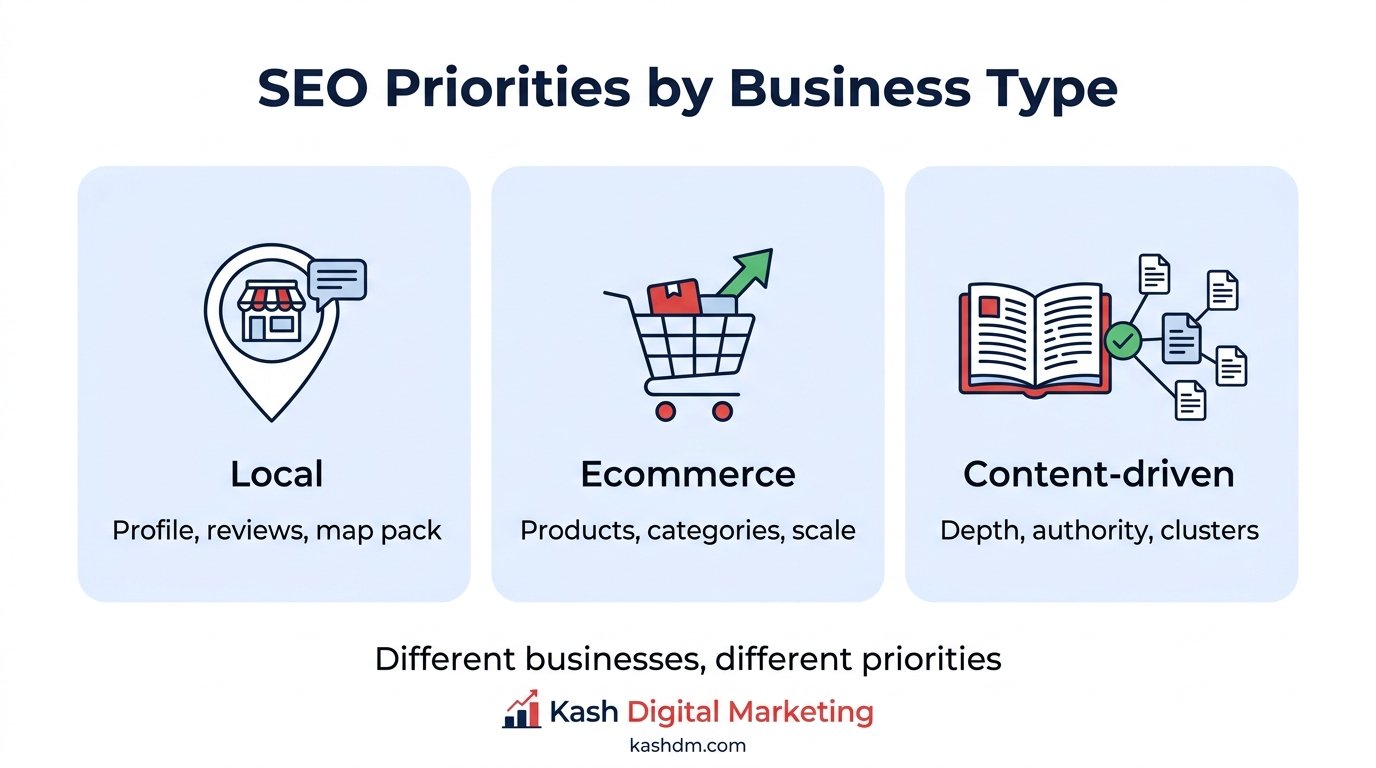
SEO priorities shift depending on your business model, and understanding where you fit helps you focus effort where it counts most. Here's a quick orientation across common business types.
SEO for local, service-based businesses
If customers come from a specific geographic area, local SEO, Google Business Profile, citations, and reviews, should be the top priority, layered on top of the core fundamentals covered throughout this guide. Our small business SEO guide covers this in depth.
SEO for ecommerce and online retail
Online stores need strong product page optimization, category structure, and technical performance at scale, since a single template issue can affect thousands of pages at once.
SEO for content-driven and informational sites
Sites built primarily around content, publishers, resource hubs, need to focus heavily on topical authority, content depth, and E-E-A-T, since their entire value proposition is being the best, most trustworthy source on their subject.
SEO for professional and regulated service businesses
Law firms, medical practices, and financial advisors operate in fields where trust and accuracy carry outsized weight, both with prospective clients and with Google's quality systems. These businesses benefit most from investing heavily in genuine E-E-A-T signals, verified credentials, accurate content, and authentic reviews, alongside the core technical and on-page fundamentals every business needs.
The Future of SEO: AI, AI Overviews and Voice Search
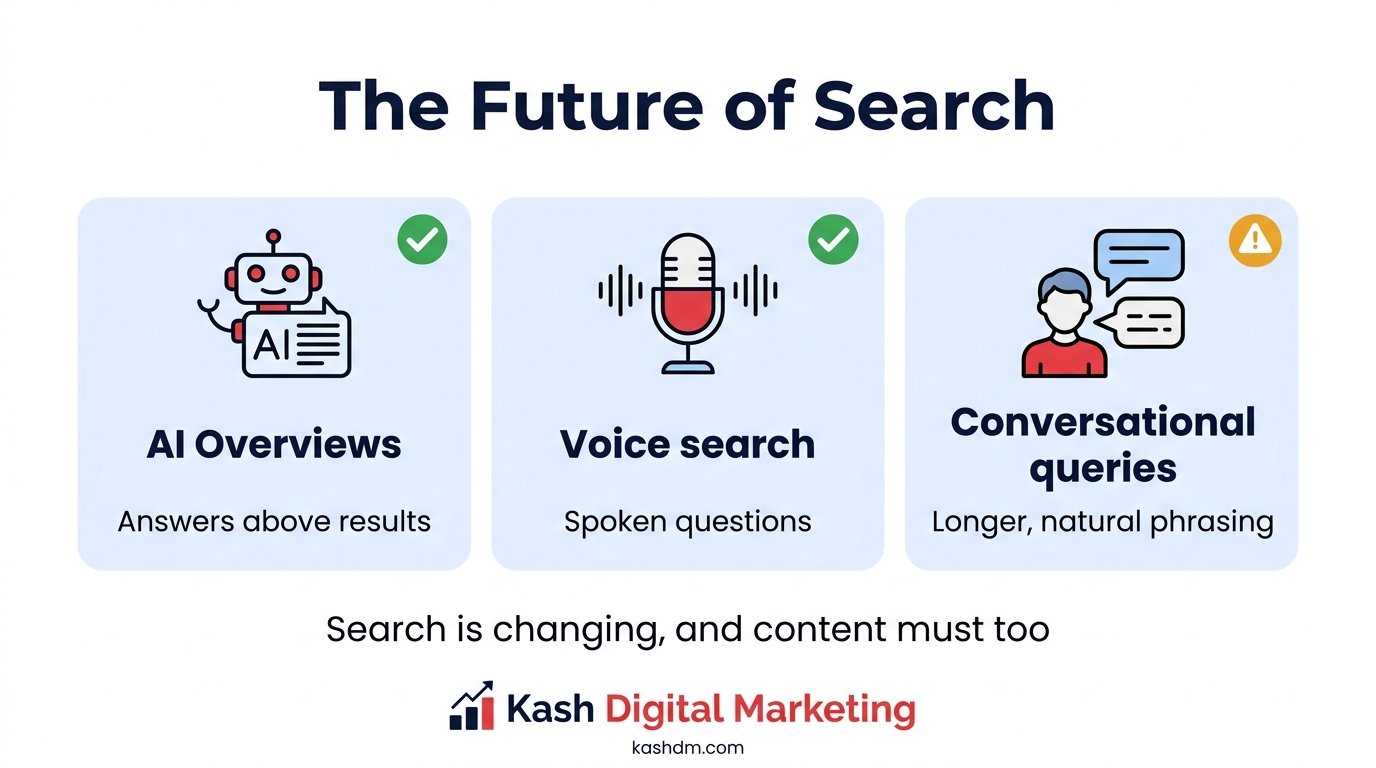
The future of SEO is being reshaped by AI-generated answers, AI Overviews appearing directly in search results, and voice search, all of which reward clear, well-structured, genuinely authoritative content over keyword-stuffed pages built purely for algorithms. Understanding where search is heading helps you build a strategy that doesn't need to be rebuilt every time the landscape shifts.
How AI Overviews change search results
AI Overviews summarize information directly at the top of search results, often answering a query before the searcher clicks any link at all. Content that's structured with clear, direct answers, strong sourcing, and genuine expertise is more likely to be pulled into these summaries and cited as a source.
Optimizing for AI-generated answers
The same fundamentals that earn strong rankings, clear structure, genuine expertise, accurate information, and well-organized content, also make content more likely to be understood and cited by AI systems. There isn't a separate playbook for "AI SEO" so much as an even sharper reward for doing traditional SEO fundamentals well.
Voice search and conversational queries
Voice search tends to favor conversational, question-based queries and returns fewer results, often just one. Content that directly and clearly answers common questions in natural language is well-positioned for both voice search and the AI-driven search experiences that are becoming more common.
Why fundamentals remain the safest long-term bet
Every major shift in search, mobile-first indexing, the rise of local search, and now AI-driven answers, has ultimately rewarded sites built on genuine quality, technical soundness, and trust. Businesses that chase every new trend often waste resources; businesses that build a solid fundamental foundation adapt to each shift with comparatively little disruption.
Preparing your site for what comes next
Rather than trying to predict every future shift precisely, the most resilient approach is building a site that AI systems, voice assistants, and traditional search all find easy to understand: clear structure, accurate structured data, direct answers to common questions, and genuinely demonstrated expertise. A site built this way tends to perform well across whatever search experience becomes dominant next, because it's optimized for being genuinely useful and easy to understand, not for gaming a specific interface that may not exist in its current form a few years from now.
SEO Content Strategy: Building Topical Authority
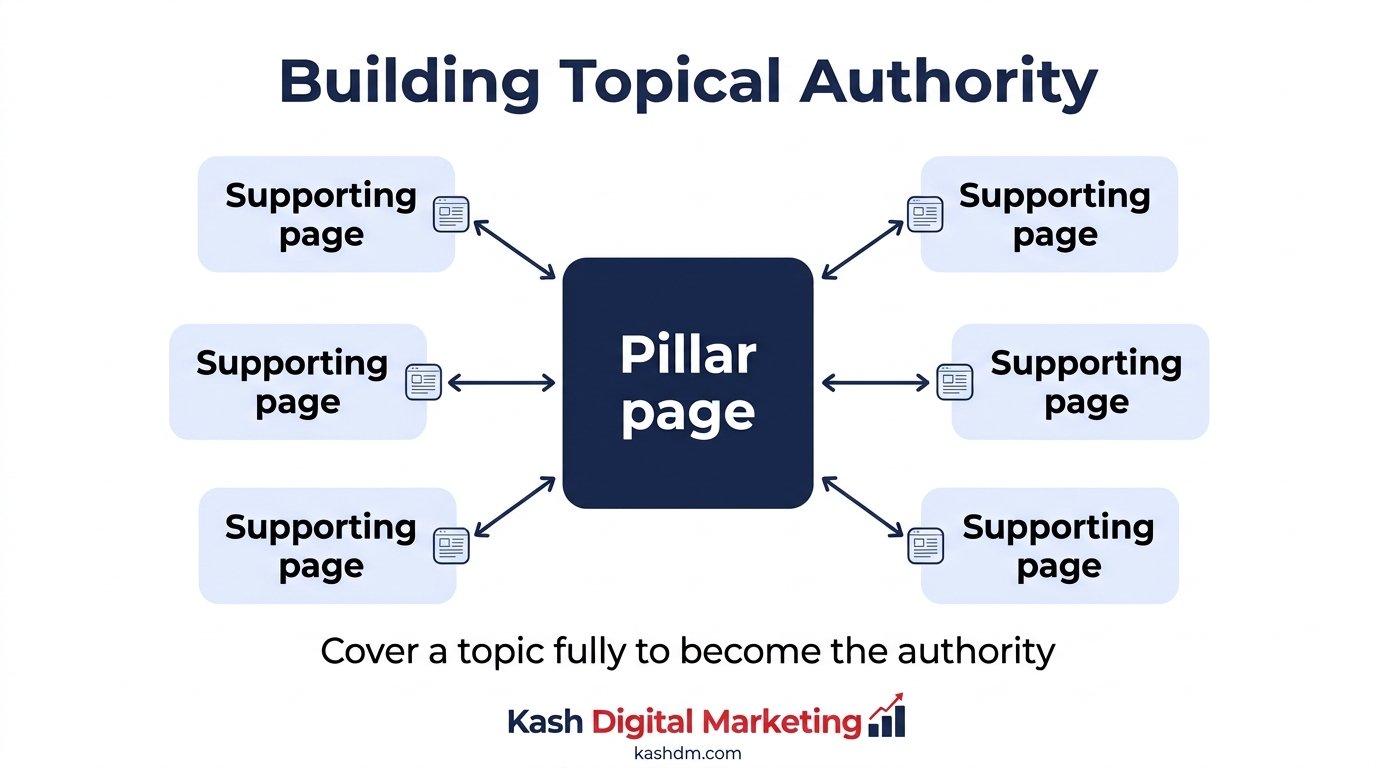
Topical authority is the depth and breadth of genuine expertise a site demonstrates on a subject, and building it is one of the most reliable ways to earn durable rankings across an entire topic rather than just a single keyword. A site with ten shallow pages on a topic rarely outranks a site with three genuinely comprehensive ones.
Pillar pages and content clusters
A common, effective structure pairs a comprehensive "pillar" page (like this one) covering a broad topic with a cluster of more specific supporting articles, all interlinked. This structure signals depth to both search engines and readers, and it's the architecture behind our own SEO content writing services.
Depth over volume
Publishing one thorough, genuinely useful page tends to outperform publishing ten thin ones, both in rankings and in the trust it builds with readers. Depth also tends to earn more natural backlinks, since thorough content is simply more useful to link to.
Updating and maintaining existing content
Topical authority isn't just about publishing new pages, it also depends on keeping existing pages accurate and current. A page with outdated statistics, broken links, or stale advice quietly erodes the trust signals that took months to build. Regularly reviewing and refreshing older content, updating examples, correcting outdated claims, and expanding thin sections, is one of the highest-return activities in an ongoing SEO program, and it's often cheaper than producing new content from scratch.
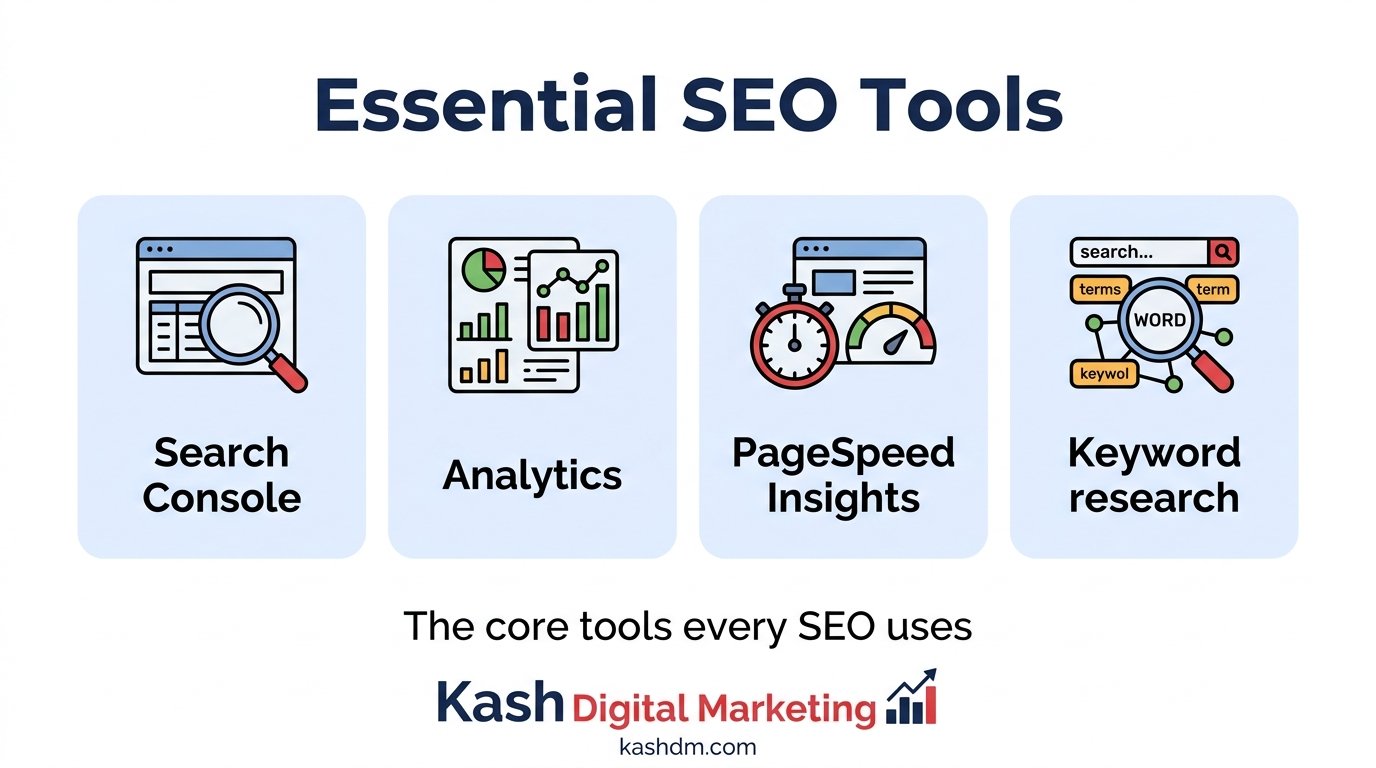
SEO Tools Worth Knowing
A handful of tools cover most of what a business needs to monitor and improve its SEO, and several of the most important ones are free. You don't need an expensive toolkit to get started; you need to consistently use the right few tools.
| Tool | What It's For | Cost |
|---|---|---|
| Google Search Console | Monitoring indexing, rankings, and technical issues | Free |
| Google Analytics | Tracking traffic and conversions | Free |
| Google Business Profile Manager | Managing your local listing | Free |
| PageSpeed Insights | Diagnosing Core Web Vitals issues | Free |
| Keyword research platforms | Finding search volume and competition data | Free tiers + paid |
| Backlink analysis platforms | Auditing your and competitors' backlink profiles | Free tiers + paid |
Starting with the free tools
Google Search Console and Google Analytics alone give a business owner enough visibility to understand what's working and diagnose most common problems, long before any paid tool becomes necessary.
Tools are only as useful as the actions they inform
It's easy to accumulate dashboards full of data without ever acting on it. The real value of any SEO tool comes from turning what it shows into a specific fix, a page rewritten, a technical issue resolved, a link outreach email sent, not from checking a number and moving on. A small business tracking three metrics consistently and acting on them will outperform one drowning in twenty metrics it never reviews.
How SEO and Social Media Work Together
SEO and social media are distinct channels, but they reinforce each other: social activity builds brand awareness and searches that strengthen SEO, while SEO content gives social channels a steady stream of material to share. Treating them as separate silos leaves value on the table.
Brand searches as an SEO signal
When people search for your brand name directly, it's a signal of genuine recognition and trust that search engines factor into their broader assessment of your prominence, particularly for local businesses. Consistent social media activity is one of the most reliable ways to build that brand recognition over time.
Repurposing content across channels
A single well-researched SEO page can be repurposed into multiple social posts, extending its reach and driving additional traffic and links back to the original page. This is exactly why we offer both SEO and social media marketing as a coordinated service rather than treating them as unrelated products.
Social proof reinforcing search decisions
Even when social media doesn't directly move a ranking, an active, well-reviewed social presence reassures a searcher who's already found you through Google that you're a real, credible, currently operating business. That extra layer of confidence, seen alongside your search result, often makes the difference between a click and a scroll past to the next competitor. Treating your social presence and your search presence as reflections of the same brand, rather than disconnected efforts, strengthens the impression you leave at every touchpoint.

Signs Your SEO Strategy Isn't Working
A handful of warning signs reliably indicate an SEO strategy has gone off track, and recognizing them early saves months of wasted effort. Watch for these patterns.
- Traffic or rankings have been flat or declining for several months with no explanation
- Content is being published but leads and calls aren't increasing
- Your agency can't clearly explain what tactics they're using
- Reports focus only on vanity metrics, never business outcomes
- You've received a manual action or sudden ranking drop notice in Search Console
- Your site's technical health hasn't been checked in over a year
What to do if you spot these signs
The fix usually starts with a fresh, honest audit, not the same provider grading their own work, but an independent look at what's actually happening technically, on-page, and off-page. Our free SEO audit is built exactly for this situation, whether or not you end up working with us.
Distinguishing a temporary dip from a real problem
Not every fluctuation is cause for alarm. Rankings and traffic naturally move around due to seasonality, algorithm updates that settle within days, or short-term competitor activity. A genuine problem is a sustained trend over several months with no seasonal explanation, not a single week's dip. Learning to tell the difference prevents both complacency about real issues and overreaction to normal, temporary noise.

SEO Glossary: Key Terms Explained
Here's a plain-English glossary of the SEO terms you'll encounter most often, whether reading this guide, talking to an agency, or researching on your own.
| Term | Definition |
|---|---|
| SEO | Search engine optimization, improving a site to rank higher in organic search results |
| SERP | Search Engine Results Page, the page of results shown after a search |
| Organic traffic | Visitors who arrive through unpaid search results |
| Crawling | The process by which search engines discover pages across the web |
| Indexing | Storing a discovered page in a search engine's searchable database |
| Backlink | A link from one website to another, used as an authority signal |
| Domain authority | A third-party estimate of a site's overall ranking strength |
| Keyword | A word or phrase people type into a search engine |
| Search intent | The underlying goal behind a search query |
| Longtail keyword | A longer, more specific, lower-competition search phrase |
| On-page SEO | Optimization of content and HTML elements on a page itself |
| Off-page SEO | Optimization activities happening away from your own site, mainly links |
| Technical SEO | Optimization of a site's infrastructure for crawlability and performance |
| Local SEO | Optimization for location-based searches and the Google map pack |
| Google Business Profile | Google's free local business listing shown in Maps and search |
| Citation | An online mention of a business's name, address, and phone number |
| NAP | Name, Address, Phone number, consistency of which matters for local SEO |
| E-E-A-T | Experience, Expertise, Authoritativeness, Trustworthiness |
| Core Web Vitals | Google's metrics for loading speed, interactivity, and visual stability |
| Schema markup | Structured data code that helps search engines understand page content |
| Meta description | The short summary shown under a title in search results |
| Title tag | The clickable headline shown in search results and browser tabs |
| Alt text | A text description of an image, used for accessibility and SEO |
| Canonical tag | A tag indicating the preferred version of a page among duplicates |
| 404 error | A "page not found" error shown when a URL doesn't exist |
| Redirect (301) | A permanent forward from one URL to another |
| Internal link | A link between two pages on the same website |
| Anchor text | The clickable text of a hyperlink |
| Bounce rate | The percentage of visitors who leave after viewing only one page |
| Conversion rate | The percentage of visitors who complete a desired action |
| White hat SEO | SEO that follows search engine guidelines |
| Black hat SEO | SEO that violates guidelines using manipulative tactics |
| Algorithm update | A change to how a search engine ranks results |
| Manual action | A penalty applied to a site by a human reviewer at Google |
| AI Overview | An AI-generated summary shown directly in search results |
| Featured snippet | A highlighted answer box shown above standard search results |
| Map pack | The block of three local business listings shown on a map |
| Crawl budget | The number of pages a search engine will crawl on a site in a given time |
| Link building | The process of earning backlinks from other websites to build authority |
| Structured data | Code (often schema) that helps search engines understand page content |
| Rich snippet | An enhanced search result with extra detail like stars, prices, or FAQs |
| SERP features | Special result types like snippets, People Also Ask, images, and maps |
| Domain Rating (DR) / Page Authority (PA) | Third-party scores estimating a domain's or page's link strength |
| Keyword difficulty | An estimate of how hard it is to rank for a given keyword |
| Keyword cannibalization | When multiple pages compete for the same keyword and dilute each other |
| Long-tail keyword | A longer, specific, lower-competition phrase with high intent |
| LSI / semantic keywords | Related terms that help search engines understand a topic's context |
| Semantic SEO | Optimizing for topics and meaning, not just individual keywords |
| Topical authority | The depth and breadth of expertise a site shows on a subject |
| Entity SEO | Optimizing around defined people, places, and things search engines recognize |
| Thin content | Low-value pages with little useful information |
| Duplicate content | Identical or near-identical content on multiple URLs |
| Mobile-first indexing | Google's use of the mobile version of a site for ranking |
| Page speed | How quickly a page loads, a ranking and user-experience factor |
| YMYL | "Your Money or Your Life" topics held to higher quality standards |
| Dwell time | How long a visitor stays on a page before returning to results |
| CTR (click-through rate) | The percentage of searchers who click your result |
| XML sitemap | A file listing a site's URLs to help search engines find them |
| Robots.txt | A file telling search engines which pages they may or may not crawl |
| Negative SEO | Malicious tactics used to try to harm a competitor's rankings |
| Google penalty (Panda / Penguin) | Ranking drops from algorithmic or manual quality enforcement |
| Local 3-pack | The three local businesses shown in the map pack |
| Programmatic SEO | Creating many pages at scale from a data set or template |
| SEM | Search engine marketing, usually meaning paid search ads |
| PPC | Pay-per-click advertising, where you pay for each ad click |
| SMO | Social media optimization, improving reach and engagement on social |
| AEO | Answer Engine Optimization, optimizing to be the answer AI engines give |
| GEO | Generative Engine Optimization, optimizing for AI-generated search results |
| SGE / AI Overviews | Google's AI-generated answers shown at the top of results |
| ROI | Return on investment, the profit generated relative to what you spend |
| KPI | Key performance indicator, a metric used to measure success |
SEO vs SEM vs PPC: what's the difference?
People often ask the difference between SEO, SEM, and PPC. SEO (search engine optimization) earns unpaid, organic rankings over time. SEM (search engine marketing) is a broader term that usually means paid search advertising, and PPC (pay-per-click) is the pay-per-click model those ads use. Put simply: SEO is earned and compounding, while SEM/PPC is paid and instant but stops when you stop paying. Most businesses get the best results by combining them, using PPC for immediate visibility while SEO builds durable, lower-cost traffic.
AEO, GEO, and SGE: what SEO for AI search means in 2026
As AI search grows, three newer terms come up constantly. AEO (Answer Engine Optimization) means optimizing so AI answer engines quote your content. GEO (Generative Engine Optimization) means optimizing for AI-generated results, and SGE or AI Overviews refers to Google's AI answers at the top of the page. They are not a replacement for SEO but an extension of it: the same fundamentals, strong content, structure, and E-E-A-T, are what earn visibility in AI search. We build AEO and GEO into modern SEO rather than treating them as separate services, so your business stays visible as search evolves in 2026.
Why the vocabulary matters, even for non-technical owners
You don't need to become an SEO expert to run a business well, but knowing this vocabulary means you can hold a real conversation with any agency or freelancer, understand what a report is actually telling you, and spot when someone is using jargon to obscure rather than explain. Every term in this glossary appears somewhere in ordinary conversations with SEO providers, and recognizing them turns those conversations from confusing to genuinely useful.

Frequently Asked Questions About SEO
What does SEO stand for?
SEO stands for search engine optimization, the practice of improving a website so it ranks higher in unpaid, organic search engine results.
Is SEO still worth it in 2026?
Yes. Even as AI Overviews and new search experiences emerge, the fundamentals behind SEO, being the clearest, most trustworthy, best-structured answer to a query, matter more than ever, both for traditional rankings and for being cited by AI systems.
How much does SEO cost?
It depends on your goals, competition, and market. See our SEO pricing guide for a full breakdown of what drives cost and how to evaluate a quote.
Can I do SEO myself, or do I need an agency?
Basic SEO is learnable and doable yourself, especially for a small site, as outlined in our step-by-step section above. Many businesses eventually hire an agency once the time investment outweighs the value of doing it in-house, or once they want faster, more reliable results.
How long does SEO take to show results?
Most businesses see meaningful movement within three to six months, with results building further over six to twelve months. Low-competition longtail terms often move faster, within four to eight weeks.
What's the difference between SEO and SEM?
SEM (search engine marketing) is the broader category that includes both SEO (organic) and paid search advertising. SEO is unpaid; SEM as a term often specifically refers to the paid side.
Does social media affect SEO?
Not directly as a ranking factor, but social media builds brand awareness and searches that indirectly support SEO, and the two channels work well together, as covered in our social media marketing section above.
What is the single most important SEO factor?
There isn't just one. Google weighs content relevance and quality, backlinks, technical health, and user experience together, and a weakness in any one of them can cap your results in the others.
Can a website recover from a Google penalty?
Yes, in most cases. Recovery typically involves identifying and fixing the underlying issue, whether it's a technical problem, thin content, or a manipulative link profile, then requesting reconsideration if it was a manual action. Recovery can take weeks to months depending on the severity.
What's the difference between SEO and content marketing?
Content marketing is the practice of creating valuable content to attract and engage an audience; SEO is the discipline of making sure that content, and the rest of your site, is discoverable and competitive in search results. They overlap heavily and work best together.
Do I need a blog for SEO to work?
Not necessarily, but regularly publishing helpful, relevant content, whether framed as a blog or as resource and service pages, is one of the most reliable ways to build topical authority and target a wider range of keywords over time.
How is AI changing SEO?
AI is changing how answers are surfaced, through AI Overviews and conversational search, but it hasn't changed what earns rankings and citations: genuine expertise, clear structure, and trustworthy, well-sourced content. The fundamentals covered throughout this guide remain the safest long-term strategy.
Get Your Free SEO Audit
Request Your Free SEO Audit
Prefer to talk it through? WhatsApp US +2135622433 or WhatsApp PK +92 348 3879366. We usually reply within an hour, and always within 8 hours.
Understanding SEO is the first step; seeing exactly where your own site stands is the next one. Our free SEO audit reviews your technical health, content, backlinks, and, if relevant, your local search presence, and hands you a clear, prioritized action plan, yours to keep whether or not you work with us.
Ready to see where you stand? Request your free audit and we'll usually reply within an hour, and always within 8 hours on business days.
- 💬WhatsApp: +2135622433
- ✉️Email: contact@kashdm.com
- 📝Free audit form: start here

Now that you understand what SEO is, how it works, and what genuinely good SEO looks like, you're equipped to evaluate any strategy, any agency, and any recommendation against real fundamentals rather than guesswork or hype. If you'd like a professional, no-obligation look at where your own site currently stands, our free audit is the fastest way to find out, and if you'd rather explore a specific discipline further, our local SEO, technical SEO, and link building pages go far deeper into each one.
SEO can feel overwhelming from the outside, a moving target full of jargon, conflicting advice, and constant change. But underneath all of that complexity sit the same durable fundamentals this guide has walked through: help search engines find and understand your site, be the genuinely best answer to what your customers are searching for, earn trust from the rest of the web, and measure what actually matters to your business. Get those fundamentals right, and everything else, algorithm updates, new search interfaces, shifting competitor tactics, becomes far easier to navigate.
Kash Digital Marketing, SEO and social media marketing services that help US businesses rank higher, get found, and grow. No spam. No long contracts. Just results.