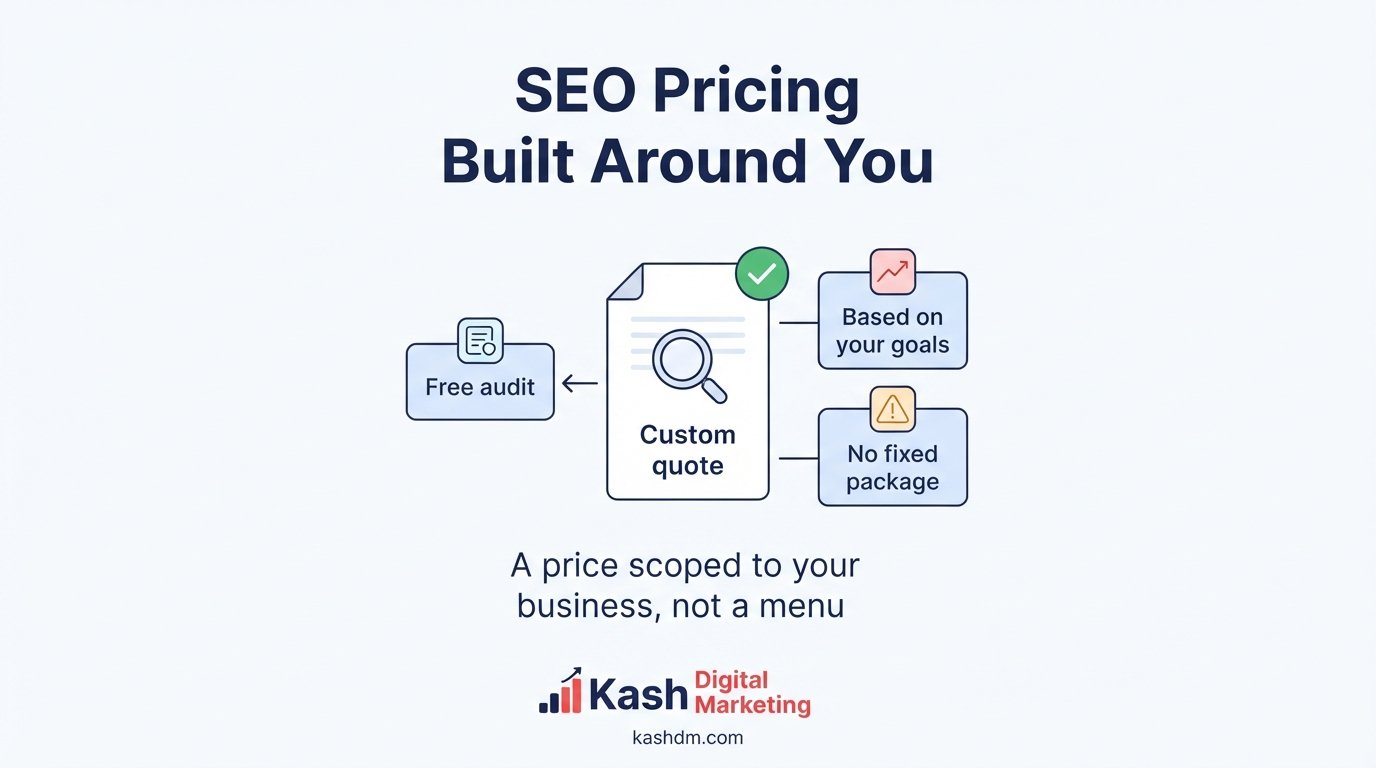
SEO services pricing varies widely because SEO is not a fixed product, it's a custom program shaped by your competition, your goals, your market, and the current state of your website. At Kash Digital Marketing, we don't publish a one-size-fits-all price list, and honestly, any agency that does is usually oversimplifying a genuinely variable service. Instead, we start every relationship with a free audit of your website, competitors, and market, then hand you a custom quote built around what it will actually take to win in your specific situation.
This page exists to educate you honestly about how SEO pricing works across the industry, what typical US market ranges look like, what actually drives cost up or down, and how to tell a fair quote from an overpriced or dangerously underpriced one. We're not going to pretend one number fits every business, a single-location dentist in a mid-sized city and a national ecommerce brand competing against Amazon face completely different investments, but we will give you the real framework agencies use internally so you can evaluate any quote, including ours, with confidence.
By the end of this guide, you'll understand the difference between monthly retainers, project-based pricing, hourly rates, and performance models, what typical costs look like across the US market for local, small business, ecommerce, and enterprise SEO, which cost factors actually matter, and how to budget for SEO the right way. Then, when you're ready, the fastest way to get an accurate number for your specific business is a free SEO audit that becomes the foundation for your custom quote.
⭐ 5.0 rating · ✅ Google & Meta certified · ⚡ Reply usually within an hour · 🛡️ 100% white-hat · 🇺🇸 Serving US local businesses
How Much Does SEO Cost? The Honest Answer
SEO cost depends on five variables: your competition, your market, your goals, your current site condition, and the pricing model you choose, which is why a trustworthy answer is always a range tied to your specifics, never a single flat number. Any agency that quotes you a price before understanding your industry, your competitors' strength, and where your website currently stands is guessing, and that guess is rarely in your favor.
That said, business owners deserve a real answer, not a dodge, so this guide gives you actual US market ranges throughout, framed honestly as industry norms rather than a Kash Digital Marketing price list. We believe an educated client makes a better decision, and we'd rather earn your trust with transparency than hide behind vague sales language.
Why "how much does SEO cost" doesn't have one answer
SEO isn't a commodity like a haircut or an oil change with a standard price. It's closer to hiring a specialist for a project whose scope depends entirely on the target. Ranking a local plumber for "plumber near me" in a mid-sized city is a fundamentally different amount of work than ranking a SaaS company for "project management software," and pricing has to reflect that difference honestly.
What a fair quote is actually based on
A fair SEO quote is built on your specific competitive landscape (who currently ranks and how strong they are), your specific goals (leads, sales, or brand visibility), the current health of your website (technical debt, existing content, existing authority), and the timeline you want results within. This is exactly what our free audit investigates before we ever give you a number.
Why we don't publish fixed prices
We could publish a simple price table, and it would be dishonest, because the same "package" name means wildly different amounts of work for different businesses. Instead, every quote at Kash Digital Marketing is custom, built from a real audit of your situation, so you pay for the work your business actually needs rather than a generic bundle padded to fit a price point that doesn't match your reality.
Reading this page as a buyer, not just a Kash Digital Marketing prospect
Even if you never end up working with us, we want this page to leave you better equipped to evaluate any SEO provider's pricing. Understanding the pricing models, the real cost factors, and the honest market ranges covered below means you'll never have to take a quote at face value again, whether you're comparing us to another agency or deciding between an agency, a freelancer, and building a team in-house.

SEO Pricing Models Explained: Retainer, Project, Hourly, and Performance
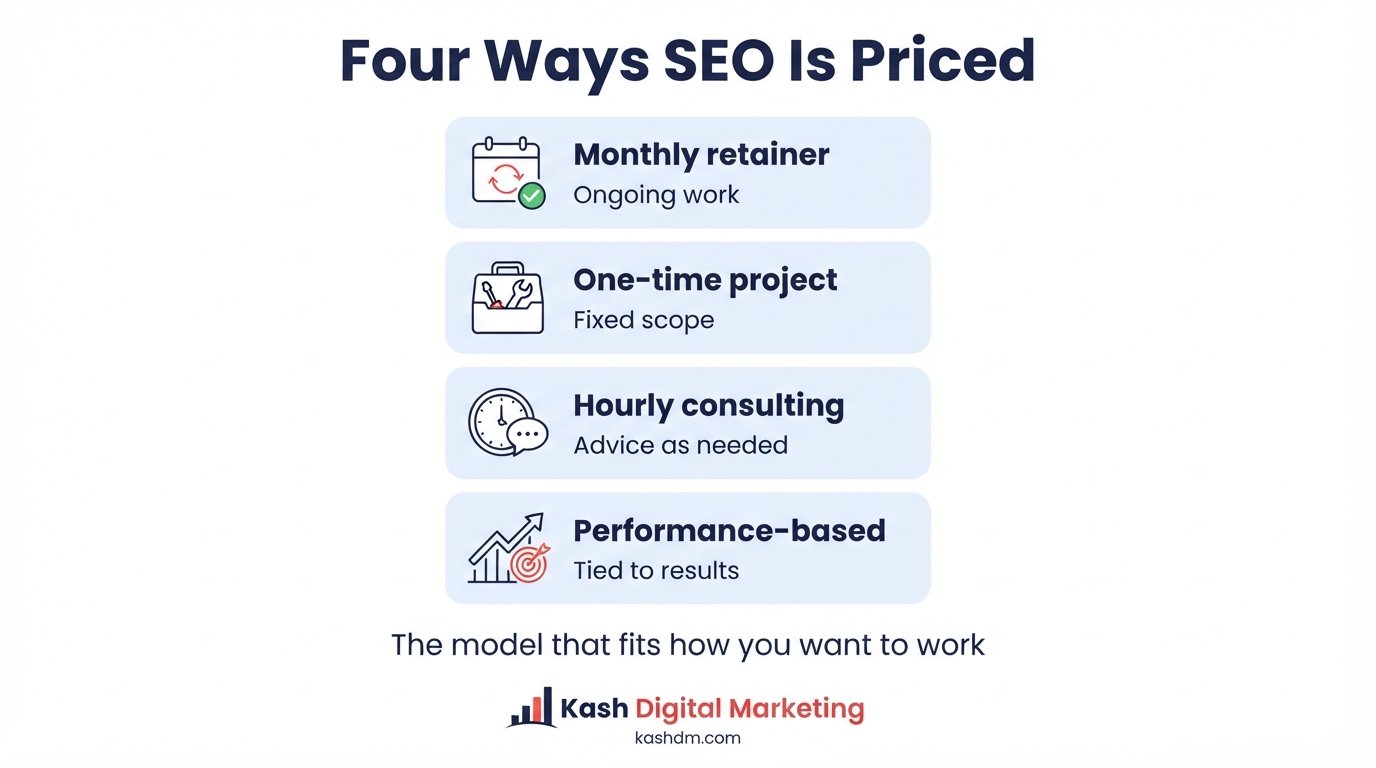
SEO is sold under four main pricing models, monthly retainers, one-time projects, hourly consulting, and performance-based deals, and understanding each helps you evaluate any quote you receive. Most ongoing SEO work is sold as a monthly retainer because SEO is inherently an ongoing process, but the other models have their place for specific needs.
| Pricing Model | How It Works | Best For | Watch Out For |
|---|---|---|---|
| Monthly retainer | Fixed or scoped monthly fee for ongoing work | Most businesses wanting sustained growth | Vague scope, no defined deliverables |
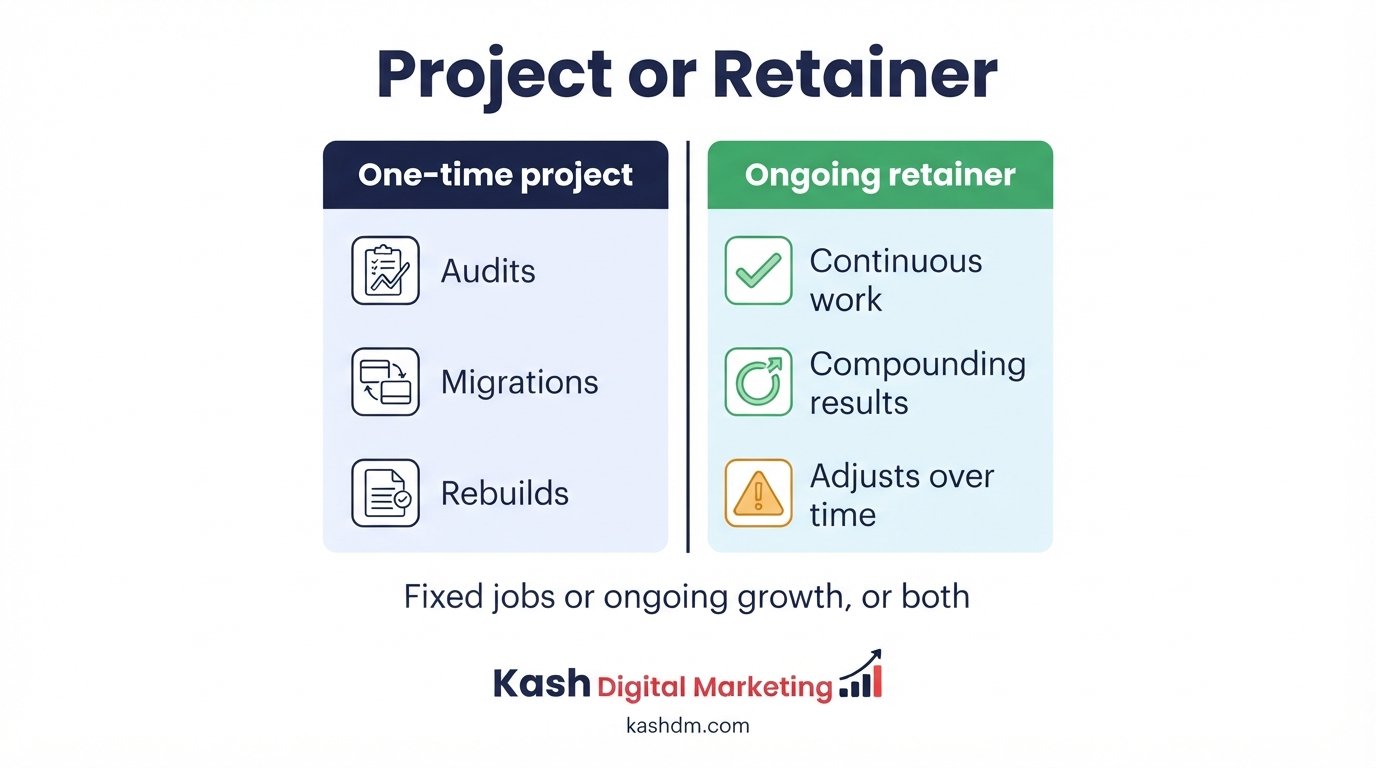
| One-time project | Fixed fee for a defined, finite scope (audit, migration, rebuild) | Specific fixes, one-off technical work | Treating SEO as "done" after the project |
| Hourly consulting | Billed by the hour for advice or specific tasks | Businesses with an in-house team needing expert guidance | Unclear hour estimates, scope creep |
| Performance-based | Fee tied to rankings, traffic, or leads achieved | Businesses wanting risk shared with the agency | Agencies gaming easy metrics instead of real growth |
Monthly SEO retainers explained
A monthly retainer is the most common way ongoing SEO is sold, because SEO is a continuous process of optimization, content, links, and adaptation, not a task you finish once. Retainers typically bundle strategy, on-page work, technical fixes, content, link building, and reporting into one recurring fee, scoped to your specific goals and competition.
One-time project pricing for defined scopes
Some SEO work genuinely has a finite endpoint: a technical audit, a site migration, a Core Web Vitals overhaul, or a one-time content buildout. These are reasonably priced as fixed projects because the scope is defined and doesn't recur monthly. The risk is businesses assuming a one-time project "finishes" their SEO, when in reality ongoing competition means rankings still need maintenance afterward.
Hourly SEO consulting
Hourly billing suits businesses that already have marketing staff or a developer and just need expert strategic guidance, a second opinion, or specific technical troubleshooting. It's rarely the right model for full SEO execution because the hours needed to move rankings meaningfully add up fast, and rate transparency doesn't always translate into cost predictability.
Performance-based and pay-for-results pricing
Performance models tie fees to results, rankings hit, traffic gained, or leads generated, and they sound appealing because they shift risk to the agency. In practice, they carry real downsides: agencies incentivized purely by rankings sometimes chase easy, low-value keywords or vanity metrics rather than the terms that actually drive revenue, and thin or non-existent contracts in this model can also invite riskier tactics to hit numbers fast. We prefer transparent retainers built around real business outcomes, calls, leads, and sales, over performance structures that can quietly misalign incentives.
Which model is right for your business
Most businesses seeking sustained growth in organic search are best served by a monthly retainer, because SEO compounds over time and needs continuous attention. One-time projects make sense for a specific, bounded problem like a site migration. Hourly consulting fits businesses that already have execution capability and need strategic direction. We structure engagements around what actually fits your situation rather than pushing everyone into the same model, which is part of why our SEO services start with a conversation about your goals before a proposal about price.
Blending models across the life of an engagement
Some of the healthiest client relationships blend models over time rather than sticking rigidly to one: a one-time technical project to fix a damaged foundation, followed by a monthly retainer for sustained growth, with occasional hourly consulting when a client's internal team needs a quick strategic gut check on something outside the regular scope. Thinking of these models as tools to combine, rather than a single box to check, often produces the most cost-effective outcome.
Average SEO Cost in the US: Industry Market Ranges
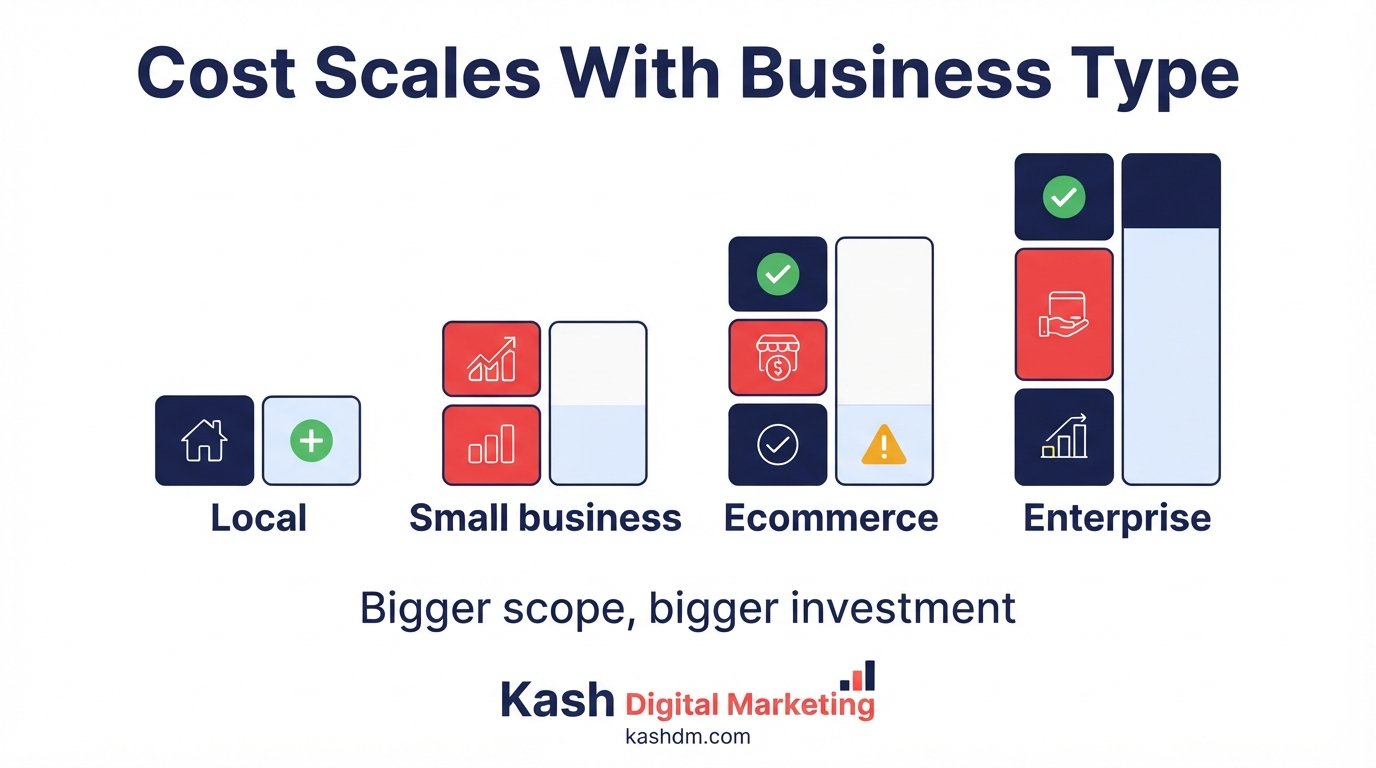
Average SEO costs across the US market typically fall into recognizable bands by business size and complexity, and understanding these industry norms helps you sanity-check any quote you receive, though your specific number always depends on your competition and goals. These figures reflect general market patterns reported across the SEO industry, not a Kash Digital Marketing price list, since our own quotes are always custom to your audit.
| Business Type | Typical Monthly Retainer Range (Industry Norm) | What Drives the Range |
|---|---|---|
| Small local business | Lower end of the market | Competition level, number of locations, service area size |
| Growing small/mid business | Mid-range | Content volume needed, link building intensity, industry competitiveness |
| Ecommerce (small-to-mid catalog) | Mid to upper-mid range | Number of product/category pages, technical complexity, platform |
| Enterprise / large ecommerce / SaaS | Upper range, often five figures monthly | Site size, technical complexity, national or global competition |
Why these ranges exist and vary so much
The spread between the low and high end of these ranges reflects genuinely different amounts of work. A single-location service business competing in a smaller city with weak local competitors requires far less monthly effort than a national ecommerce brand fighting established players for competitive product keywords. Both are "SEO," but the labor, content, and link-building intensity required are worlds apart.
How to read industry averages without being misled
Published "average SEO cost" figures you'll find across the industry are useful as a sanity check, but they can mislead if taken as gospel, because they blend businesses of wildly different sizes and goals into one number. A meaningful average for your business only comes from comparing your specific competitive situation to the range for businesses genuinely similar to yours, which is exactly what a proper audit does instead of a generic industry statistic.
Geographic and market variation in pricing
SEO costs also vary by market. Businesses competing in major metros with dense competition, New York, Los Angeles, Chicago, tend to need more investment than businesses in smaller markets with fewer serious competitors targeting the same searches. This mirrors the same logic we apply across our local SEO work: your quote reflects the market you're actually fighting in, not a national blanket average.
Why we quote custom instead of publishing a table like this as our price list
The table above is genuinely useful for setting expectations, but it's deliberately not a menu you can point to and order from. Two businesses in the "small local business" row can have costs that differ by a meaningful margin depending on whether they're in a sleepy suburb or a fiercely contested niche. That's precisely why our process starts with a free audit to place your business accurately, rather than asking you to self-select from a table and hope it fits.
How these figures compare to other common business expenses
It's often useful to compare an SEO investment against other recurring business costs you already budget for confidently, a commercial lease, a point-of-sale system, a single employee's salary. Framed this way, even the higher end of the small business range typically represents a modest fraction of what many businesses already spend on overhead that doesn't directly generate new customers, which helps put the number in realistic context rather than viewing it in isolation.
What Determines SEO Pricing: The Real Cost Factors
SEO pricing is ultimately driven by how much work is required to outrank your competition for the keywords that matter, and that work is shaped by a handful of concrete, assessable factors. Understanding these factors is the single best way to evaluate whether a quote, from us or anyone else, is reasonable for your situation.
Competition level in your market and industry
The strength of the businesses currently ranking above you is the single biggest driver of cost. If your competitors have years of content, hundreds of backlinks, and well-optimized sites, out-competing them requires proportionally more work than if the current top results are thin, outdated, or poorly optimized. We assess this directly in every audit by analyzing exactly who you're up against.
Your goals and target keywords
Chasing a handful of low-competition longtail terms costs far less than pursuing highly competitive head terms with massive search volume and commercial intent. Businesses that need broad market dominance across dozens of terms naturally require more investment than those focused on a tight set of high-value local keywords.
Current state of your website
A site with strong existing content, clean technical health, and some established authority needs less foundational work than a site with years of technical debt, thin content, or a history of black-hat tactics that need cleaning up. We factor this into every quote, because fixing a damaged foundation is real, billable work that a healthier site simply doesn't need.
Your industry and niche
Some industries are inherently more competitive and higher-stakes than others. Legal, finance, healthcare, and insurance sit in Google's "Your Money or Your Life" category, where the bar for expertise, authority, and trust signals is highest, which typically means more work to compete credibly. Lower-stakes local service categories often see faster, less expensive wins.
Content and link building intensity required
The volume and quality of content and links needed to compete scales with competition and goals. A market where top competitors publish weekly and earn links regularly requires sustained content and outreach to match; a quieter market may need far less to take the lead.
Scope: how many services and pages are involved
Pricing also scales with breadth: a single-location business with one core service page needs a narrower scope than a multi-location franchise or an ecommerce site with thousands of product pages. More pages and locations mean more technical, content, and optimization work across a larger surface area.
| Cost Factor | Lower Cost When | Higher Cost When |
|---|---|---|
| Competition | Weak or few real competitors | Established, well-optimized competitors |
| Goals | A few longtail keywords | Broad market dominance, competitive head terms |
| Site condition | Clean, healthy foundation | Technical debt, thin content, past penalties |
| Industry | Lower-stakes local services | YMYL (legal, medical, finance) |
| Scope | Single location, few pages | Multi-location, large catalog, national reach |
Timeline expectations and how urgency affects cost
A business that wants results as fast as possible sometimes needs a more front-loaded investment, more content produced in parallel, a more intensive technical sprint, a faster cadence of outreach, than a business comfortable with a steadier, more gradual pace. Urgency itself isn't free: compressing months of foundational work into a shorter window typically requires more resources allocated at once, and we're upfront about that tradeoff whenever a client asks us to move faster than the default pace.

Local SEO Pricing: What Drives the Cost of Ranking Locally
Local SEO pricing is generally the most accessible entry point into SEO because you're competing only within your geographic area rather than nationally, but cost still scales with local competition and how many areas you serve. A single-location business in a lightly contested suburb pays far less than a multi-location business competing across several dense metros.
Single-location versus multi-location pricing
A single storefront targeting one city needs a focused, contained campaign, one strong Google Business Profile, consistent citations, and a well-optimized site. A business with multiple locations or a wide service area multiplies that work across each additional market, since each location genuinely needs its own optimized profile and, often, its own localized landing page, as covered in depth on our local SEO page.
How local competition density changes the price
Local SEO in a small town with two or three real competitors is a very different cost proposition than local SEO in a major metro where dozens of established businesses fight for the same map pack spots. We assess the actual competitive density of your specific area during the audit rather than assuming your city behaves like a national average.
What's typically included in a local SEO investment
A typical local SEO engagement covers Google Business Profile optimization, citation building, review generation, local content, and local link building, the full system described on our local SEO page. Pricing reflects how much of each is needed, a business starting from zero citations and an unoptimized profile needs more foundational work than one that already has a decent base.
Service-area businesses versus storefront businesses
Businesses that travel to customers, plumbers, electricians, cleaning services, often serve a wider geographic radius than a single storefront, and pricing needs to reflect that broader footprint. Ranking across an entire service area rather than a single fixed address typically requires more localized content and a more deliberate citation and link strategy to establish relevance across every community served, which is a meaningful factor in scoping the investment correctly.

Small Business SEO Pricing: Budgeting Realistically
Small business SEO pricing should be scaled to realistic budgets, prioritizing the highest-impact, lowest-cost-to-win opportunities first so the investment can start generating leads before scaling further. Small businesses don't need to outspend national brands, they need a strategy that concentrates limited budget on winnable ground.
Why small businesses shouldn't chase the most competitive terms first
A small business chasing the most competitive, highest-volume keywords right out of the gate often burns budget without results, because that ground is the most expensive to win. A smarter approach targets longtail, lower-competition keywords first, generating early wins and revenue that can fund more ambitious targets later. This longtail-first philosophy runs through our small business SEO approach.
Scaling investment as results come in
Small business SEO pricing works best as a scalable relationship: start with a focused scope matched to a realistic budget, prove the return, then reinvest as leads and revenue grow. This avoids the common trap of overcommitting to a large retainer before you've seen any evidence it's working.
What separates cheap from affordable for small businesses
Affordable doesn't mean the cheapest option on the market, it means efficient allocation of budget toward what actually moves the needle. A cut-rate SEO service that skips technical fixes, uses thin content, or churns through templated tactics may look cheap upfront but usually costs more in the long run through wasted spend or, worse, penalty cleanup.
Setting realistic expectations at a small business budget
A modest budget can absolutely produce real results, but it's worth being honest that it may mean a narrower initial keyword focus and a longer runway to reach the most competitive terms in your niche. We'd rather set that expectation clearly upfront than overpromise broad rankings on a budget that realistically supports a more focused campaign, because a client who understands the plan trusts the process even when growth takes a few extra months.
Ecommerce SEO Pricing: What Adds Cost for Online Stores
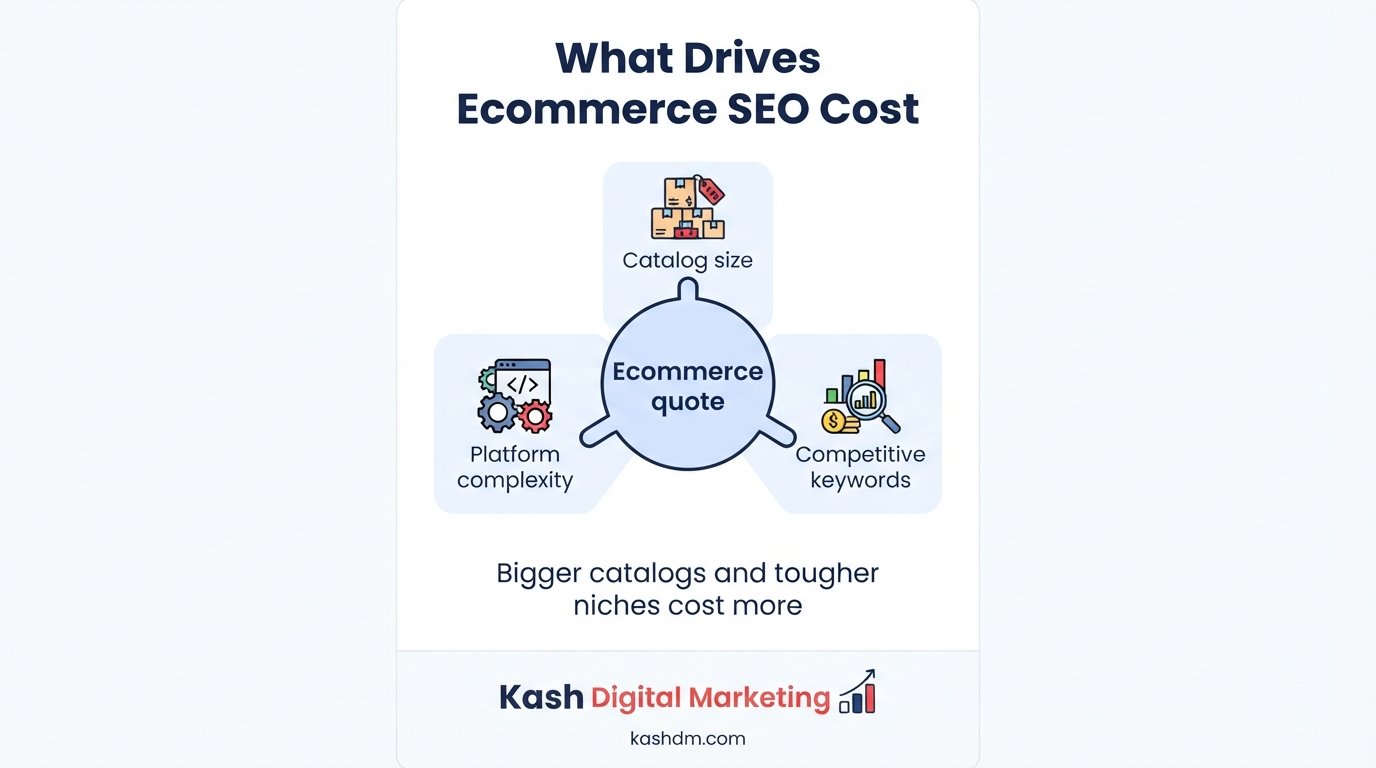
Ecommerce SEO pricing typically runs higher than standard local or small business SEO because of the sheer number of pages involved, product pages, category pages, and the technical complexity of platforms like Shopify, WooCommerce, and Magento. Cost scales directly with catalog size and platform complexity.
Catalog size and page volume
An ecommerce site with a few dozen products needs a fundamentally smaller optimization effort than one with thousands of SKUs across many categories. Each category and product page represents potential optimization work, from unique descriptions to structured data, and larger catalogs multiply that workload.
Technical complexity: platforms, faceted navigation, and duplicate content
Ecommerce platforms introduce technical challenges rarely seen on simpler sites, faceted navigation generating thousands of filtered URL variations, duplicate content across similar products, pagination issues, and out-of-stock page handling. Resolving these well requires deeper technical SEO expertise, which our technical SEO team applies specifically to ecommerce architectures.
Competitive product and category keywords
Ecommerce keywords, especially for popular product categories, are often fiercely competitive nationally, sometimes against marketplaces like Amazon itself. Competing for these terms typically requires more sustained content and link-building investment than local service keywords with a smaller competitive field.
Enterprise SEO Pricing: Scale, Complexity, and Stakeholders
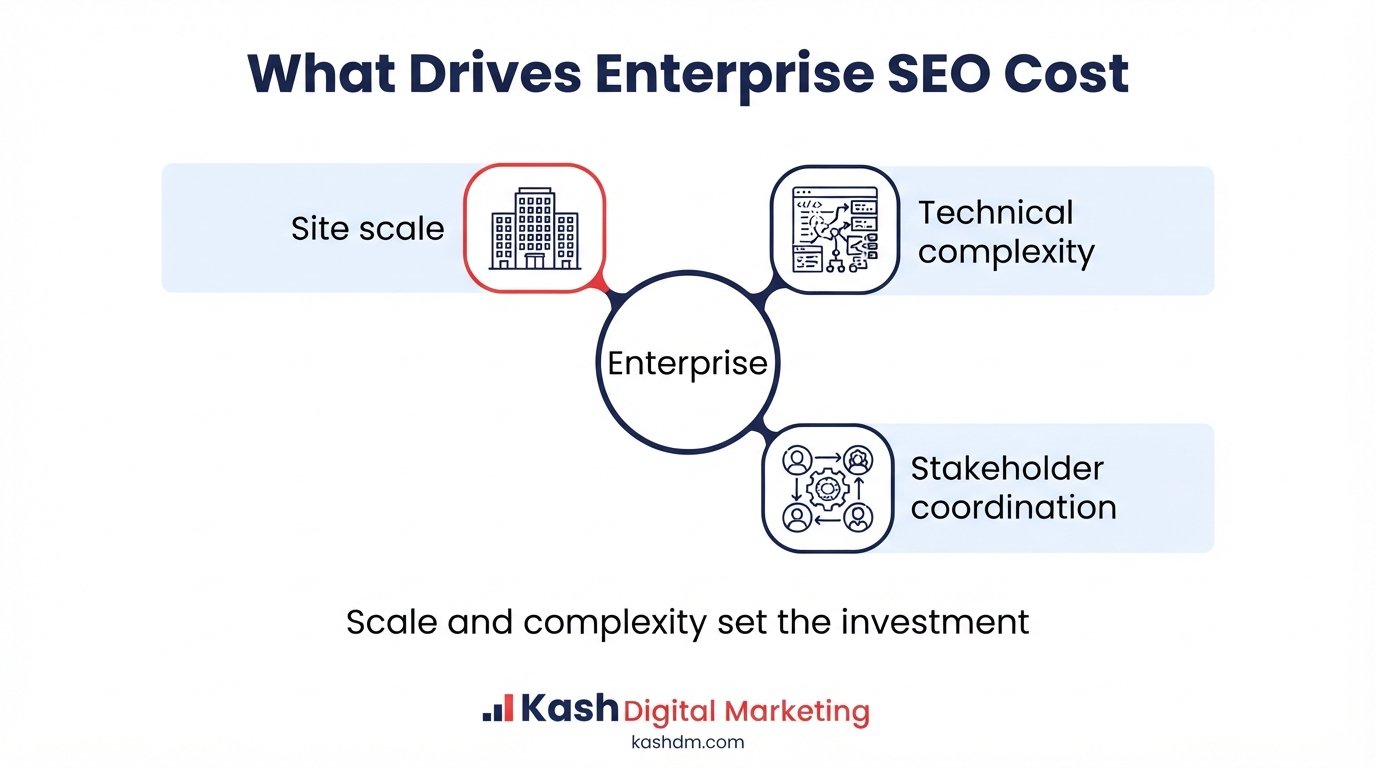
Enterprise SEO pricing sits at the top of the market because it involves massive site scale, complex technical infrastructure, multiple stakeholders, and often intense national or global competition. Enterprise engagements typically run into five figures monthly in industry norms, reflecting the scope of work genuinely required at that scale.
Why enterprise SEO costs more
Enterprise sites often span tens of thousands of pages, involve multiple departments and approval chains, run on complex custom or legacy technology stacks, and compete against other well-funded organizations with mature SEO programs. Each of these adds real work: technical audits at scale, cross-team coordination, and content and link-building programs sized to match serious competitors.
What enterprise budgets typically fund
Enterprise SEO investment typically funds a larger dedicated strategy and execution team, extensive technical infrastructure work, large-scale content programs, sophisticated internal linking and site architecture, and enterprise-grade reporting integrated with existing analytics stacks. Our enterprise SEO page details the full scope of what this level of engagement involves.
Stakeholder complexity as a hidden cost driver
Beyond the technical scale, enterprise SEO often costs more simply because of organizational complexity, more people need to review and approve changes, more systems need to be navigated, and more coordination is required to actually ship changes to a live site. A quote for enterprise SEO should account for this coordination overhead honestly rather than pretending it doesn't exist.
Custom scoping for enterprise engagements
Because enterprise sites vary so dramatically in scale and complexity, from a few thousand pages to hundreds of thousands, we scope enterprise engagements individually after a deep technical and competitive audit, rather than fitting them into the same audit-and-quote process used for smaller local campaigns. The underlying principle is identical, price should follow real, assessed work, but the depth of assessment required for a genuinely enterprise-scale site is naturally more involved.
SEO Packages Explained: What's Usually Bundled and Why That's Risky
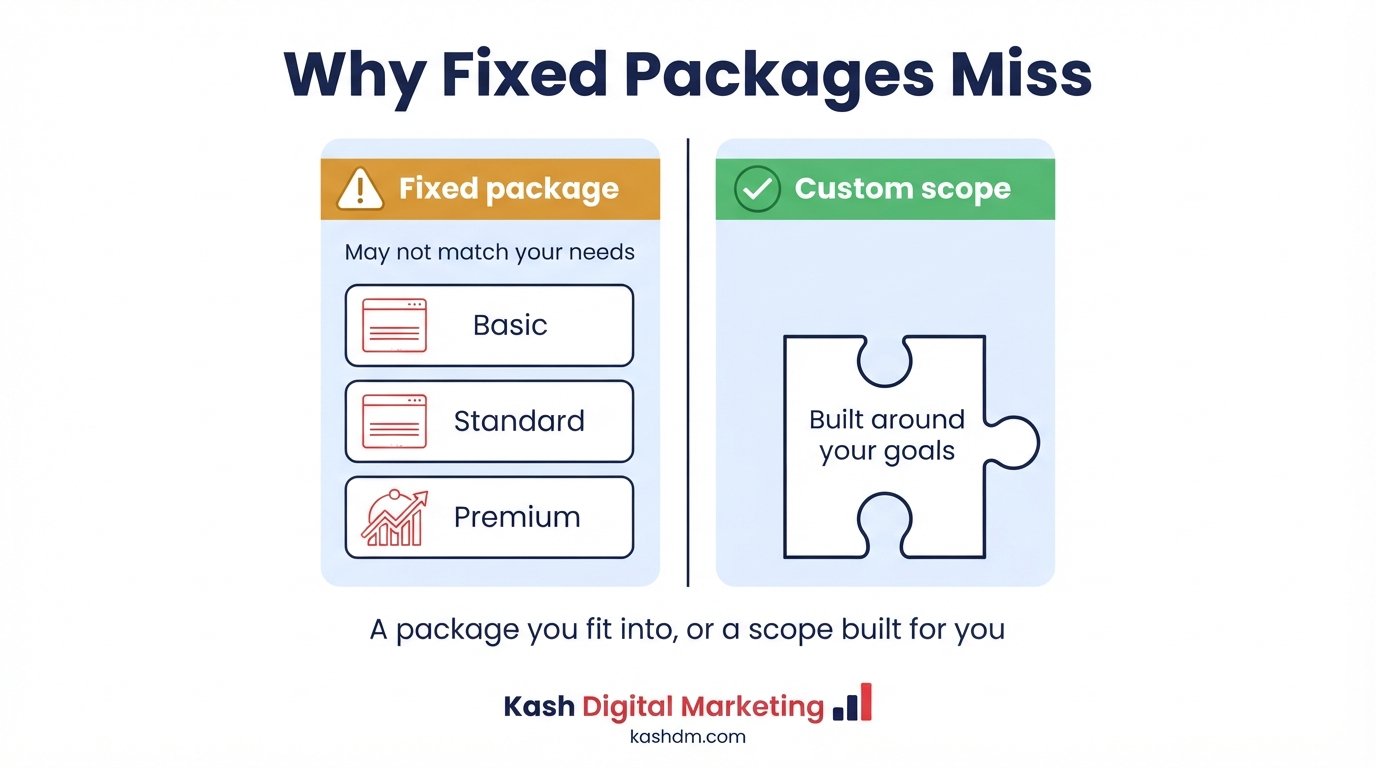
SEO "packages" bundle a set of deliverables at a fixed price, and while the language of packages, Starter, Growth, Premium, is common across the industry, it can obscure whether the bundle actually matches what your specific business needs. Understanding what's typically packaged helps you evaluate any package-based quote critically.
What a typical SEO package usually includes
Most SEO packages bundle some combination of keyword research, on-page optimization, a set number of content pieces per month, a set number of link-building activities, technical fixes, and monthly reporting. The tiers usually differ by volume, more content, more links, more hours, at a higher price point.
Why fixed packages don't fit every business
The risk with rigid packages is mismatch: a business in a lightly competitive niche may be sold a package with far more content and links than it needs, while a business in a brutally competitive niche may be sold a package that's genuinely too light to move the needle, leaving them disappointed despite paying regularly. A package built for an "average" business fits very few actual businesses precisely.
How we approach packaging differently
Rather than selling from a fixed tier list, we scope your engagement around what your audit actually reveals you need, then quote that scope. If that ends up resembling a smaller or larger engagement than a "typical package," that's the point, it's shaped by your reality rather than a template. This is why our free audit always comes before any number, not after.
| Typical Package Element | What to Ask About It |
|---|---|
| Number of content pieces per month | Are they matched to your actual content gap, or an arbitrary round number? |
| Number of links per month | Is quality specified, or just quantity? |
| Technical work included | Is it a one-time fix or ongoing monitoring? |
| Reporting | Does it show leads and revenue, or just rankings and traffic? |
| Contract length | Are you locked in regardless of results? |
When a package-style structure is genuinely fine
None of this means package pricing is inherently bad, a clear, well-defined package can work well when a provider has genuinely tailored the tiers to distinct, realistic business profiles and is upfront about which tier fits which situation. The problem isn't packages themselves, it's packages sold without any real assessment of whether the tier actually matches the buyer's competitive reality.
Monthly SEO Retainer: What You're Actually Paying For
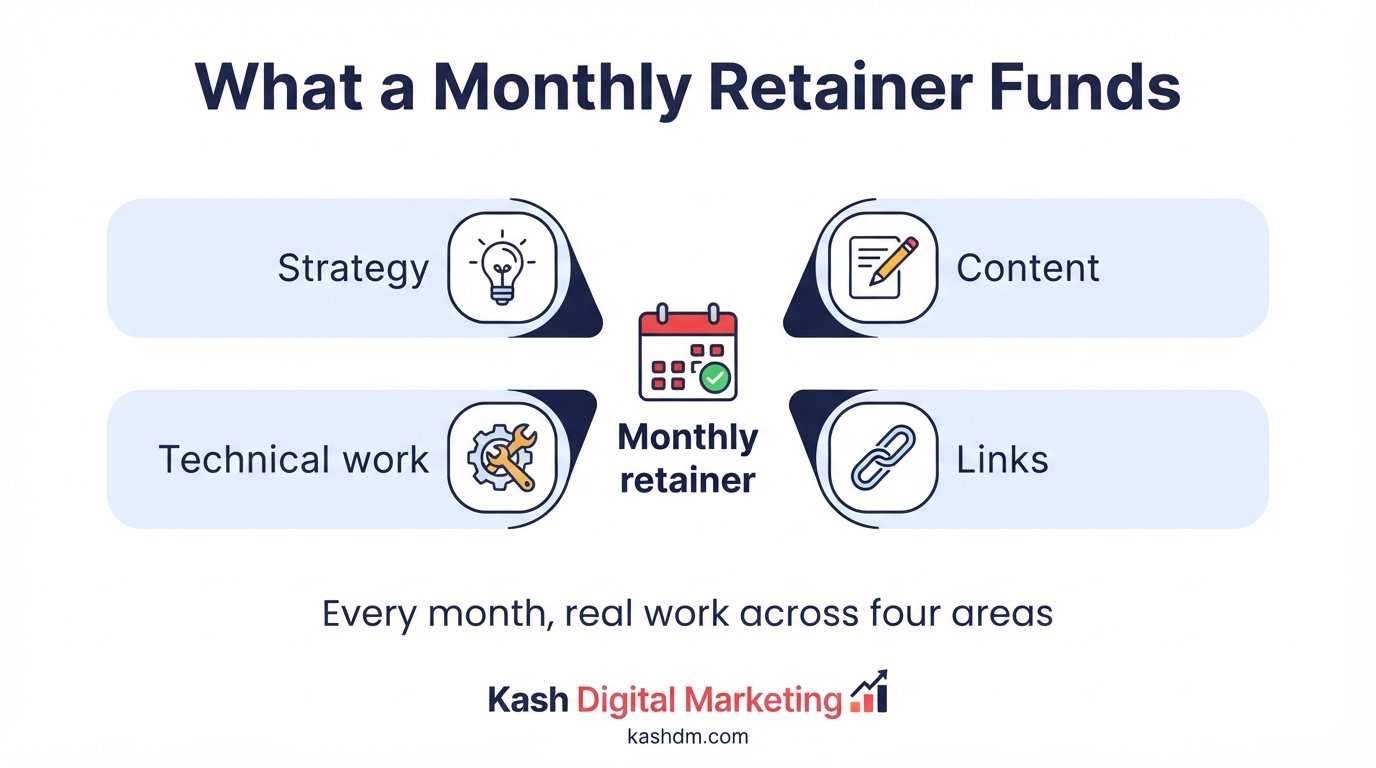
A monthly SEO retainer funds a continuous, coordinated program, strategy, content, technical work, links, and reporting, that compounds over time, not a static list of one-time tasks. Understanding what a retainer actually pays for helps you judge whether a quoted monthly figure represents fair value.
The ongoing work a retainer funds
Each month, a well-run retainer typically funds continued keyword and competitor monitoring, new content production, on-page refinement, technical maintenance, link-building outreach, review and reputation work for local clients, and transparent reporting. It's an active, evolving program responding to what's working and what the market is doing, not a set-and-forget subscription.
Why retainers make sense for a compounding channel
SEO results build on each other, content published last quarter still ranks and earns links this quarter, authority earned last year still supports rankings today. A retainer structure matches this compounding nature, funding continuous investment rather than a single burst of effort that fades once the project ends.
How to evaluate whether a retainer price is fair
A fair retainer price should be explainable: the agency should be able to tell you roughly how the monthly fee breaks down across strategy, content, technical work, and links, and why that mix suits your specific competitive situation. If a quote can't be explained beyond "that's our standard rate," that's a signal to ask more questions.
One-Time SEO Project Cost: Audits, Migrations, and Rebuilds
One-time SEO projects, technical audits, site migrations, or content overhauls, are priced as fixed fees for a defined scope, and they make sense when the work genuinely has a clear endpoint. These differ meaningfully from retainers because the deliverable is bounded rather than ongoing.
When a one-time project makes sense
A one-time project fits situations with a clear, finite goal: migrating to a new platform without losing rankings, fixing a specific technical problem that's suppressing visibility, or a focused content overhaul of existing underperforming pages. These are legitimate, valuable engagements with a natural completion point.
Why a one-time project isn't a substitute for ongoing SEO
The risk with treating SEO purely as a one-time project is assuming rankings, once achieved, stay static. They don't. Competitors keep publishing and building links, Google keeps updating its algorithm, and a site left untouched after a one-time project slowly loses ground to more actively maintained competitors. A one-time project is often a smart first step, not a complete strategy.
Combining a project with a retainer
Many engagements sensibly start with a one-time project, fixing foundational technical issues, for example, and then transition into an ongoing retainer once the foundation is solid. This sequencing lets you address urgent problems first before committing to sustained monthly investment, and we structure engagements this way whenever it's the right fit for your situation.
SEO Audit Cost: What a Proper Audit Should Include
A proper SEO audit examines your technical health, content, backlink profile, competitors, and current rankings to produce a prioritized action plan, and its cost should reflect real analytical work, not an automated report dump. Audit pricing in the industry ranges from free introductory audits to substantial paid engagements for deep enterprise audits.
What separates a real audit from a generic report
A real audit involves a human analyst interpreting data in the context of your specific business and competitors, not just running your URL through automated software and handing you the raw output. Automated tools are a starting point, but the value is in the prioritized, business-specific recommendations that follow, this is what turns a wall of data into an actionable plan.
Why we offer a free audit rather than charging for one
We offer a free SEO audit because it's the fastest way for a prospective client to see real, specific value before spending anything, and it's the foundation we use to build your custom quote. There's no obligation attached, you keep the findings and the prioritized action plan whether or not you move forward with us.
When a paid, deep-dive audit makes sense
Very large or complex sites, particularly enterprise sites with tens of thousands of pages, sometimes warrant a paid, deep-dive audit that goes well beyond what a free introductory audit can cover in the time available. This is less common for local and small business clients but is a legitimate, industry-standard offering for genuinely complex technical environments.

Content Writing Pricing Within an SEO Program
SEO content pricing reflects research, keyword strategy, writing, editing, and on-page optimization, not just word count, and it typically scales with the depth and volume of content your competitive situation requires. Content is frequently one of the largest line items in an SEO budget because it's the raw material that earns rankings and links.
What drives SEO content cost
Cost is driven by how much research and expertise a piece requires, how competitive the target keyword is, and how much content volume your strategy calls for each month. A quick local service page costs far less to produce well than a comprehensive, heavily researched pillar page competing for a high-value national keyword.
Why cheap content is a false economy
Content priced far below market rates is almost always thin, generic, or poorly researched, and thin content rarely ranks and can actively drag down a site's overall quality signals under Google's Helpful Content system. Paying for genuinely well-researched, well-written content, the standard behind our content and SEO copywriting services, produces content that ranks, earns links naturally, and converts readers into customers.
How content pricing fits into your overall SEO budget
Content is rarely priced in isolation, it's typically bundled into a retainer alongside strategy, technical work, and links, because content that isn't properly optimized, linked to internally, and promoted underperforms regardless of how well it's written. We treat content as one integrated part of the system rather than a standalone line item.
AI-assisted content and its effect on pricing
AI writing tools have changed the content production landscape, and some providers now offer lower content prices by leaning heavily on AI-generated drafts. Used responsibly, as a starting point that a knowledgeable human then researches, fact-checks, and substantially rewrites, AI can genuinely improve efficiency without hurting quality. Used irresponsibly, as unedited output published straight to your site, it produces exactly the kind of generic, unreliable content that struggles to rank and can damage trust with readers and search engines alike. Ask any provider directly how AI fits into their content process, and be wary of vague or evasive answers.

Link Building Pricing: Why Quality Costs More Than Quantity
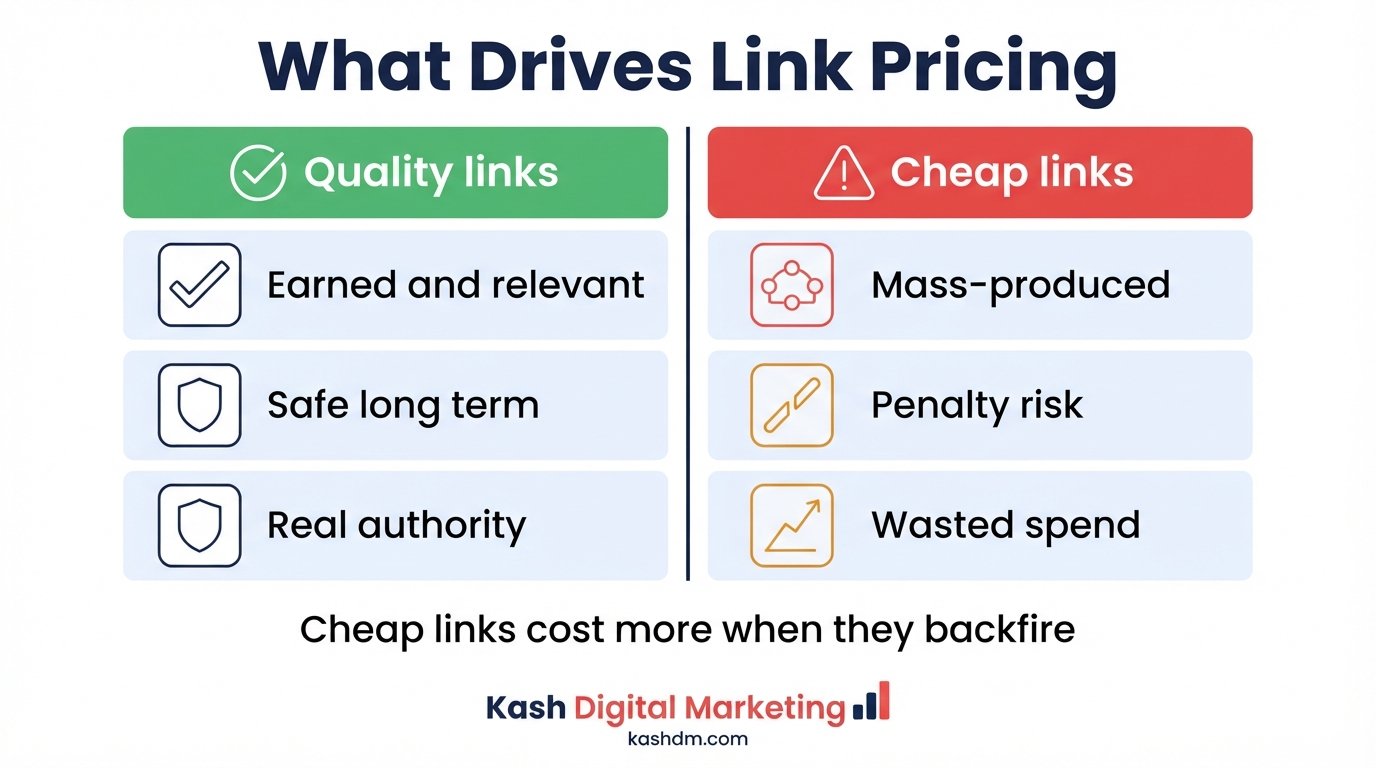
Link building pricing varies enormously across the industry because the range runs from genuinely earned, high-authority links to cheap, mass-produced spam links, and the price difference reflects real differences in quality and risk. A single high-authority, relevant link is often worth more than dozens of low-quality ones, and pricing should reflect that.
Why quality links cost more
Earning a link from a genuinely authoritative, relevant site takes real outreach, relationship-building, and often a link-worthy asset, a useful guide, original research, or a newsworthy story, to justify the link. That work takes time and expertise, which is reflected honestly in the price. Cheap, mass-produced links skip all of that and instead rely on paid placements, low-quality directories, or link schemes.
The hidden cost of cheap links
Cheap link packages that promise large quantities at a low price almost always violate Google's guidelines, and when Google detects them, and detection has become increasingly sophisticated, the resulting penalty can erase your rankings and take months or longer to recover from. The true cost of cheap links includes this real risk of penalty, not just the upfront price. Our link building services are white-hat only, precisely to avoid this trap.
How to evaluate a link building quote
A fair link-building quote should be able to explain, at least in general terms, the kind of outreach and asset creation behind the price, not just a number of links per month. If a quote guarantees a specific large quantity of links at a suspiciously low price, that's one of the clearest warning signs in all of SEO pricing.
How many links does a campaign actually need
There's no universal monthly link quota that applies to every business, the right pace depends entirely on how aggressively your competitors are building authority and how competitive your target keywords are. A market where nobody is actively link building may need very little to pull ahead, while a fiercely contested niche may require sustained, ongoing outreach just to keep pace. We calibrate link-building pace to your specific competitive landscape rather than defaulting to an arbitrary number that sounds impressive in a sales pitch.
Cheap SEO vs Quality SEO: Why the Cheapest Quote Is Rarely the Best Deal
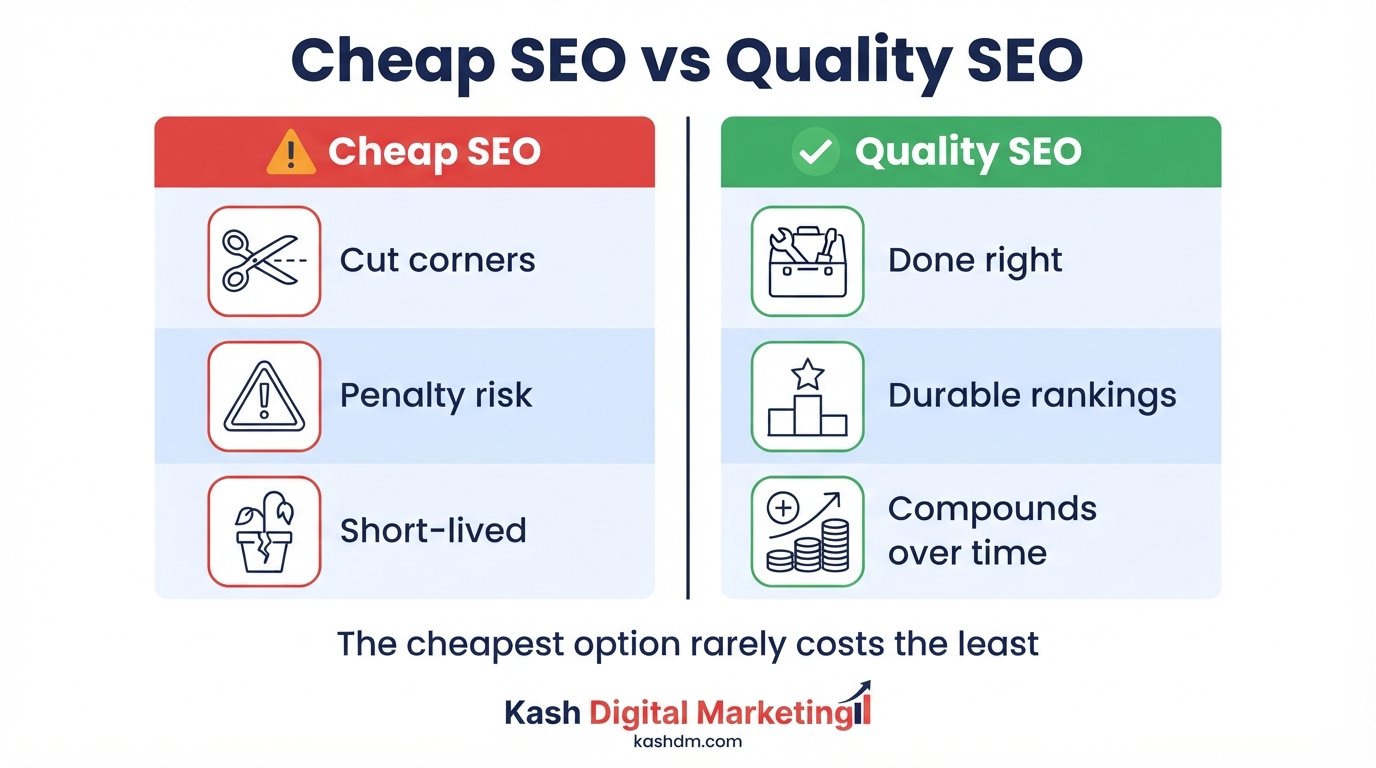
Cheap SEO usually means cut corners, thin content, spammy links, templated tactics, that produce short-term results at best and real damage at worst, while quality SEO costs more upfront but builds a durable, compounding asset. This is one of the most important distinctions to understand before choosing based on price alone.
How agencies deliver rock-bottom prices
Agencies that quote dramatically below market rates typically do so by cutting real corners: automated, unedited content; templated location pages; purchased or exchanged links; and minimal actual strategic attention to your specific business. The math only works if the labor behind the service is minimized, and that minimization shows up in results, or lack of them.
What cheap SEO actually costs you
The real cost of cheap SEO isn't just the wasted monthly fee, it's the opportunity cost of months spent with no meaningful progress, and in worse cases, the cost of recovering from a Google penalty caused by risky tactics, which can take far longer and cost far more than doing it right from the start. Many clients come to us after exactly this experience, and cleanup work is often harder than building correctly from scratch would have been.
How to spot a red-flag-cheap quote
- Ask what specific link-building methods are used, vague answers are a warning sign
- Ask whether content is written by a human familiar with your industry
- Ask for examples of real, verifiable client results
- Be wary of guarantees of specific rankings by a specific date
- Be wary of prices dramatically below the market ranges discussed earlier on this page
A useful mental model: SEO as an asset, not a bill
It helps to think of quality SEO spend less like a recurring bill and more like an investment building an asset you own, your rankings, your content library, your backlink profile, your reputation. Cheap SEO rarely builds anything durable; it produces short-lived, fragile gains that evaporate the moment effort stops, or that actively work against you once Google catches up with the tactics behind them. Quality SEO, even at a higher monthly figure, builds something that keeps paying you back long after any individual invoice is forgotten.
SEO ROI and Payback Period: Thinking About Cost as an Investment
The right way to evaluate SEO pricing isn't "is this expensive" but "what will this return," and businesses that think in terms of ROI and payback period make far better SEO decisions than those focused purely on the monthly fee. SEO, done well, is one of the highest-return marketing channels available to most businesses.
How to calculate a realistic SEO payback period
Payback period is roughly the point at which the revenue generated by new customers from SEO exceeds your cumulative investment. To estimate it, you need your average customer value, your likely close rate on SEO-driven leads, and a realistic view of when meaningful lead volume begins arriving, typically a few months in for easier terms and longer for competitive ones.
| ROI Input | Why It Matters |
|---|---|
| Average customer lifetime value | Determines how many new customers "pay for" a month of SEO |
| Expected lead-to-close rate | Converts traffic and calls into actual revenue |
| Time to first meaningful rankings | Sets realistic expectations for when payback begins |
| Compounding nature of organic traffic | Explains why later months typically cost less per lead than early months |
Why SEO's ROI improves over time
Unlike paid ads, where cost per lead stays roughly constant as long as you're paying, SEO's cost per lead tends to fall over time as rankings and authority compound. The content and links built in month one keep generating value in month twelve and beyond, so the same monthly investment produces a growing return the longer a campaign runs.
Is SEO worth it for your business
SEO is worth it for the vast majority of businesses whose customers search on Google before buying, which describes most local businesses, most ecommerce stores, and most B2B and SaaS companies. It's a poor fit only for businesses with essentially no search demand for what they sell, a genuinely rare situation. For everyone else, the real question isn't whether SEO is worth it, it's whether you're working with a provider capable of delivering it well.

A simple worked example of SEO payback
Consider a home-services business where a new customer is worth several hundred dollars on the first job and often more across repeat visits. If a modest monthly SEO investment produces even a handful of qualified calls a month once rankings mature, the campaign pays for itself well before it produces its full lead volume, and every additional lead beyond that point is close to pure upside. The exact numbers differ for every business, which is why we walk through this math with you directly using your real customer value rather than a generic example, but the underlying logic holds across almost every local and small business we work with.
Why judging SEO on month one alone is a mistake
Because SEO's cost per lead falls as a campaign matures, judging the investment purely on its first month's output misrepresents its real value. Early months carry a disproportionate share of foundational work, technical fixes, initial content, first citations and links, that doesn't yet show up as leads but sets up every month that follows. Businesses that pull the plug after one quiet month often walk away just before the compounding effect they paid for actually arrives.
In-House vs Agency vs Freelancer: Comparing the True Cost of Each
Building an in-house SEO team, hiring a freelancer, or partnering with an agency each carry different cost structures, and the cheapest-looking option on paper isn't always the most cost-effective once you account for the full picture. Comparing them honestly means looking beyond the headline number.
| Option | Typical Cost Pattern | Strengths | Real Tradeoffs |
|---|---|---|---|
| In-house team | Salaries, benefits, tools, training, ongoing | Deep product/business knowledge, full control | Slow to build, expensive to staff across all needed skills |
| Freelancer | Lower hourly/project rate | Flexible, lower entry cost | Limited bandwidth, single point of failure, narrower skill set |
| Agency | Monthly retainer or project fee | Full team of specialists, established process | Requires finding a trustworthy, transparent partner |
The real cost of building an in-house SEO team
Hiring in-house means recruiting, salaries and benefits, SEO tools and software subscriptions, ongoing training as the field evolves, and management overhead, well before a single ranking improves. For most small and mid-sized businesses, this fixed cost is far higher than an agency retainer covering the same scope of work, because an agency spreads its team and tools across many clients.
The real cost and risk of a freelancer
A skilled freelancer can be a genuinely good value, particularly for narrower needs, but SEO spans several distinct skills, technical, content, links, strategy, that a single freelancer rarely masters equally well. There's also a bandwidth and continuity risk: if your freelancer gets sick, gets busy with other clients, or moves on, your SEO stalls with no backup.
What you're actually paying for with an agency
An agency retainer funds access to a full team of specialists, technical, content, link building, strategy, plus established processes, tools, and reporting systems built over many client engagements. For most businesses without the scale to justify a full in-house department, an agency delivers more comprehensive expertise per dollar than either building in-house or relying on a single freelancer.
Hybrid models: when a mix makes sense
Some businesses sensibly combine models: an in-house marketing generalist who manages the relationship with an agency handling execution, or a freelancer for specific content while an agency handles technical and links. There's no single right answer, the right mix depends on your existing team's skills and your budget, and we're happy to discuss how our services fit alongside whatever internal capability you already have.
What to ask before choosing a model
Regardless of which model you're leaning toward, ask honestly whether you have the internal bandwidth to manage the work day to day, whether you need breadth across technical, content, and links or just one of those skills, and how quickly you genuinely need results. A business with an in-house content writer but no technical SEO knowledge might sensibly hire an agency for the technical and link-building pieces alone, rather than choosing one model exclusively for everything.

How to Budget for SEO: A Practical Framework
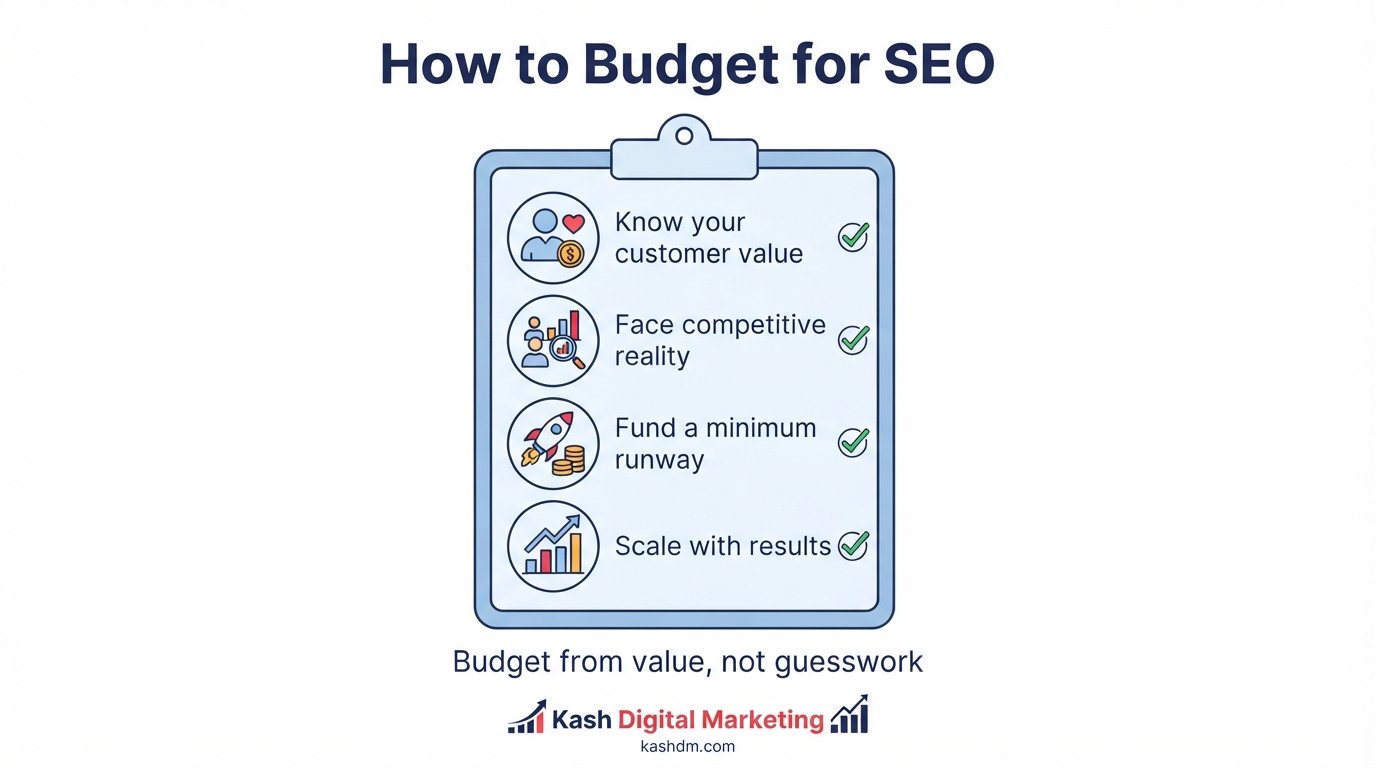
Budgeting for SEO works best when you set it as a percentage of realistic customer value and expected volume rather than picking an arbitrary number, then adjust based on what your specific competitive audit reveals. A structured approach prevents both underinvesting into irrelevance and overspending beyond what your business can sustain.
Start with what a new customer is worth to you
Before setting any SEO budget, know your average customer value and, ideally, lifetime value. This single number anchors every other budgeting decision, a business where a new customer is worth thousands of dollars can rationally invest more aggressively than one where margins per customer are thin.
Match your budget to your competitive reality
A budget that would dominate a lightly contested local market may barely register in a fiercely competitive national niche. Use the cost factors covered earlier on this page, competition, goals, site condition, industry, and scope, to sanity-check whether your intended budget is realistic for what you're trying to achieve.
Budget for a minimum commitment period
SEO needs a reasonable runway to show results, evaluating it after a single month rarely provides enough data to judge fairly. Budget with at least a few months of runway in mind so you can fairly evaluate whether the strategy is working before deciding whether to continue or adjust.
Build in room to scale what works
Rather than committing your entire budget upfront to a single large retainer, consider starting with a focused scope, evaluating results, and scaling investment into the channels and keywords proving their return. This staged approach reduces risk while still giving the campaign enough resources to genuinely move rankings.
- Know your average customer value before setting a budget
- Benchmark your competition honestly, not optimistically
- Commit to a minimum runway of a few months
- Plan to scale budget as leads and revenue prove out
- Get a free audit before finalizing any number
Common budgeting mistakes to avoid
The two most common budgeting mistakes sit at opposite extremes: setting a budget so low it can't produce meaningful movement in a competitive market, and setting a budget so high, too early, that it outpaces your ability to evaluate whether the strategy is even the right one. Both waste money in different ways. A well-set budget matches the scale of the opportunity while still leaving room to learn and adjust before committing further.
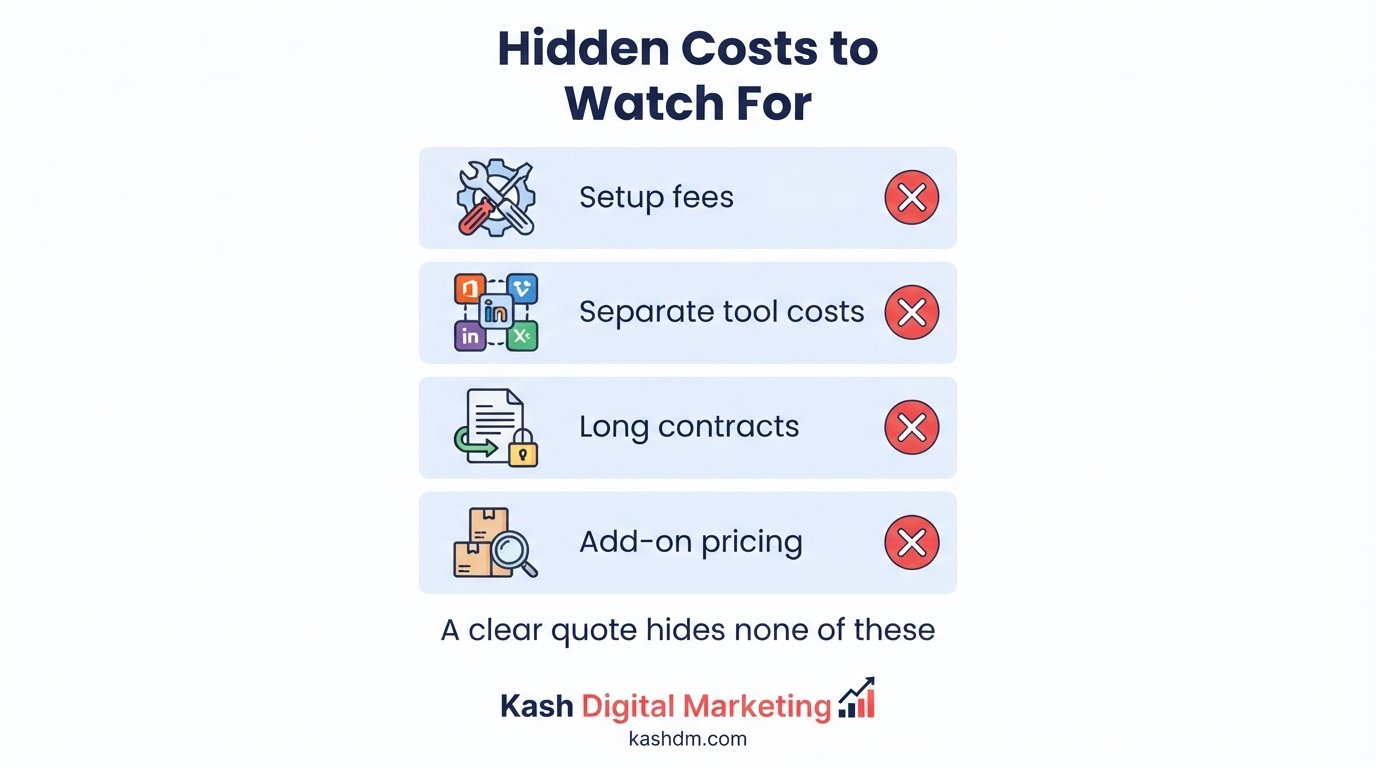
Hidden Costs to Avoid When Evaluating SEO Pricing
The advertised monthly fee isn't always the full cost of an SEO engagement, and knowing where hidden costs tend to hide protects you from an unpleasant surprise later. A little scrutiny upfront saves real money and frustration down the line.
Setup fees and onboarding charges
Some providers add a substantial setup or onboarding fee on top of the ongoing retainer, sometimes disclosed clearly, sometimes buried in fine print. Ask directly whether any onboarding or setup cost exists before signing anything.
Tool and software costs billed separately
Certain providers bill SEO tools and software subscriptions separately from the retainer, effectively increasing your real monthly cost beyond the headline number. Clarify upfront whether the quoted price is fully inclusive or whether tools, reporting software, or ad spend for testing are extra.
Long contracts and early termination penalties
A long mandatory contract term, or steep penalties for leaving early, effectively raises your risk even if the monthly fee looks reasonable, because you're locked in regardless of whether results materialize. We deliberately avoid long contracts for exactly this reason, preferring to earn renewal through results every month.
Content and link "add-on" pricing that inflates the real cost
Some low headline retainers turn out to exclude content or link building entirely, sold instead as pricey add-ons once you're already engaged. Always clarify exactly what's included in the quoted price versus what will be billed separately as the engagement proceeds.
The cost of cleanup after a bad provider
The largest hidden cost in SEO is often not from the provider you're evaluating, but from a previous one: recovering from thin content, spammy links, or a penalized profile frequently costs more, in both money and lost time, than the original engagement did. Factor this real risk into how you weigh price against provider quality from the start.
Why we itemize scope clearly upfront
We list exactly what's included in a proposed engagement before you sign anything, so there's no ambiguity about what's covered by the quoted figure and what would be a separate conversation. If your needs change later, an additional location, a larger content push, we discuss and agree on any change before it's billed, never after.
Is SEO Worth It? Weighing Cost Against Long-Term Value
SEO is worth it for the overwhelming majority of businesses because it captures customers at the exact moment they're searching for what you sell, and unlike paid advertising, the results keep compounding rather than stopping the moment you stop paying. Weighing SEO's cost honestly means comparing it to the alternative channels you'd otherwise spend that budget on.
Comparing SEO's cost to paid advertising over time
Paid advertising delivers traffic only as long as you keep paying, and cost per click tends to rise as competition for ad space increases. SEO requires sustained investment too, but the content, authority, and rankings built along the way continue generating traffic and leads well beyond the months you actively paid for that specific work, an asset-building dynamic paid ads simply don't offer.
When SEO is genuinely not the right fit
SEO isn't the right first investment for every business at every stage. A brand-new business with zero online presence and an urgent, immediate need for customers might reasonably start with paid ads for quick volume while SEO builds in parallel. Businesses selling something with essentially no organic search demand are also a poor fit. For nearly everyone else with real search demand, though, SEO belongs in the marketing mix.
The compounding case for starting now
Every month without SEO investment is a month competitors who are already investing pull further ahead, since their rankings and authority keep compounding while yours stand still. The earlier you start, the sooner you begin building the same kind of durable advantage, and the gap only gets more expensive to close the longer it's left open.
Running SEO and paid ads together
Many businesses see the best results not by choosing one channel over the other, but by running SEO and paid ads together, using ads to fill the gap while SEO builds, then gradually shifting budget toward organic as rankings mature and cost per lead falls. This blended approach captures the immediate volume paid ads provide while the longer-term, compounding asset of organic search grows in parallel, so you're never solely dependent on either channel alone.

SEO Pricing for Different Business Sizes at a Glance
Bringing the earlier sections together, business size and complexity are the clearest starting point for setting expectations about SEO investment, before your specific competitive audit refines the number further. This section summarizes how the earlier local, small business, ecommerce, and enterprise breakdowns fit together.
Solo and small local businesses
Solo operators and small local businesses typically see the most accessible entry point into SEO, particularly when focused on a defined local service area with moderate competition, following the local SEO pricing and small business guidance covered earlier.
Growing small-to-mid-sized businesses
Businesses that have outgrown a bare-bones setup and are ready to compete more seriously, whether local or broader in reach, typically need a moderately scaled investment covering more content, more links, and possibly multiple locations or service lines.
Ecommerce and multi-location businesses
Ecommerce stores and multi-location businesses generally require larger investment due to page volume, technical complexity, or the multiplication of local campaigns across markets, as detailed in the ecommerce and local sections above.
Enterprise and highly competitive national brands
Enterprise organizations and brands competing nationally against well-funded competitors sit at the top of the market, reflecting genuinely larger scope, technical complexity, and stakeholder coordination.
Where most businesses actually land
In practice, the majority of businesses we work with fall somewhere between the solo local operator and the large ecommerce or enterprise brand, growing local and regional businesses with one to a handful of locations, a defined service area, and a genuine ambition to outrank specific, identifiable local or regional competitors. This middle segment is where the free-audit-then-custom-quote model proves most valuable, because generic ranges are least reliable exactly where most real businesses actually sit.

How SEO Pricing Compares Across Service Types
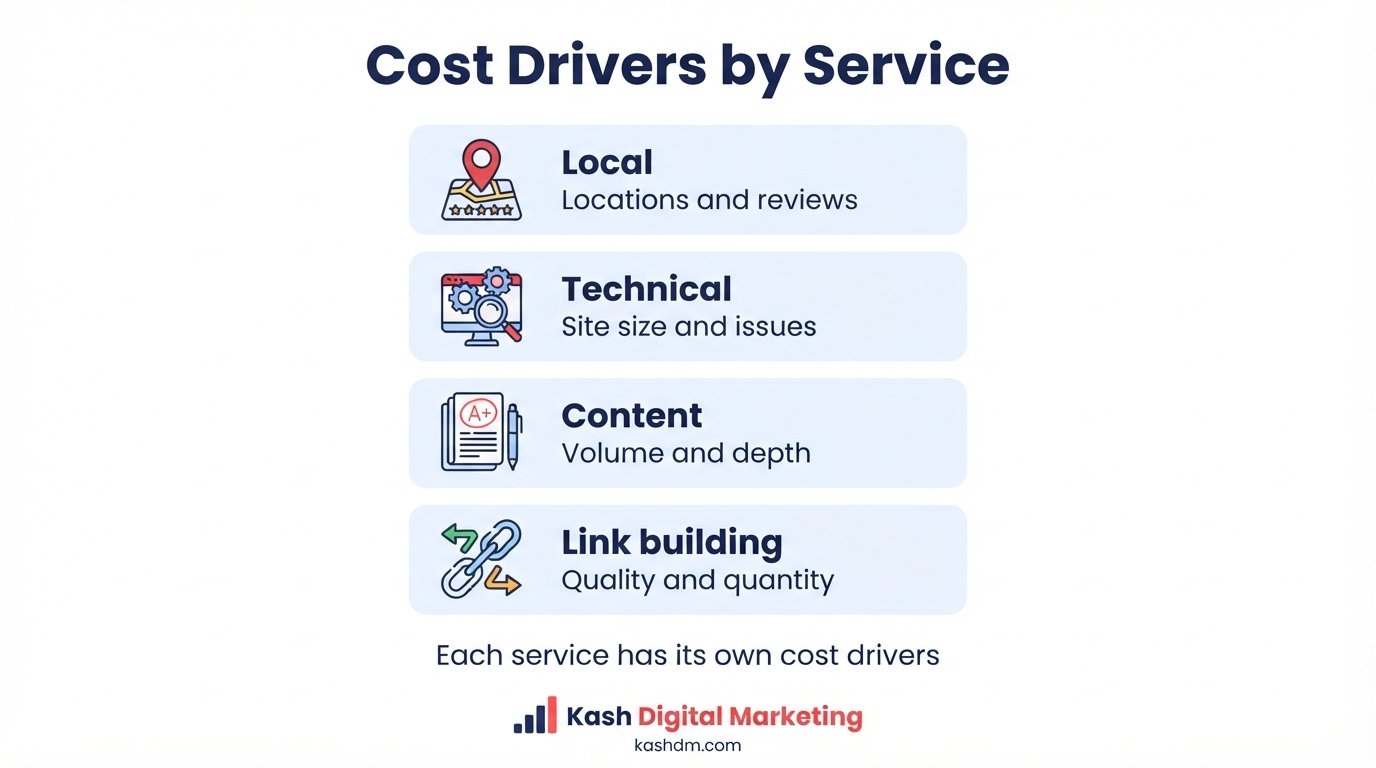
Different SEO services carry different cost profiles because they require different mixes of labor, tools, and time, and understanding this helps you allocate a total budget sensibly across the services that matter most for your goals. Not every business needs equal investment across every service type.
| Service Type | Typical Cost Driver | When It Deserves a Larger Share of Budget |
|---|---|---|
| Local SEO | Number of locations, local competition | Business depends on nearby, in-person customers |
| Technical SEO | Site size, existing technical debt | Site has significant crawl, speed, or structural issues |
| Content writing | Volume and competitiveness of target keywords | Thin or outdated existing content, informational search demand |
| Link building | Competitiveness of target keywords, outreach effort | Competitors have significantly stronger backlink profiles |
Weighting your budget toward your biggest gap
A site with strong content but weak technical health should weight investment toward technical fixes first; a technically sound site with thin content should weight toward content. A proper audit identifies which of these gaps is holding your specific site back the most, so your budget goes toward closing the biggest gap first rather than spreading evenly regardless of where the real problem lies.
Why balance still matters over time
Even when one area needs more attention initially, a mature SEO program eventually needs reasonable investment across all core areas, technical, content, links, and, for local businesses, profile and reputation work, because neglecting any one of them eventually caps what the others can achieve.
Reassessing budget allocation over time
The right allocation isn't fixed forever. As technical issues get resolved and content gaps get filled, the biggest remaining opportunity often shifts toward links or toward expanding into new keyword territory. We revisit this allocation regularly as part of ongoing reporting, so your budget keeps flowing toward whatever will move the needle most at each stage of the campaign, rather than staying locked into the original split indefinitely.
Combining SEO with Social Media: Pricing the Full Digital Marketing Mix
When SEO is combined with social media marketing, pricing typically reflects genuine efficiencies, shared content, shared brand-building, and coordinated strategy, rather than simply adding two separate budgets together. Businesses evaluating full digital marketing costs should factor this coordination value into their comparison.
Why combined pricing can be more efficient than separate vendors
When one team handles both SEO and social media marketing, content created for one channel can be repurposed for the other, brand awareness built on social reinforces branded search that strengthens SEO, and strategy stays coordinated instead of siloed across separate vendors working from separate playbooks.
How to think about your total digital marketing budget
Rather than pricing SEO and social media in isolation, consider your total digital marketing budget and how it should split based on where your customers actually are and how they search versus how they discover brands socially. We help clients think through this full-mix question rather than just quoting the SEO piece in a vacuum.

Warning Signs of Overpriced or Underpriced SEO Quotes
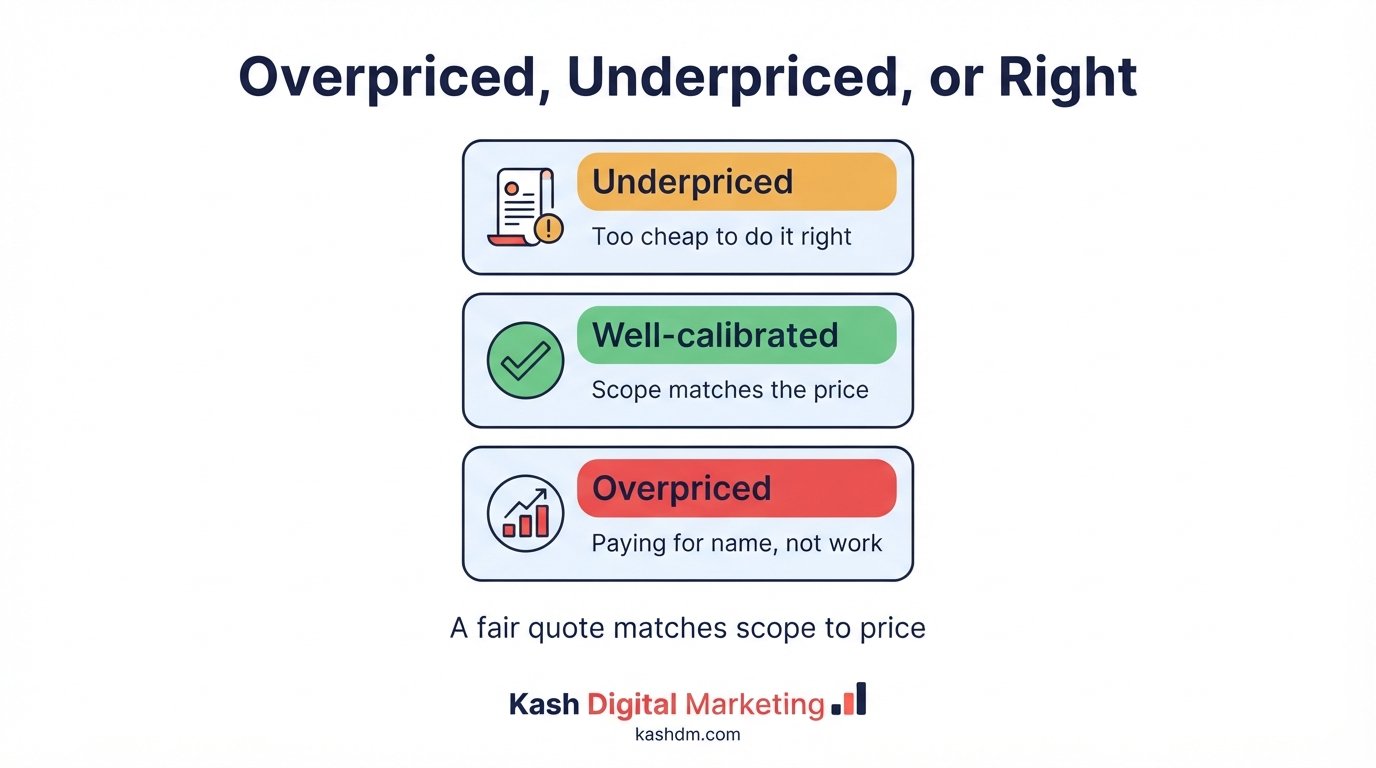
Both overpriced and underpriced SEO quotes carry real risks, overpriced quotes waste budget on padded or unnecessary work, while underpriced quotes typically signal corners being cut that will cost you later. Recognizing the warning signs of each protects your investment.
Signs a quote may be overpriced
- The price seems disconnected from your actual competitive situation
- The agency can't explain what specifically justifies the price beyond "that's our rate"
- You're quoted the same price regardless of your industry or goals
- Heavy pressure to sign quickly without a real audit first
Signs a quote may be dangerously underpriced
- The price is dramatically below the market ranges discussed earlier on this page
- Vague or evasive answers about actual link-building or content methods
- Guarantees of specific rankings by a specific date
- No real audit or competitive analysis behind the number
What a well-calibrated quote looks like
A well-calibrated quote sits within a defensible range for your specific competition and goals, comes after a genuine audit rather than a generic sales call, and can be explained in plain language, what work it funds and why that work suits your situation. That's the standard we hold every quote we send to, and it's a fair standard to hold any provider you're evaluating to as well.
Trust your instincts, then verify with data
If a quote feels either suspiciously cheap or unexplainably expensive, that instinct is worth listening to, but don't stop there. Ask the specific questions raised throughout this page, request references or verifiable examples, and compare the number against the market ranges and cost factors covered earlier. A provider confident in their pricing will welcome the scrutiny; one that deflects or grows defensive under reasonable questions is telling you something important about how the rest of the relationship would go.
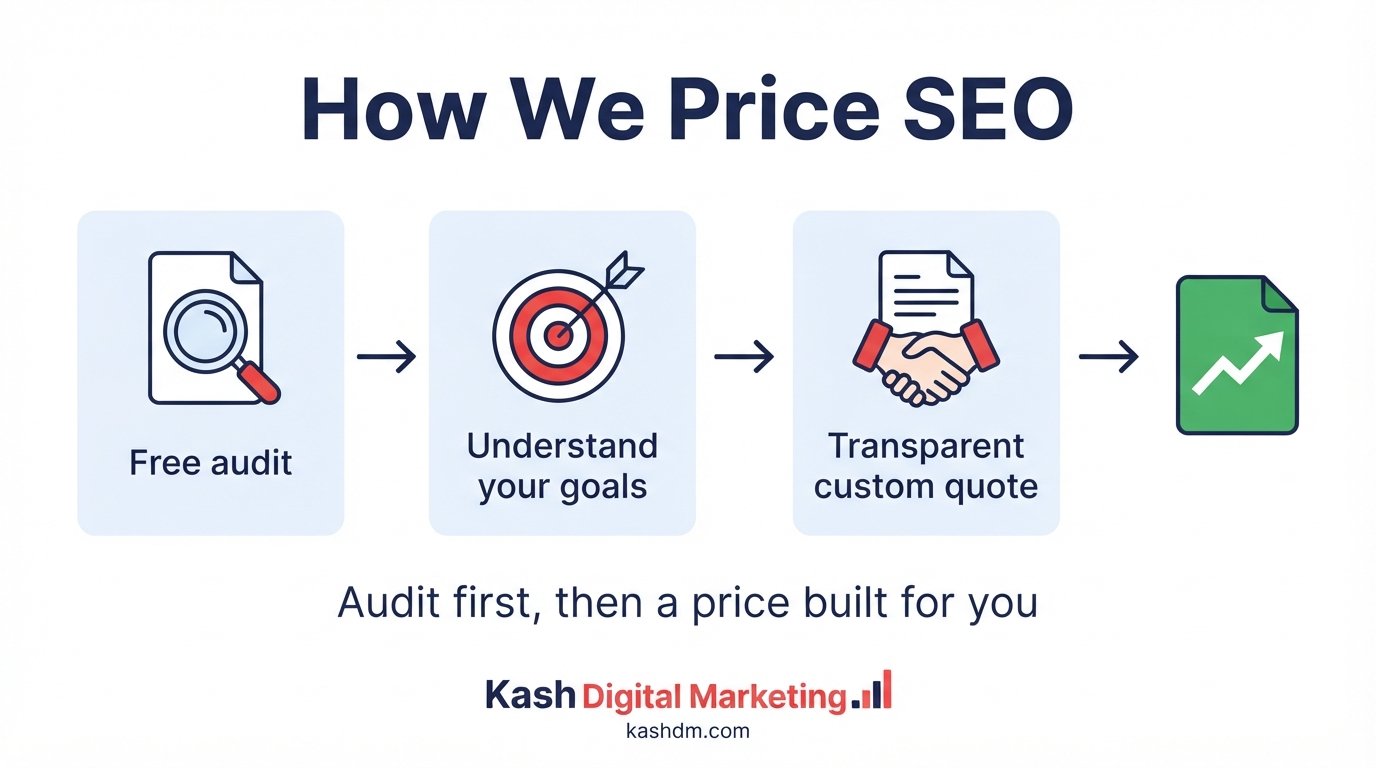
How Kash Digital Marketing Prices SEO: Free Audit, Then a Custom Quote
We publish our starting range openly, then price every engagement individually after a free audit of your website, competitors, and market. Most local SEO engagements with us start between $400 and $500 a month. What we don't publish is a full package price list, because the number that fits a single-location cleaning company and the number that fits a contractor competing across three metros are not the same, and pretending otherwise would mean overcharging one of them.
Why we lead with a free audit
The free audit gives us, and you, real data: where you currently stand, how strong your competitors are, what's holding your site back, and what it would genuinely take to win the keywords that matter to your business. That data is what turns a guess into a defensible, custom quote.
What happens after the audit
Once the audit is complete, we walk you through the findings in plain English, no unexplained jargon, and present a custom quote scoped to what your specific situation requires. You'll understand exactly what you're paying for and why, and there's no obligation to move forward, the findings are yours either way.
No long contracts, transparent scope
Every quote comes with transparent scope and no long-term lock-in, because we'd rather earn your continued business with results each month than trap you in a contract. This philosophy runs through everything we do, from local SEO to small business SEO to our approach to best SEO services more broadly.
What Our SEO Engagements Actually Cost
Most of our local SEO engagements start between $400 and $500 a month. That is a real starting range, not a teaser, and it is the number we work from when we scope a local business.
We are telling you this on the page because you should not have to sit through a discovery call to find out whether an agency is in your budget. If $400 to $500 a month is not where you are right now, you have saved yourself a phone call, and we would rather you knew that in ten seconds than in ten days.
What sits inside that starting range
At the entry point, an engagement is focused rather than broad. That usually means your Google Business Profile, your local citations and NAP consistency, on-page optimisation of the pages you already have, a review process you can actually run, and monthly reporting you can read without a translator. It is the work that moves a local business in the map pack, concentrated on one service area.
What it does not include at that level is a large monthly content programme or an aggressive link acquisition campaign. Those are real costs, and quoting them inside an entry-level figure would mean doing them badly.
What moves the number up
| Factor | Keeps cost near the starting range | Pushes cost higher |
|---|---|---|
| Service area | One city or one tight radius | Several cities, or a whole metro |
| Competition | Few established competitors ranking | Entrenched competitors with strong link profiles |
| Site condition | Modern, reasonably fast, well structured | Old site needing technical remediation or a rebuild |
| Content | You write, we brief and optimise | We produce everything |
| Scope | Local SEO and Business Profile | Local, technical, content and link acquisition together |
| Locations | Single location | Multi-location or franchise |
What we will not do on price
We will not quote before looking at your site. We will not lock you into a long contract. And we will not quote a number so low that the only way to deliver it is automated links and unreviewed AI content, because that is not a cheaper version of SEO, it is a different and worse thing wearing the same name.
If you have a quote from someone else that seems too cheap to be real, send it to us with the scope attached. We will tell you plainly what that money can and cannot buy, whether or not you end up working with us.
What to Expect During Your Free Custom Quote Process
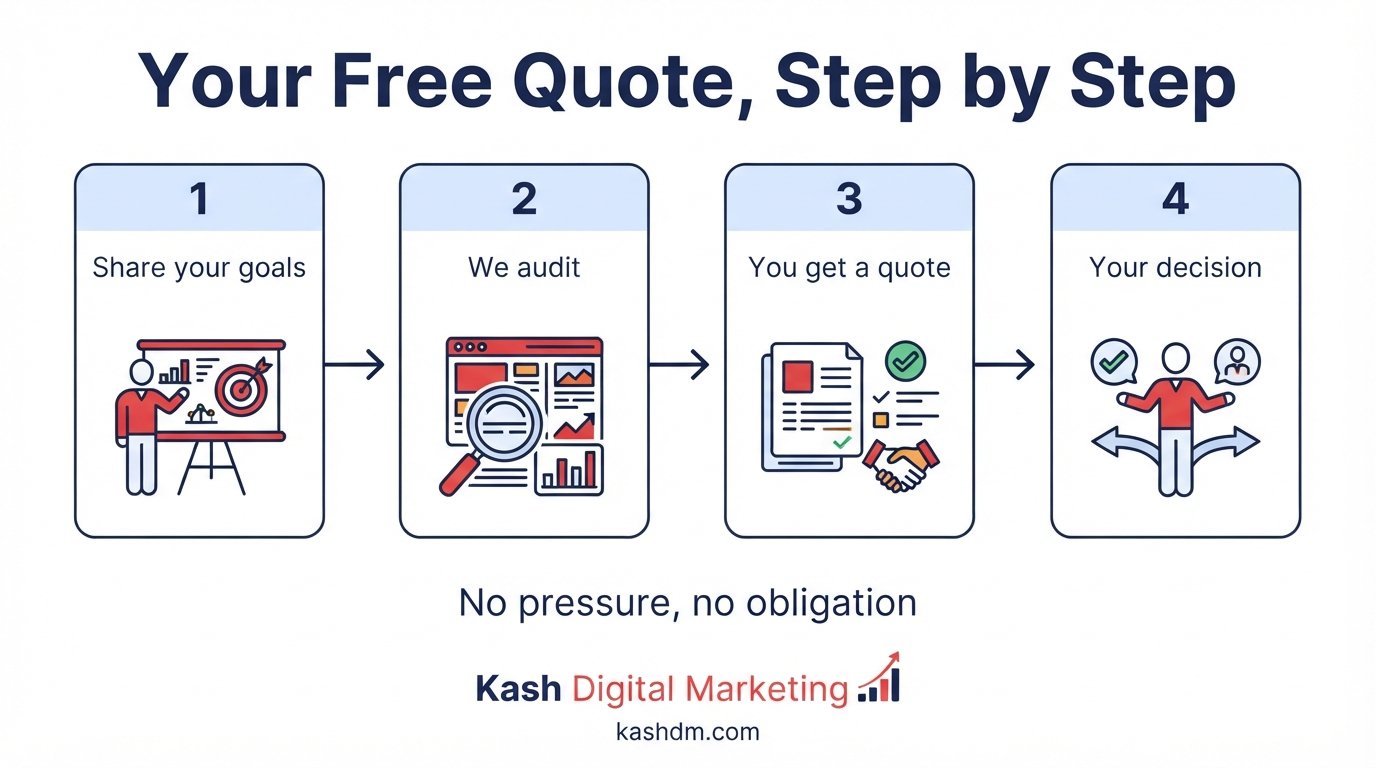
Requesting a custom quote is a straightforward, no-pressure process designed to give you real answers quickly, typically starting with a short conversation about your goals followed by the audit itself. Knowing what to expect makes the process feel far less like a sales pitch and more like the useful diagnostic it actually is.
Step one: tell us about your business and goals
We start by understanding your business, your target customers, your current marketing, and what success would look like for you, whether that's more phone calls, more online sales, or broader brand visibility.
Step two: the free audit
We audit your website, technical health, existing content, backlink profile, and current rankings, alongside a competitive analysis of who's currently winning the searches that matter most to you.
Step three: your custom quote and action plan
You receive a clear breakdown of what we found, a prioritized action plan, and a custom quote scoped to your specific situation, presented in plain English with room for questions. There's no pressure and no obligation, you keep the findings regardless of your decision.
Step four: your decision, on your timeline
We'd love to work with you, but the decision is entirely yours and there's no pushy follow-up campaign. If you have questions later, reach out any time, we're happy to talk through the quote whenever you're ready.
SEO Services Pricing by Type: Plans, Packages, and What It Costs
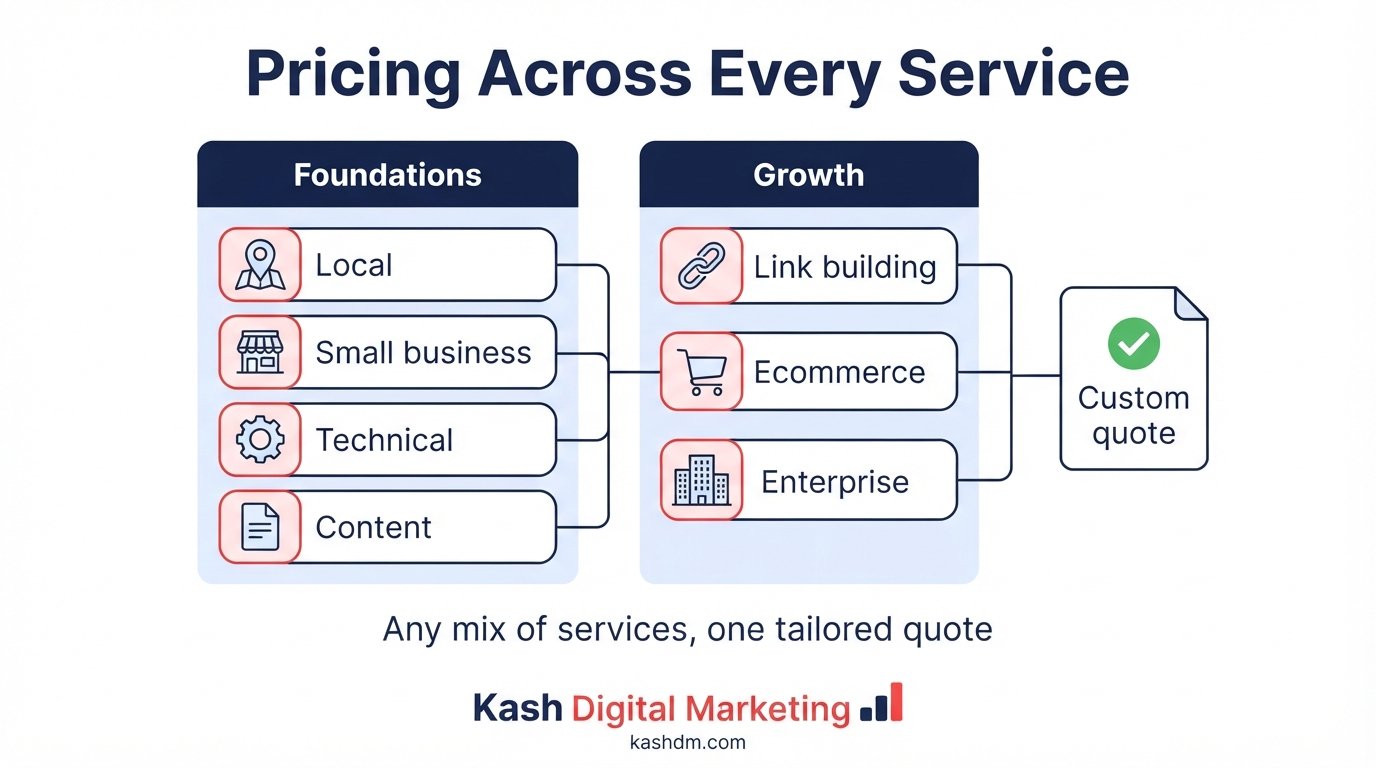
SEO services pricing depends on the service and the scope, so instead of a rigid price list we scope pricing plans and packages to what your business actually needs, then give you a custom quote after a free audit. Whether you searched for seo services pricing plans, local seo services pricing, or simply how much SEO services cost, here is how pricing works across every service and how to compare it.
SEO services pricing plans, packages, and price lists
We build seo services pricing plans and packages around your goals rather than forcing you into a fixed price list, because a rigid seo company pricing table almost always overcharges some businesses and underserves others. Most pricing for seo services works as a monthly retainer, with project-based and hourly options where they fit. After a free audit you get a clear, right-sized package and a transparent price, with no long-term contract.
Pricing for local, small business, and Google SEO services
Local seo services pricing and small business seo services pricing are typically the most affordable, because the work is focused on a defined service area. Businesses often search for google seo services pricing, which really means the cost of ranking well on Google, and for pricing for ongoing local seo services that maintains those rankings. We scope local seo services pricing and packages, including options for small businesses, so the investment matches the size of your market and the results you need. See our small business SEO and local SEO pages for what is included.
Pricing for technical, content, link building, ecommerce, and B2B SEO
Different services carry different seo services pricing because they involve different work. Technical seo services pricing reflects the depth of your site's issues; seo content writing services pricing scales with volume; seo link building services pricing depends on the quality and quantity of links; and ecommerce seo services pricing and enterprise-level seo services pricing reflect catalog size and scale. We also scope b2b seo services pricing and ai seo services pricing for teams that need those specialties. Each is quoted transparently so you only pay for the services you actually need, drawing on our technical SEO, content, and link building work.
What factors influence SEO services pricing, and how to compare it
The main factors that influence seo services pricing are your competition, your market, your current site health, and how fast you want results. That is what seo services pricing really is: a reflection of the work required to hit your goals, not an arbitrary number. Rather than a one-size seo services pricing calculator, we use a free audit to give you an accurate figure. When you compare pricing for seo services or run a seo services pricing comparison, look past the headline number to what is included, since the cheapest quote often leaves out the work that actually drives results, and we explain how to judge that in our guide to choosing an SEO agency.
How much does SEO cost? Rates, monthly, and hourly pricing
The most common question is simply how much SEO services cost, and honestly it depends, which is why we quote per business rather than publish a misleading flat rate. As general context, seo service rates in the US commonly run as a monthly retainer, with some providers offering hourly pricing for specific projects. If you are wondering how much you should pay for SEO services, or how much SEO services cost per month, the right answer is the price at which the customers it generates clearly outweigh the seo services cost. We scope affordable, managed seo services pricing plans with no long contracts, so your seo services cost per month always ties to real value.
Affordable, managed, and USA SEO pricing, plus AEO vs SEO
We offer affordable seo services pricing for small businesses and fully managed seo services pricing plans for teams that want everything handled, with premium options for competitive markets. We provide seo services pricing for businesses across the USA, so a company comparing seo services pricing in any state gets a transparent, custom quote. One newer question we hear is about AEO vs SEO services pricing, as answer engine optimization for AI search grows; we build that into modern SEO rather than billing it as a costly add-on, and our pricing reflects how search works in 2026. Explore coverage on our locations page.
Frequently Asked Questions About SEO Pricing
How much does SEO cost per month?
It depends entirely on your competition, goals, market, and current site condition, industry ranges typically run from a few hundred dollars a month for a lightly competitive local business up to five figures monthly for enterprise-scale, nationally competitive sites. We provide a specific number only after a free audit of your actual situation.
Does Kash Digital Marketing have fixed SEO packages?
No. We deliberately avoid fixed package pricing because it doesn't reflect the real variation in what different businesses need. Every quote follows a free audit and is scoped to your specific competition, goals, and website condition.
Is a cheap SEO provider ever a good idea?
Rarely. Prices dramatically below market ranges usually mean cut corners, thin content, spammy links, or minimal real strategic work, and the cleanup cost after a bad cheap provider frequently exceeds what quality SEO would have cost from the start.
How long do I need to commit to see SEO results?
Most campaigns show early movement on easier, longtail keywords within a few months, with more competitive terms taking longer. We recommend budgeting for at least a few months of runway before judging results, since SEO is a compounding process rather than an instant switch.
Do you require long-term contracts?
No. We don't lock clients into long contracts, because we believe in earning continued business through results each month rather than through contractual obligation.
What's included in a custom SEO quote from Kash Digital Marketing?
Your quote is built from your free audit and typically covers strategy, on-page optimization, technical SEO, content, link building, and, for local businesses, Google Business Profile and reputation work, scoped to exactly what your competitive situation requires.
Is SEO more affordable than paid advertising?
Over time, yes, for most businesses. Paid ads deliver traffic only while you're paying and typically at a rising cost per click; SEO requires sustained investment too, but the content and authority built along the way continue generating traffic and leads well after that specific work was done.
How do I know if an SEO quote I received elsewhere is fair?
Compare it against the market ranges and cost factors covered throughout this page, competition, goals, site condition, industry, and scope, and ask the provider to explain specifically what work justifies the price for your situation. A fair quote should be explainable in plain language, not just asserted.
Can I start with a smaller SEO budget and scale up later?
Yes, and for many small businesses this is the smarter approach, starting with a focused scope targeting quick-win opportunities, then reinvesting as leads and revenue prove the return.
How do I get a custom SEO quote from Kash Digital Marketing?
Request a free audit, reach out on WhatsApp, or email us directly. We'll review your website and market, then walk you through a clear, custom quote with no obligation.
Do you offer fixed price SEO?
Yes, in the sense that matters: once we have seen your site and your market, we scope the engagement to a fixed monthly figure so you know what you are paying and what is included. Most local engagements start between $400 and $500 a month. What we cannot do is quote a single fixed price for every business before knowing anything about it, because that number would be wrong for most of the people reading it.
Why is some SEO so much cheaper than this?
Below a certain point the money simply does not cover a person doing real work, so it buys automation instead: bulk directory submissions, low-quality links, spun or unreviewed AI content, and reports that show activity rather than results. It is not that cheap SEO is lazy, it is that the arithmetic does not allow for anything else. The risk is not only that it fails to work, because link-based tactics at that price point can actively damage a site.
Do you require a long contract?
No. Long lock-in contracts mostly exist to protect the agency from being judged on its results. SEO does take months to compound, and we will tell you that before you start rather than after, but the way to earn the next month should be the work done in the last one.
Get Your Custom SEO Quote
Request Your Free SEO Audit
Prefer to talk it through? WhatsApp US +2135622433 or WhatsApp PK +92 348 3879366. We usually reply within an hour, and always within 8 hours.
Your accurate SEO price starts with a free audit of your specific business, not a generic price list, and getting yours takes just a few minutes to request. We'll review your website, your competitors, and your market, then walk you through exactly what it would take to win, in plain English, with a transparent custom quote and no pressure to commit.
Ready to see what SEO would actually cost for your business? Request your free audit and custom quote, and we'll usually reply within an hour, and always within 8 hours on business days.
- 💬WhatsApp: +2135622433
- ✉️Email: contact@kashdm.com
- 📝Free audit form: start here

Pricing shouldn't be the mystery it so often is in this industry. You deserve a number grounded in your actual competition, your actual goals, and your actual website, not a guess pulled from a generic price list. The free audit is the fastest, lowest-risk way to get that real number, and there's no obligation attached to finding out.
Kash Digital Marketing, transparent SEO pricing built on a free audit and a custom quote for US local businesses. No fixed price lists. No long contracts. Just honest numbers and real results.