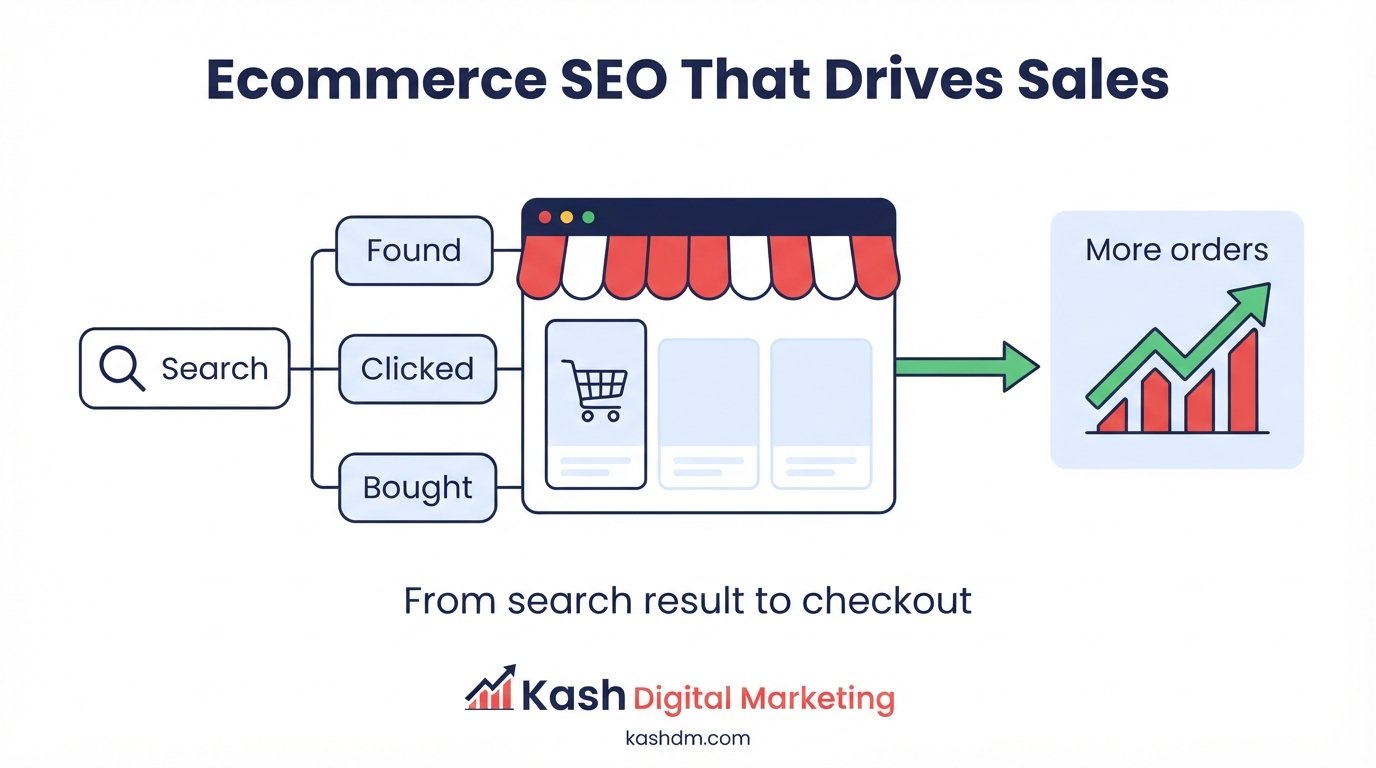
Ecommerce SEO services are specialized search engine optimization services that help online stores rank product, category, and collection pages higher on Google so more shoppers find, click, and buy. At Kash Digital Marketing, our ecommerce SEO services combine deep technical audits, product-level keyword research, scalable content systems, structured data, and link building into one program built specifically for the way online stores actually work, thousands of pages, constant inventory changes, and a shopping cart that needs to convert, not just rank.
Ecommerce SEO is not the same discipline as local SEO or a simple blog content strategy. A store with 5,000 SKUs across 40 categories faces problems that a five-page brochure site never encounters: faceted navigation that can spawn millions of duplicate URLs, out-of-stock products that vanish and reappear, seasonal collections that need to be built and retired without losing rankings, and a checkout funnel where every second of load time costs revenue. This page explains everything our ecommerce SEO services include, how they work platform by platform, and how to get started with a free ecommerce SEO audit.
Whether you run a Shopify store selling direct-to-consumer products, a WooCommerce shop bolted onto WordPress, a Magento or BigCommerce catalog with tens of thousands of SKUs, or a brand trying to win visibility on Amazon alongside your own website, this guide walks through exactly how ecommerce SEO grows revenue. We've written it to be genuinely useful on its own, not just a sales pitch, so by the end you'll understand what a serious ecommerce SEO program actually involves and be able to judge any provider, including us, against a clear standard. If you'd rather skip straight to seeing where your store stands today, the free audit is the fastest way to find out.
⭐ 5.0 rating · ✅ Google & Meta certified · ⚡ Reply usually within an hour · 🛡️ 100% white-hat · 🇺🇸 Serving US ecommerce brands
What Are Ecommerce SEO Services and Why Online Stores Need Them
Ecommerce SEO services are the ongoing process of optimizing an online store's architecture, product content, and technical foundation so it ranks for the searches shoppers use before they buy. Unlike a typical content site, an ecommerce store has to rank thousands of near-identical product pages, manage constantly changing inventory, and compete against marketplaces like Amazon for the exact same keywords, all while keeping pages fast enough to convert.
Ecommerce SEO works by strengthening three layers at once: a crawlable, logical site architecture that helps Google discover and understand every product; unique, keyword-targeted content on every category and product page; and the technical performance and structured data that let Google display your listings as rich, clickable results. Our ecommerce SEO services build and maintain all three layers, because a store that nails only one of them still leaves revenue on the table.
Think of an online store as a warehouse with thousands of aisles. A shopper searching Google is standing at the door asking for a specific item. If your aisles aren't labeled clearly, if the same item sits in three different spots with three different descriptions, or if the doors are slow to open, that shopper walks to the next warehouse over. Ecommerce SEO organizes the aisles, labels every shelf precisely, and keeps the doors opening instantly, so the shopper finds exactly what they searched for and buys it from you instead of a competitor.
How ecommerce SEO differs from other types of SEO
A local business optimizes a handful of pages for geographic intent. A content site optimizes articles for informational intent. An ecommerce store has to do both, plus manage transactional intent at massive scale across product, category, and collection pages that all compete for similar terms. Our technical SEO foundation and content systems both get adapted specifically for this scale when we run an ecommerce campaign.
Ecommerce SEO and paid traffic working together
Many stores rely heavily on paid ads and treat organic as an afterthought, then watch margins shrink every time ad costs rise. Ecommerce SEO builds a channel that keeps selling without a per-click fee attached, which is exactly what protects your margin during high-competition seasons like Black Friday. Stores that build a strong organic foundation consistently spend less to acquire each customer over time, because the traffic that used to require a bid now arrives for free.
Why ecommerce SEO is a continuous discipline, not a project
Catalogs change constantly: new products launch, old ones go out of stock, prices shift, and categories get reorganized. A site optimized once and left alone accumulates broken links, orphaned pages, and duplicate content within months. Our ecommerce SEO services treat your catalog as a living system that needs ongoing tending, the same principle that keeps our local SEO clients ranking month after month rather than briefly visiting the top and sliding back down.

Why Ecommerce SEO Matters for Online Store Revenue
Ecommerce SEO matters because organic search is the highest-intent, lowest-cost traffic channel available to an online store, and most competitors are leaving it half-optimized. Shoppers who search "buy waterproof hiking boots men" or "best noise cancelling headphones under 200" are close to purchase, and the store that answers that search precisely wins the sale before an ad ever gets a chance.
The economics compound in your favor over time. A ranked product page keeps generating sales at zero incremental cost per click, while a paid campaign stops the instant you stop paying. Stores that invest steadily in ecommerce SEO build a growing base of organic revenue that lowers blended customer acquisition cost every quarter, freeing up ad budget to chase new customer segments instead of defending existing rankings.
Organic traffic converts differently than paid traffic
Shoppers who click an organic result because it precisely matches their search tend to convert at strong rates, because they self-selected into your page by searching the exact term you rank for. This is different from broad paid campaigns that cast a wider net. Ranking well for specific, high-intent product searches puts your store in front of shoppers who already know what they want.
Category and collection pages capture volume paid ads miss
Broad category searches like "men's running shoes" or "organic skincare" carry enormous volume that's expensive to bid on but achievable to rank for organically with the right ecommerce site architecture. A well-optimized collection page captures a slice of that volume every single day without a bid.
SEO builds a defensible moat against Amazon and marketplaces
Amazon and other marketplaces dominate generic product searches, but they can't out-rank a brand's own site for branded terms, detailed buying guides, or long-tail comparison searches. Ecommerce SEO lets independent stores carve out and defend territory that a marketplace listing simply can't compete with, building direct customer relationships instead of renting them from a platform.
Mobile shopping makes fast, well-optimized pages non-negotiable
The majority of ecommerce searches and a growing share of purchases now happen on mobile devices. A slow product page loses shoppers before they even see the "add to cart" button. Our mobile ecommerce SEO work makes sure your store is fast and usable on the device most of your shoppers actually use.
Ecommerce Keyword Research That Maps to Buyer Intent
Ecommerce keyword research identifies the exact terms shoppers type at every stage of the buying journey and maps each one to the right product, category, or content page. This is the foundation everything else builds on, because a beautifully optimized page targeting the wrong keyword never gets found.
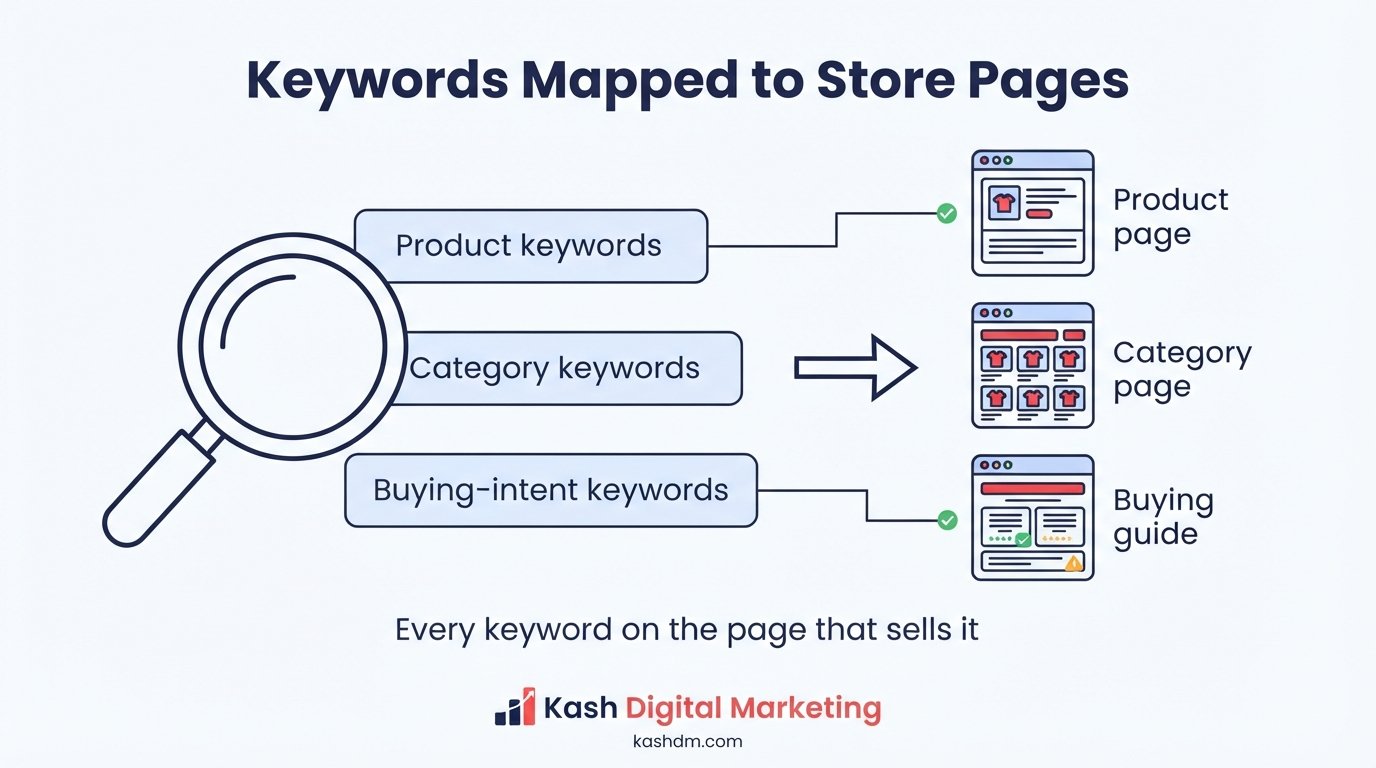
We research broad category terms, specific product terms, comparison and "best" queries, and long-tail buyer-intent phrases, then organize them into a keyword map that assigns each term to exactly one page, preventing the internal competition that quietly caps rankings on large catalogs.
Transactional versus informational keyword intent
Ecommerce keywords split into distinct intent buckets: transactional ("buy," "shop," specific product names), commercial investigation ("best," "vs," "review"), and informational (how-to and buying-guide queries). We map transactional terms to product and category pages, and informational terms to supporting content that captures shoppers earlier in their journey and nurtures them toward a purchase.
Long-tail product keywords that convert fast
Specific, descriptive searches like "women's waterproof trail running shoes size 9 wide" carry lower volume but far less competition and much higher conversion intent than a generic head term. We build product pages and attributes around these long-tail terms first, generating early wins while the site builds authority toward more competitive category terms.
Competitor and marketplace gap analysis
We analyze which keywords your direct competitors and marketplace listings already rank for, then identify gaps, terms they've missed, questions they haven't answered, product variations they haven't listed, that your store can capture. This gap analysis often reveals easy wins that a generic keyword tool alone would never surface.
Seasonal and trending keyword planning
Ecommerce demand shifts with seasons, holidays, and trends. We plan keyword targeting and content calendars around these cycles, gift guides ahead of the holidays, seasonal collection terms, trending product searches, so your store is fully optimized before demand peaks rather than scrambling to catch up once it's already passed.
Attribute and modifier keyword research
Shoppers search not just by product type but by attribute: material, size, color, price range, use case, and compatibility. "Stainless steel french press 8 cup" tells us far more than "french press" alone, and a store that captures these attribute-level modifiers in its titles, filters, and page copy earns a share of demand that competitors targeting only the broad head term miss entirely. We build attribute keyword lists directly from your product data, so every meaningful variation and specification a shopper might search for has somewhere to be discovered.
Search volume, competition, and prioritization
Not every keyword deserves equal investment. We score each keyword opportunity on realistic search volume, ranking difficulty against your current authority, and commercial value, then sequence the roadmap so effort goes first toward terms that are winnable now and meaningfully move revenue, saving the most competitive head terms for once the site has built enough authority to seriously compete for them.
| Keyword Type | Example | Best Mapped To |
|---|---|---|
| Head term | "running shoes" | Top-level category page |
| Attribute/modifier | "waterproof trail running shoes size 9" | Filtered collection or product |
| Comparison | "asics vs brooks running shoes" | Blog/buying guide |
| Informational | "how to choose running shoes" | Blog/buying guide |
| Branded | "[your brand] running shoes" | Homepage/brand page |
Product Page SEO That Ranks and Converts
Product page SEO optimizes each individual product listing so it ranks for the specific terms shoppers use and gives them everything they need to buy with confidence. A product page has one job: convince a searcher this is exactly the item they're looking for, and Google rewards pages that do that job well with better rankings.
Every product page we optimize gets a unique, keyword-rich title and meta description, genuinely original product copy rather than manufacturer boilerplate, complete specifications, high-quality images with descriptive alt text, and Product schema markup that unlocks star ratings and price display directly in search results.
Writing unique product descriptions at scale
Copy-pasted manufacturer descriptions create duplicate content across the web and give Google no reason to rank your page over a competitor selling the identical item. We write original, benefit-focused descriptions for every product, or build a scalable system for large catalogs, so each page offers genuinely unique value. Our content and copywriting team handles this at whatever scale your catalog requires.
Product schema and rich snippets
We implement Product structured data covering price, availability, and review ratings, so your listings can display star ratings and pricing directly in Google's search results. These rich snippets meaningfully increase click-through rate because they let a shopper compare price and reputation before ever clicking.
Optimizing images, reviews, and trust signals on product pages
Shoppers and Google both respond to trust signals. We optimize image file names and alt text for both accessibility and search, encourage and display genuine customer reviews, and surface shipping, return, and warranty information clearly, all of which improve both rankings and conversion rate on the same page.
Product variants and URL structure
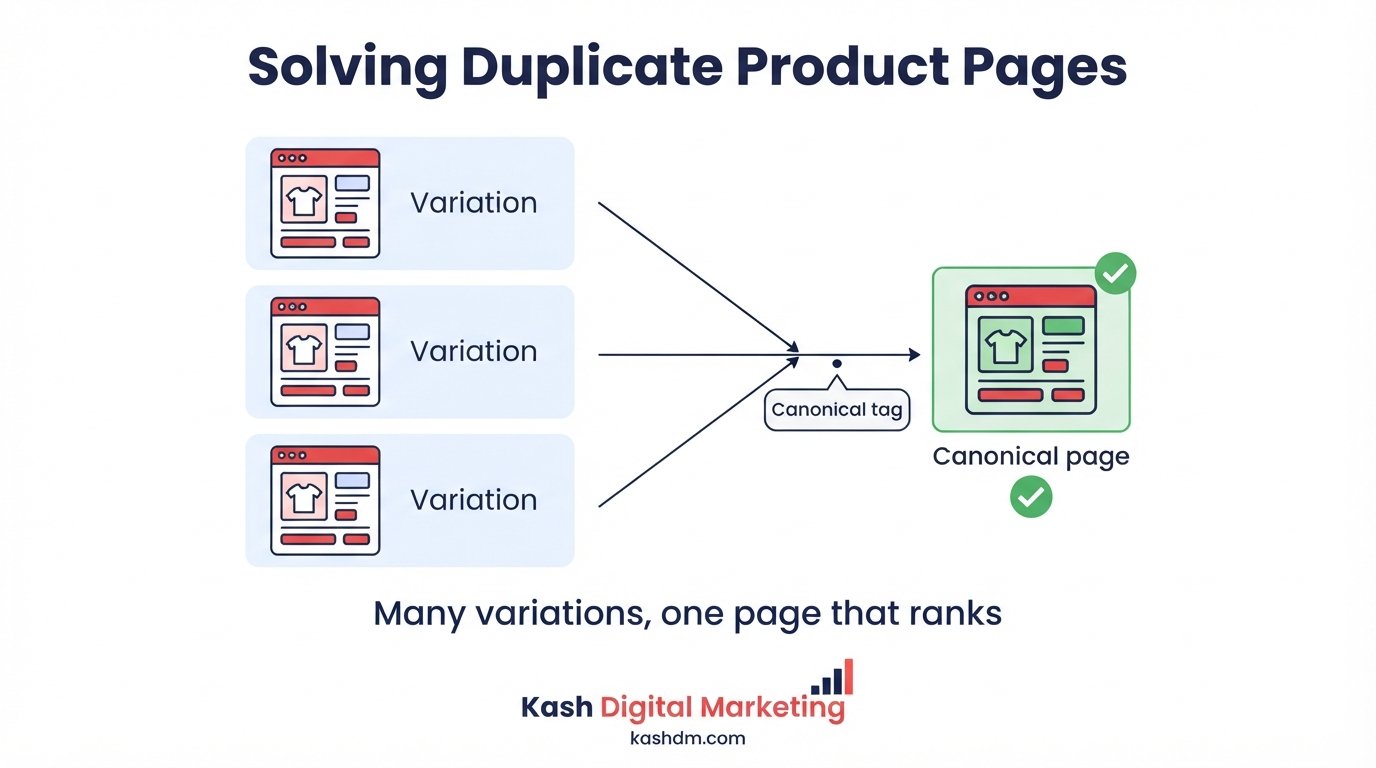
Products with size, color, or style variants need a deliberate URL and canonicalization strategy so Google indexes the right version without splitting ranking signals across near-duplicate variant pages. We set canonical tags and variant handling correctly for your specific platform, whether that's a single page with selectable options or separate URLs per variant.
Above-the-fold content and the buy box
The information a shopper sees without scrolling, price, availability, key differentiators, shipping timeline, has an outsized effect on whether they stay or bounce back to the search results. We make sure the most persuasive, decision-relevant information sits above the fold, because a page that makes a shopper hunt for the price or shipping cost loses them to a competitor whose page didn't.
Handling thin or sparse product listings
Some categories, especially smaller accessories or simple commodity items, naturally have less to say than a flagship product. Rather than padding these pages with filler, we build a consistent template of genuinely useful information, sizing details, compatibility notes, care instructions, comparison to related products, that adds real substance without resorting to keyword-stuffed filler text that helps no one.

Category and Collection Page SEO for Scalable Rankings
Category and collection page SEO optimizes the pages that group your products, category pages, collections, and shop-by-attribute pages, so they rank for the high-volume, broad terms shoppers search before narrowing to a specific product. These pages often carry more organic traffic potential than any single product page because they capture demand earlier and broader.
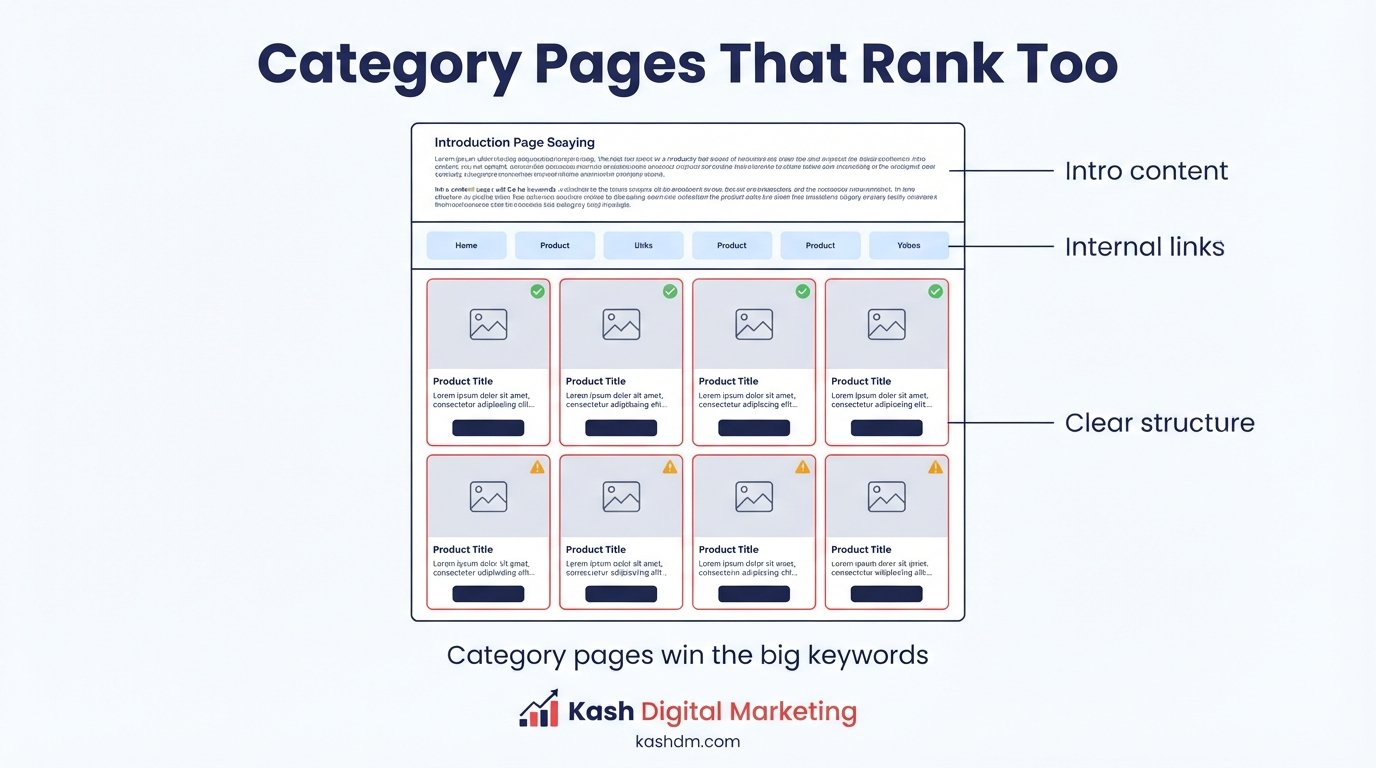
We write unique, keyword-targeted introductory content for each category, structure internal links so category pages pass authority down to products, and build a logical hierarchy that lets Google understand exactly what each collection page represents.
Writing category content that ranks without hurting UX
A wall of text above a product grid annoys shoppers, but a category page with zero unique content gives Google nothing to rank. We strike the balance: concise, genuinely useful category copy placed where it doesn't interfere with browsing, along with FAQ sections and buying-guide snippets that add real depth for both search engines and shoppers.
Collection pages for seasonal and curated shopping
Curated collections, "gifts under $50," "summer essentials," "back to school", capture high-intent shopping searches and give merchandisers a flexible way to promote products. We optimize these collection pages for the seasonal and thematic searches shoppers actually use, then archive or redirect them cleanly once the season passes rather than leaving broken, outdated pages live.
Internal linking architecture between categories and products
Category pages are the connective tissue of an ecommerce site. We build internal linking so every category links clearly to its subcategories and top products, and every product links back to its parent categories and related items, creating the crawl paths that let Google discover and rank your entire catalog efficiently.
Ecommerce Site Architecture Built to Scale
Ecommerce site architecture is the structural blueprint of how categories, subcategories, products, and content pages link together, and it determines whether Google can efficiently crawl and rank a catalog of any size. A flat, chaotic structure buries products under too many clicks and confuses Google about what matters most; a clean hierarchy does the opposite.
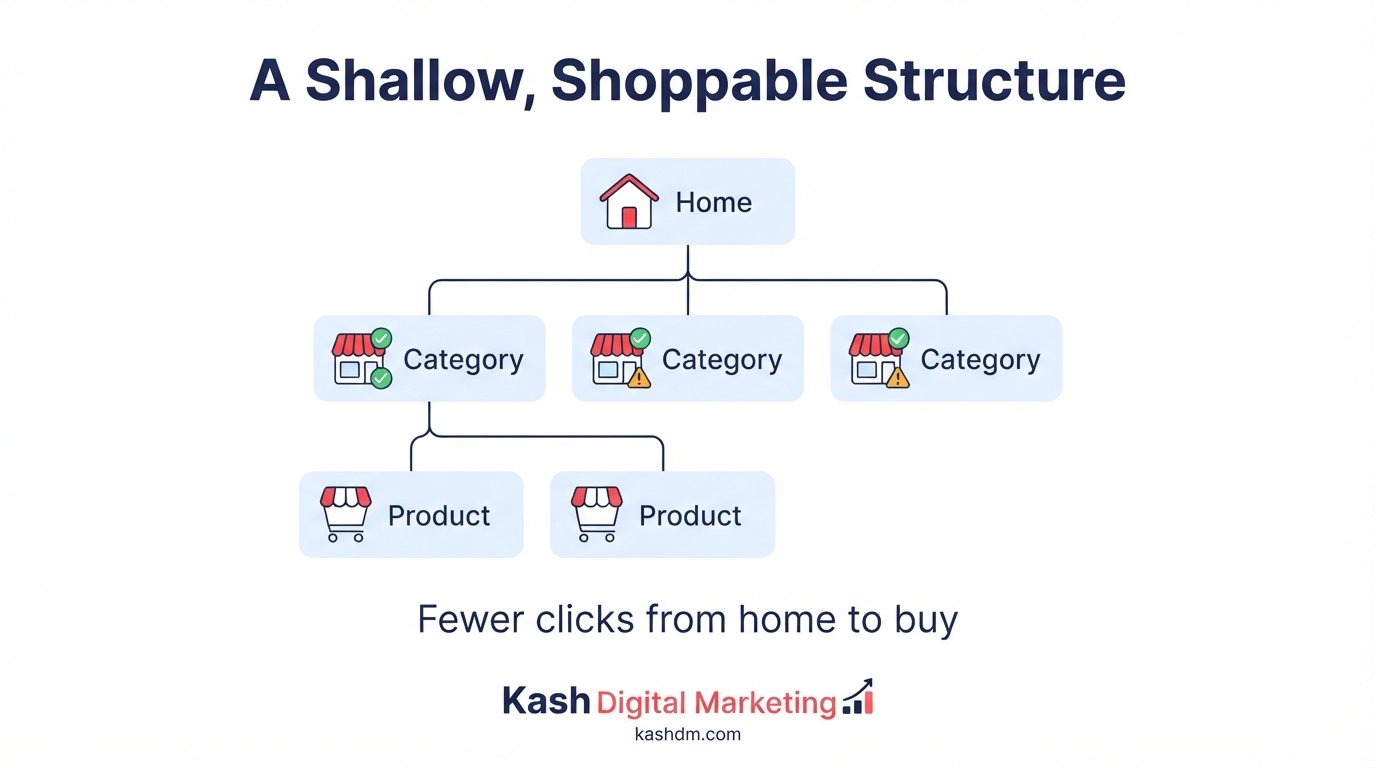
Our approach follows a simple rule: every important page should be reachable within three or four clicks from the homepage, and the hierarchy should mirror how shoppers actually think about your products, not how your inventory system happens to be organized internally.
The ideal click-depth hierarchy for large catalogs
We structure sites so shoppers and search engines move logically from homepage to top-level category, to subcategory, to product, without excessive depth. Pages buried five or six clicks deep get crawled less often and rank worse, so we flatten the hierarchy wherever the catalog allows it while keeping navigation genuinely usable.
URL structure and taxonomy planning
Clean, logical URLs (/mens-running-shoes/ rather than a string of category IDs) help both Google and shoppers understand a page before they click. We plan taxonomy and URL structure up front for new stores, and carefully migrate existing structures for established ones, always protecting existing rankings during the transition.
Breadcrumbs and structured navigation
Breadcrumb navigation, both visible and marked up with BreadcrumbList schema, reinforces your site hierarchy to Google and gives shoppers an easy way to move back up the category tree. It's a small addition that consistently improves both crawl efficiency and the on-page experience.
Planning architecture for a growing catalog
A structure that works for 200 products can collapse under 20,000. We design taxonomy with headroom, planning subcategory splits and navigation patterns that accommodate growth before it happens, so you're never forced into a disruptive re-architecture mid-scale that costs you rankings during the rebuild.
Internal linking as a ranking-signal distribution system
Site architecture is only half the equation; how you link between pages decides where authority actually flows. We treat internal linking deliberately, linking from high-authority pages like the homepage and top categories down into the products and subcategories that most need a lift, and cross-linking related products so shoppers, and Google, discover more of your catalog on every visit. A well-built architecture with weak internal linking still leaves value on the table; the two need to work together.
Handling pagination and "view all" pages
Long category listings that paginate across multiple pages need careful handling so Google can crawl the full product set without treating each page as thin, near-duplicate content. We implement pagination correctly, often paired with a well-optimized "view all" option where practical, so shoppers and search engines can both access your full catalog without hitting artificial walls.
Ecommerce Technical SEO for Large, Dynamic Catalogs
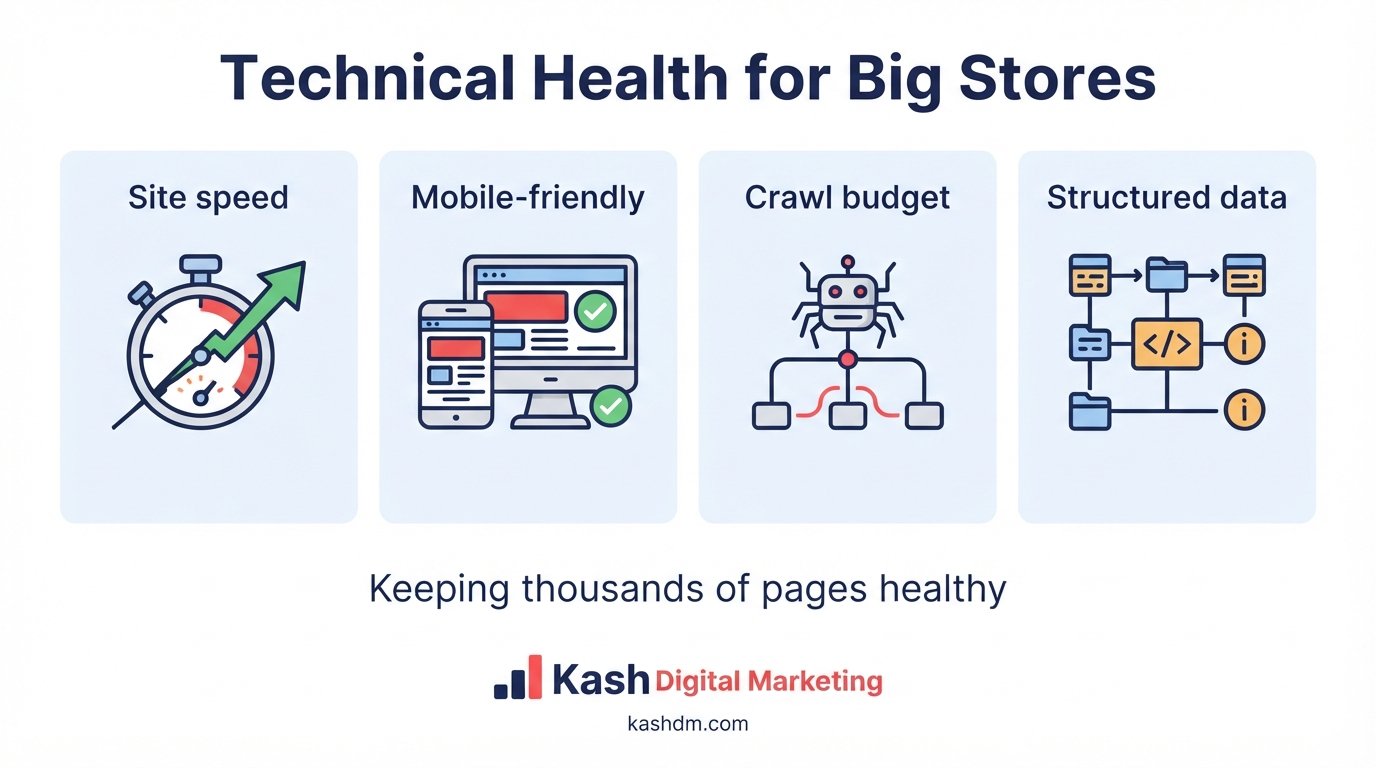
Ecommerce technical SEO addresses the crawling, indexing, speed, and structural issues unique to stores with large, constantly changing catalogs. These sites face technical challenges a simple website never will: massive URL counts, dynamic parameters, frequent inventory changes, and complex platform-generated code that can quietly block Googlebot from important pages.
Our technical audits cover crawl budget, indexation, site speed, structured data, mobile usability, and security, the full technical foundation described in depth on our dedicated technical SEO page, applied specifically to the scale and quirks of ecommerce platforms.
Managing crawl budget on large catalogs
Google allocates a finite crawl budget to every site. On a store with tens of thousands of URLs, wasted crawl budget on filtered, duplicate, or low-value pages means important products get crawled less often. We audit crawl logs, block or noindex low-value URL patterns, and direct Googlebot toward the pages that actually drive revenue.
XML sitemaps and indexation for ecommerce
We build and maintain dynamic XML sitemaps that update automatically as products are added, removed, or go out of stock, so Google always has an accurate map of what should be indexed. We also monitor Google Search Console for indexation drops and diagnose them quickly, before they become a revenue problem.
Site speed and Core Web Vitals for checkout funnels
Every second of load time on a product or checkout page costs conversions. We optimize image compression, script loading, and server response times to hit strong Core Web Vitals scores across mobile and desktop, a discipline that pays off twice, once in rankings and once directly in conversion rate.
Structured data across the entire catalog
Beyond individual Product schema, we implement Organization, BreadcrumbList, and Merchant listing markup site-wide, so every page type sends Google the structured signals it needs to display rich, clickable results consistently across your whole catalog rather than on a handful of hand-optimized pages.
Log file analysis for large stores
For catalogs in the tens of thousands of URLs, we go beyond Search Console and analyze raw server log files to see exactly how Googlebot crawls your site: which pages it visits often, which it ignores, and where it wastes time on low-value URLs. This level of analysis routinely surfaces crawl-budget problems that no on-page audit alone would ever reveal, and it's a step many ecommerce SEO providers skip entirely because it requires direct server access and genuine technical skill to interpret correctly.
HTTPS, security, and payment page considerations
Security is non-negotiable for any store handling payment information, and Google factors HTTPS into its ranking systems directly. We verify certificate configuration, mixed-content issues, and secure checkout implementation as a standard part of every technical audit, protecting both your rankings and your customers' trust at the moment it matters most.
Fixing Faceted Navigation and Filter SEO Problems
Faceted navigation, the filters shoppers use to narrow by size, color, price, and brand, is one of the biggest technical SEO risks on any ecommerce site, because it can generate millions of near-duplicate, low-value URLs that dilute crawl budget and confuse search engines. Left unmanaged, filter combinations multiply endlessly and bury a store's genuinely important pages under an avalanche of junk URLs.
We audit every facet combination, decide which filtered views deserve their own indexable, optimized page (because they match real search demand) and which should be canonicalized, blocked, or parameterized so they never compete with the pages that matter.
Deciding which filter combinations deserve to rank
Some filter combinations match genuine search demand, "blue running shoes size 10", and deserve a real, indexable, optimized landing page. Most others, arbitrary multi-filter combinations nobody searches for, should never be indexed at all. We use actual keyword data to decide which combinations earn a page and which get excluded.
Canonical tags, parameter handling, and robots directives
For the filter combinations that shouldn't rank, we implement the correct combination of canonical tags, URL parameter handling in Search Console, and robots directives to prevent index bloat without accidentally blocking Googlebot from crawling the filters entirely, a common and costly mistake we see on stores that attempt this fix themselves.
Preventing crawl traps from infinite filter combinations
Poorly configured faceted navigation can create genuine crawl traps, infinite loops of filter combinations that trap Googlebot in low-value pages indefinitely and starve the rest of the site of crawl attention. We test and fix these traps directly, verifying the fix in server logs rather than assuming a configuration change worked.

Solving Duplicate Content in Ecommerce Stores
Duplicate content is one of the most common and most damaging SEO problems in ecommerce, arising from manufacturer descriptions, product variants, filtered URLs, and syndicated listings that all compete against each other instead of ranking as one strong page. When Google sees multiple pages saying essentially the same thing, it has to guess which one to rank, and it often guesses wrong or ranks neither well.
Our duplicate content audits identify every source of duplication on your store, then apply the right fix for each, unique content, canonical tags, redirects, or consolidation, so every page has a clear, undiluted shot at ranking.
Manufacturer descriptions and syndicated content
Using the same product description as every other retailer selling that item is the single most common source of ecommerce duplicate content. We rewrite descriptions to be genuinely unique, giving your page a real reason to outrank competitors selling the identical product.
Print, mobile, and session-based URL duplication
Legacy platforms sometimes generate separate URLs for printer-friendly pages, mobile versions, or session-tracked links, each one a duplicate of the main page. We audit for these hidden duplication sources and consolidate them with canonical tags or redirects so ranking signals aren't split across silent copies.
Cross-domain and marketplace duplication
If you sell the same products on your own site, Amazon, and other marketplaces, that content exists in multiple places across the web. We can't control marketplace listings, but we make sure your own site's content is differentiated enough, richer descriptions, better images, exclusive content, that Google and shoppers have a clear reason to prefer your page.
Out-of-Stock and Discontinued Product SEO
Out-of-stock product SEO handles what happens to a page's rankings and links when an item sells out or gets discontinued, a moment many stores mishandle by deleting pages and destroying earned rankings and backlinks in the process. An out-of-stock product page is often still a valuable, ranking asset, and the wrong response can throw that value away permanently.
We apply the right treatment based on whether the product is temporarily out of stock, permanently discontinued, or replaced by a newer model, keeping the page live with clear messaging, redirecting to the closest equivalent, or handling removal properly with a 410 status when a page truly needs to go.
Temporarily out of stock: keep the page live
For items restocking soon, we keep the page indexed and live, clearly marked as temporarily unavailable, with an option to notify shoppers when it's back and links to similar in-stock alternatives. Deleting a page for a two-week stock gap throws away rankings that took months to earn.
Permanently discontinued: redirect strategically
When a product is genuinely gone for good, we redirect the URL to the closest replacement product or the relevant category page, preserving link equity and giving the shopper somewhere useful to land instead of a dead end. A blanket redirect to the homepage wastes this opportunity and frustrates shoppers.
When to remove a page entirely
Occasionally a page genuinely should be removed with no reasonable replacement to redirect to. In these cases we use a proper 410 Gone status rather than leaving a 404 or a soft-404 lingering, giving Google a clear, honest signal instead of ambiguity that can waste crawl budget and confuse indexing.
Ecommerce Content Marketing That Drives Organic Sales
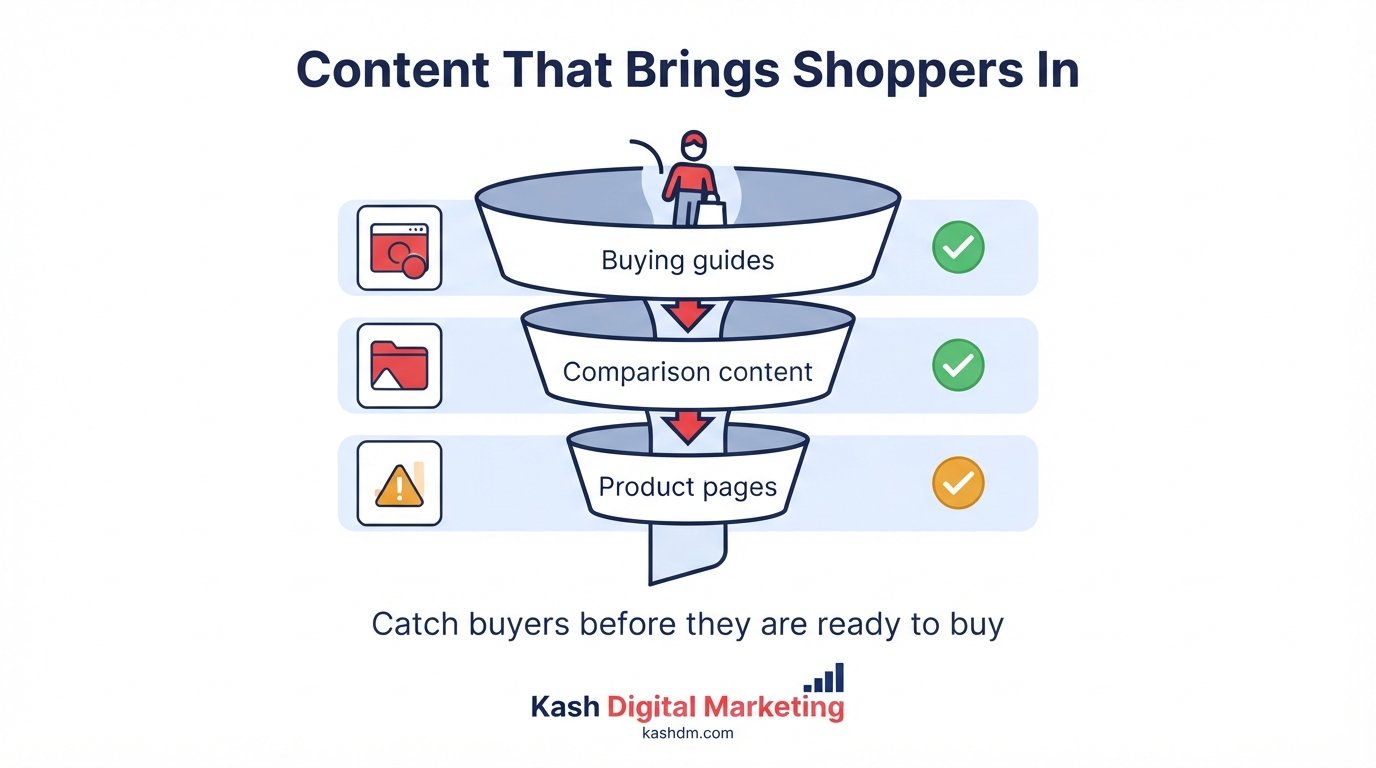
Ecommerce content marketing creates buying guides, comparison articles, and how-to content that captures shoppers earlier in their journey and builds the topical authority that lifts rankings across your entire product catalog. Product and category pages alone can't capture every valuable search, a huge volume of demand exists in the research phase, before a shopper has settled on exactly what to buy.
We build content that answers those research-phase questions, "how to choose running shoes," "best gifts for coffee lovers," "gore-tex vs waterproof membrane explained", and links strategically into the products and categories that satisfy the intent once a reader is ready to buy.
Buying guides and comparison content
Buying guides and product comparisons capture shoppers who are evaluating options rather than ready to purchase immediately, and they build the kind of genuine expertise that Google's quality systems reward. We create these as a bridge between informational search and transactional pages, naturally linking to relevant products throughout.
Blog content that builds topical authority
A consistent blog covering your product category in depth signals topical authority to Google and gives your store a steady stream of content to promote through social media. Over time this authority lifts the whole domain's ability to rank, including product and category pages that never had a single word of dedicated content written for them.
Seasonal and gift guide content
Gift guides and seasonal content capture enormous demand spikes around holidays and events. We plan and publish this content well ahead of the season, giving Google time to index and rank it before the traffic peak arrives, rather than publishing reactively once the opportunity has already partly passed.
Video and visual content as an SEO asset
Product demonstration videos, unboxing content, and styling guides increasingly appear directly in search results and satisfy shoppers who prefer to see a product in action before buying. We help integrate video content into product and category pages where it adds genuine value, giving both Google and shoppers another reason to trust and choose your listing over a text-only competitor.
Repurposing content across channels
A single well-researched buying guide can fuel a blog post, several social media posts, an email newsletter feature, and a video script. We plan content with this reuse in mind from the start, so the research and writing investment pays off across every channel you use, tying naturally into our social media marketing services when a client runs both together.
Ecommerce Link Building That Builds Domain Authority
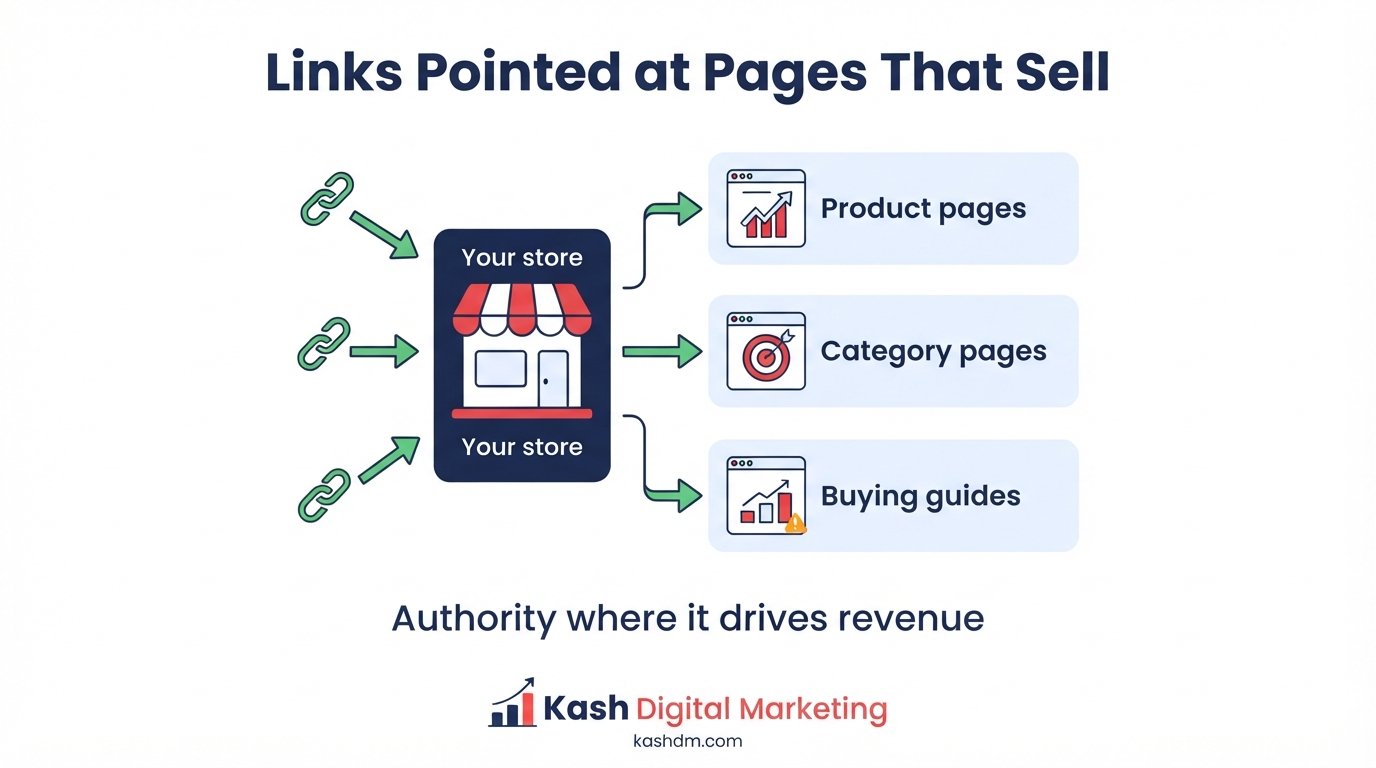
Ecommerce link building earns backlinks from relevant publishers, industry sites, and press coverage to build the domain authority that helps every page on your store rank higher. For online stores, link building carries extra weight because ecommerce is a competitive, commercial space where Google leans on authority signals to separate trustworthy retailers from thin, low-quality ones.
Our approach uses digital PR, product seeding, and content-driven outreach, the same white-hat methods described on our dedicated link building page, adapted specifically for the products, launches, and newsworthy angles an ecommerce brand can offer.
Digital PR for product launches and brand stories
A genuinely interesting product launch, founder story, or original data set gives journalists and bloggers a reason to cover your brand and link to your site. We identify and package these angles, then pitch them to relevant publications, earning authoritative links that a generic outreach email never could.
Product seeding and influencer link earning
Sending products to relevant bloggers, reviewers, and creators in exchange for honest coverage, never paid links, earns genuine editorial mentions and backlinks while also building brand awareness and driving direct referral traffic and sales.
Resource page and roundup link building
Many industries have active roundup and resource pages ("best gear for X") that link out to recommended products and brands. We identify these opportunities and pitch your products for inclusion where they genuinely fit, earning relevant, contextual links from pages your target audience already reads.
Original research and data-driven link earning
Publishing original survey data, usage statistics, or industry benchmarks gives journalists, bloggers, and competitors' own audiences a genuine reason to cite and link to your site as a source. We help brands develop these data-driven assets from information many stores already have on hand, purchase trends, customer surveys, product usage patterns, turning what's normally internal-only data into a genuine link-earning asset.
Building relationships, not one-off transactions
The strongest ecommerce link profiles come from ongoing relationships with journalists, bloggers, and industry sites, not one-time outreach blasts. We invest in building these relationships over time, so future product launches and stories get easier, faster coverage instead of starting from zero with every new pitch.
Shopify SEO Services
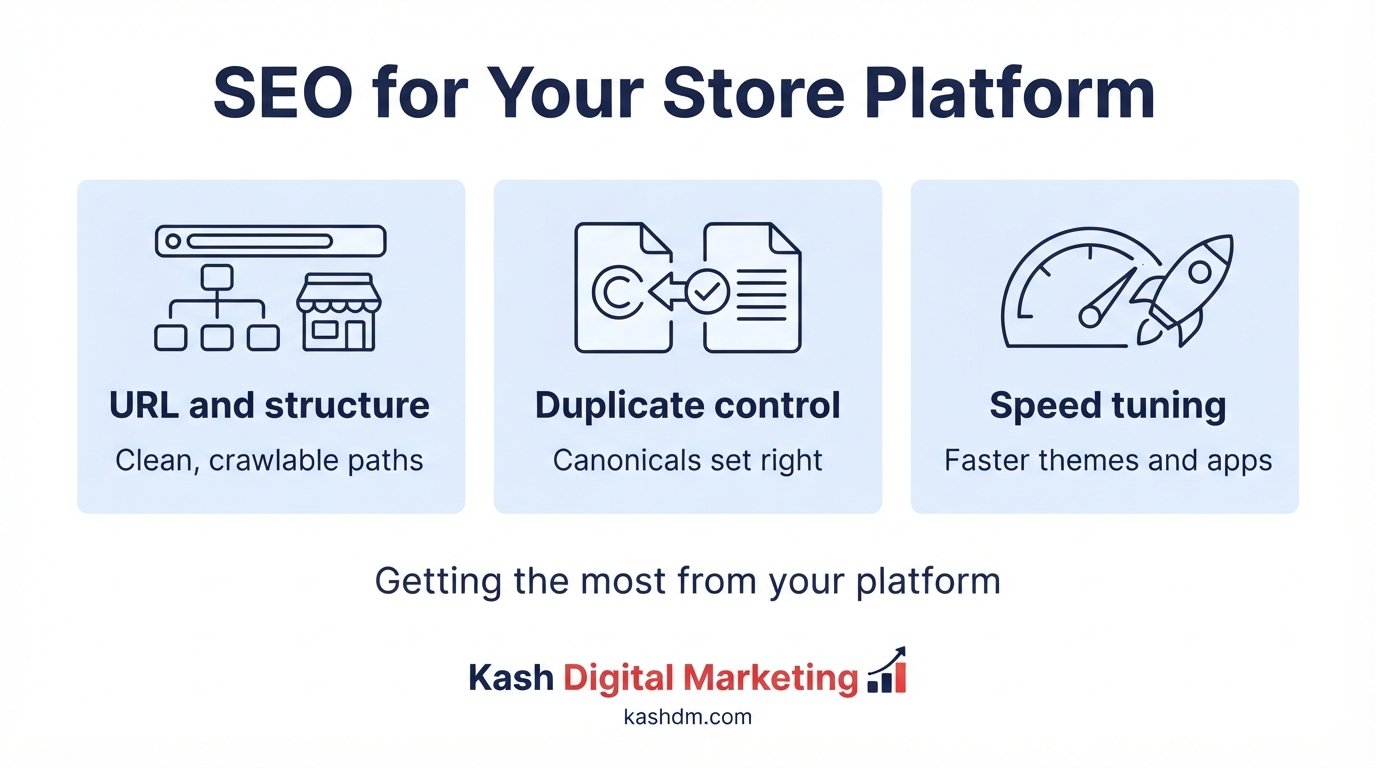
Shopify SEO services optimize the platform's specific strengths and workarounds its specific limitations, since Shopify's fixed URL structure, app ecosystem, and theme architecture all shape what's possible for ranking a Shopify store. Shopify is fast and reliable out of the box, but its rigid URL structure and reliance on apps for advanced SEO functionality mean a store needs deliberate, platform-aware optimization to reach its full ranking potential.
We handle Shopify-specific technical work: URL and collection structure within the platform's constraints, app selection and configuration for schema and redirects, theme code optimization for speed, and the metafield and content setup that lets a Shopify store compete with far more flexible platforms.
Working within Shopify's fixed URL structure
Shopify forces certain URL patterns, like /products/ and /collections/, that can't be fully customized without significant development work. We optimize everything within those constraints and use redirects and canonicalization carefully wherever the platform's defaults create duplication risk.
Choosing and configuring the right SEO apps
Shopify's app ecosystem can add powerful SEO functionality, image compression, schema markup, redirect management, but a poorly chosen or misconfigured app can also slow the store down or create conflicts. We select and configure only the apps that add real value, avoiding the bloat that hurts more Shopify stores' page speed than almost anything else.
Theme speed optimization for Shopify
Shopify themes, especially heavily customized ones, are a common source of slow load times. We optimize theme code, image delivery, and third-party script loading to protect Core Web Vitals, because a beautiful theme that loads slowly quietly bleeds both rankings and sales.
WooCommerce SEO Services
WooCommerce SEO services optimize stores built on WordPress and WooCommerce, a combination that offers enormous flexibility but requires careful technical setup to avoid the plugin bloat and configuration mistakes that commonly slow these stores down. Because WooCommerce runs on WordPress, it inherits both WordPress's SEO strengths, like flexible URL structures and a mature plugin ecosystem, and its common weaknesses, like plugin conflicts and bloated page weight.
We audit and optimize plugin stacks, configure WooCommerce-specific schema and sitemap settings, and apply the same technical SEO rigor we use across every platform, tuned to WordPress's particular quirks.
Managing plugin bloat on WooCommerce stores
WooCommerce stores often accumulate plugins over time, many of them redundant, poorly coded, or actively slowing the site down. We audit the full plugin stack, remove what's unnecessary, and replace poor performers with lean, well-coded alternatives, a cleanup that frequently improves site speed dramatically on its own.
WooCommerce product schema and category configuration
We configure Product and Review schema correctly within WooCommerce's structure, and set up category and attribute taxonomies so they generate clean, keyword-relevant URLs rather than the messy defaults many stores launch with and never revisit.
Combining WooCommerce with WordPress content strength
WooCommerce's biggest advantage is native WordPress content publishing. We use this to build the buying guides, comparison content, and blog authority described in ecommerce content marketing directly alongside the store, without the plugin gymnastics some other platforms require to achieve the same thing.
Magento SEO Services
Magento SEO services address the platform most commonly used by large, complex catalogs, where Magento's power and flexibility come with genuine technical complexity that requires specialized SEO expertise to manage well. Magento (Adobe Commerce) offers unmatched control over large, multi-store, multi-currency catalogs, but that same complexity creates more ways for technical SEO problems, duplicate URLs, layered navigation issues, slow page generation, to quietly develop.
Our Magento SEO work focuses on the platform's most common trouble spots: layered navigation and faceted URL management, page speed optimization for its heavier architecture, and correct multi-store and multi-language configuration for brands operating across regions.
Layered navigation and URL rewrite management
Magento's layered navigation is powerful but a frequent source of the faceted navigation index bloat problems described earlier, at a scale that can spiral quickly on a large catalog. We configure URL rewrites and indexing rules specifically for Magento's layered navigation system to keep it under control from the start.
Page speed on Magento's heavier architecture
Magento's flexibility comes with a heavier default architecture than lighter platforms, making speed optimization especially important. We tune caching, indexing, and image delivery specifically for Magento's infrastructure to hit strong Core Web Vitals despite the platform's inherent complexity.
Multi-store and multi-region Magento SEO
Large Magento deployments often run multiple stores or regional storefronts from one instance. We configure hreflang, canonical tags, and store-view-specific settings correctly so each region ranks appropriately without cannibalizing the others, a setup mistake that's common and costly when handled without deep Magento-specific experience.
BigCommerce SEO Services
BigCommerce SEO services optimize a platform known for strong built-in SEO features, giving stores a genuinely solid technical starting point that still benefits significantly from strategic optimization on top of the defaults. BigCommerce ships with cleaner default URL structures and more native SEO controls than many competitors, but a strong foundation still needs the keyword research, content, and link building layered on top to actually rank.
We take full advantage of BigCommerce's native SEO controls, custom URL structures, page-level metadata, and multi-storefront tools, while layering in the content, technical audit, and link building work every platform needs regardless of its built-in strengths.
Making the most of BigCommerce's native SEO controls
BigCommerce gives store owners direct control over URLs, metadata, and redirects without needing third-party apps for basic functionality. We configure these native tools correctly from the start, avoiding the app dependency that can slow down stores on other platforms.
BigCommerce multi-storefront and B2B configuration
BigCommerce's multi-storefront capability suits brands running separate B2B and B2C experiences or multiple regional stores from one back end. We configure the SEO settings for each storefront independently, ensuring each one ranks for its specific audience without duplicating content across them.
Amazon SEO and Listing Optimization Services
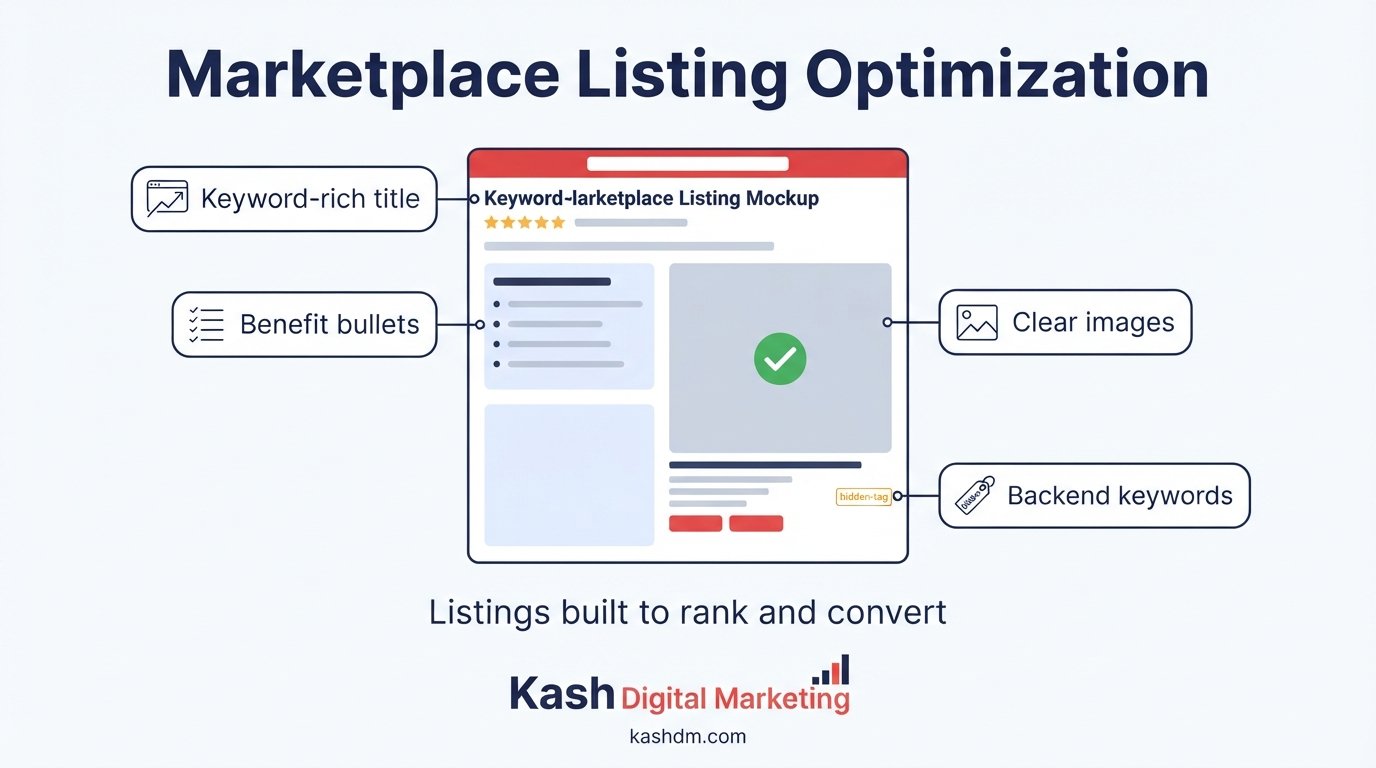
Amazon SEO, more precisely called Amazon listing optimization, is the practice of optimizing product titles, bullet points, backend keywords, images, and reviews so a listing ranks higher in Amazon's own search results and converts once a shopper clicks. Amazon's search algorithm, commonly called A9/A10, weighs relevance and, critically, sales velocity and conversion rate far more heavily than traditional Google SEO does, so an Amazon listing needs a distinct optimization approach from your own website.
Our Amazon listing optimization covers keyword-rich titles within Amazon's character limits, benefit-driven bullet points, backend search terms, enhanced brand content, and the review and pricing strategy that keeps a listing's conversion rate, and therefore its ranking, strong.
Amazon keyword research and listing structure
We research the specific terms shoppers use on Amazon, which often differ meaningfully from Google search behavior, then structure titles, bullets, and backend keywords to maximize relevance for Amazon's search algorithm without resorting to keyword stuffing that can trigger suppression.
Why Amazon rankings depend on conversion rate
Unlike Google, Amazon ranks listings partly based on how well they convert once a shopper sees them, because Amazon's own revenue depends on completed sales. We optimize images, pricing presentation, and review generation, all things that lift conversion rate, because on Amazon, conversion rate improvements often move rankings almost as directly as keyword optimization does.
Amazon SEO alongside your own website
Amazon and your own store aren't necessarily in competition, they can work together. A strong Amazon presence builds brand recognition that increases branded searches on Google, while a strong website builds the direct customer relationships and margins Amazon's fee structure limits. We help brands run both channels with a coordinated strategy rather than treating them as separate, disconnected efforts.
Google Shopping and Merchant Center Optimization
Google Shopping and Merchant Center optimization ensures your product feed is accurate, complete, and optimized so your products appear prominently in Shopping results, both paid and the free listings Google now shows across search. A poorly maintained feed, missing attributes, mismatched pricing, thin titles, gets products suppressed or shown poorly, wasting both organic Shopping visibility and any paid Shopping spend built on top of it.
We audit and optimize your Merchant Center feed for completeness and accuracy, structure product titles and descriptions specifically for Shopping's display format, and keep the feed synced with real-time inventory and pricing so nothing gets flagged or disapproved.
Feed optimization for free and paid Shopping listings
Google now shows free product listings in Shopping results alongside paid ones, making feed quality a genuine organic SEO concern, not just a paid media task. We optimize titles, descriptions, images, and attributes in the feed itself, since Shopping results pull directly from feed data rather than your website's on-page content.
Avoiding feed disapprovals and suppressions
Missing GTINs, mismatched pricing between your feed and website, or policy violations can get products disapproved or suppressed from Shopping entirely. We audit for these issues proactively and monitor Merchant Center diagnostics regularly, catching problems before they cost you weeks of lost visibility.
Aligning Merchant Center data with on-site SEO
Your Merchant Center feed and your website should tell Google the same story about every product, matching titles, pricing, and availability. When they drift apart, Google trusts both sources less, which can suppress visibility in both organic Shopping results and traditional search. We build a process that keeps feed and website data synced automatically wherever your platform allows, rather than relying on manual updates that inevitably fall out of step over time.
Ecommerce SEO for Small Business Online Stores
Ecommerce SEO for small business focuses limited budgets on the highest-impact activities first, long-tail product keywords, core technical fixes, and a handful of strong category pages, rather than spreading effort thin across a large catalog all at once. A small store doesn't need every tactic in this guide implemented simultaneously; it needs the right sequence of work that generates revenue early and funds the next phase.
We start small ecommerce clients with a focused technical audit, long-tail product page optimization, and Google Business Profile and local signals if the store has any local pickup or physical presence, then scale into content and link building as early wins prove the channel out.
Prioritizing for limited budgets and catalogs
We identify the products and categories with the best combination of demand and low competition, optimize those first, and use the resulting traffic and sales to justify expanding the program. This mirrors the longtail-first approach that also powers our small business SEO services more broadly.
DIY-friendly foundations we help you build
For very early-stage stores, we often help set up the technical and structural foundations correctly from day one, clean URLs, proper schema, a sensible taxonomy, so future growth doesn't require an expensive re-architecture later. Getting this right early is far cheaper than fixing it after the catalog has grown to thousands of SKUs.
Combining ecommerce SEO with local visibility
Small ecommerce brands with a physical showroom, local pickup option, or hybrid retail presence can benefit from local SEO signals in addition to standard ecommerce optimization, capturing "near me" and local buy-online-pickup-in-store searches that a pure ecommerce strategy alone would miss entirely. We fold these local signals into the broader campaign wherever a client's business model supports it, rather than treating local and ecommerce SEO as mutually exclusive services.
Realistic expectations for a small catalog
A small store with fifty products won't out-rank a category leader with fifty thousand SKUs for the broadest head terms any time soon, and setting that expectation honestly upfront matters. What a small, focused catalog can absolutely do is dominate a specific niche, own the long-tail searches within it, and build a loyal, repeat customer base through genuinely excellent product pages and content. We help small stores play to this strength rather than chasing rankings that would take years and a budget they don't have.
International Ecommerce SEO for Multi-Country Stores
International ecommerce SEO optimizes a store to rank correctly across multiple countries, currencies, and languages, using hreflang tags, proper domain or subdirectory structure, and localized content so each market gets the right version of the site. A store expanding internationally without this structure risks Google showing the wrong country's pricing or language to shoppers, or worse, having its various country versions compete against each other instead of each ranking cleanly in its own market.
We plan the right international structure for your situation, whether that's country-code domains, subdomains, or subdirectories, implement hreflang correctly across every page, and localize content and currency rather than simply translating it word for word.
Choosing the right international URL structure
Country-code top-level domains, subdomains, and subdirectories each carry different tradeoffs for authority consolidation, management complexity, and geotargeting clarity. We assess your specific situation, resources, and growth plans to recommend the structure that fits, rather than defaulting to a one-size-fits-all answer.
Hreflang implementation without costly mistakes
Hreflang tags tell Google which page version to show searchers in each language and region, but they're notoriously easy to implement incorrectly, a single mismatched tag can cause the wrong version to rank in the wrong market. We implement and audit hreflang carefully, verifying it in Search Console rather than assuming the initial setup is correct.
Localization beyond translation
True localization goes beyond translating text, it means adjusting currency, sizing conventions, cultural references, and even which products are featured, to match each market's expectations. We build genuinely localized experiences rather than machine-translated copies, because Google and shoppers both recognize the difference.
International link building and local market authority
Ranking in a new country often requires backlinks from that country's own websites and publications, not just a translated version of your existing content. We identify local link-building opportunities, relevant regional publications, industry sites, and directories, so your international pages build the same kind of genuine local authority your domestic site relies on, rather than expecting existing domain authority to carry an entirely new market on its own.
Ecommerce Site Migration SEO Without Losing Rankings
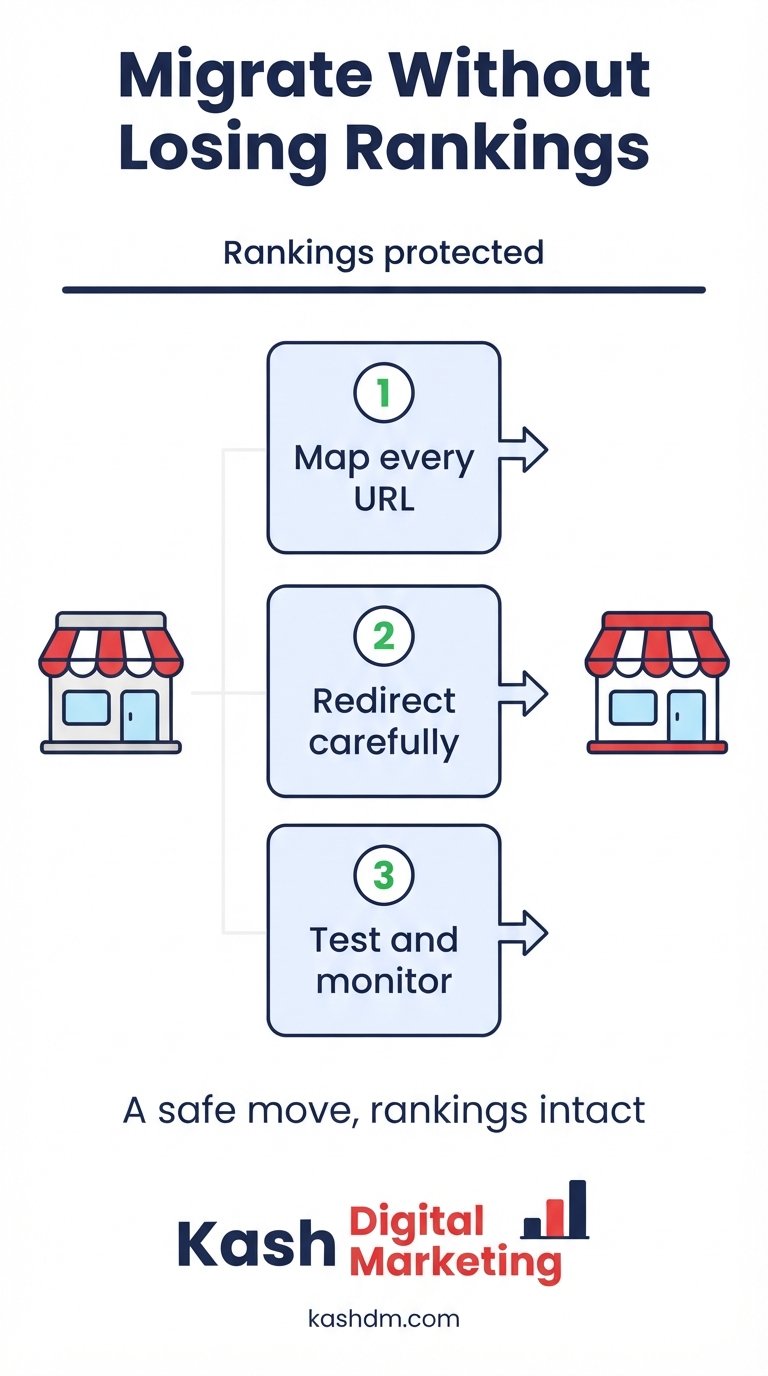
Ecommerce site migration SEO protects a store's hard-earned rankings and revenue during a platform switch, domain change, or major redesign, the single riskiest moment in any ecommerce SEO program if handled without a rigorous process. We've seen stores lose sixty to eighty percent of their organic traffic overnight from a poorly executed migration, and recovering from that damage takes far longer and costs far more than doing the migration correctly the first time.
Our migration process maps every existing URL to its new destination, implements complete 301 redirect coverage, preserves and re-implements structured data, and monitors rankings and traffic closely in the weeks after launch so any issue gets caught and fixed immediately.
Pre-migration URL mapping and redirect planning
Before any migration begins, we crawl and catalog every existing URL, map each one to its equivalent on the new site, and build a complete redirect plan. Missing even a small percentage of redirects on a large catalog can mean thousands of broken links and a significant, avoidable traffic loss.
Preserving rankings through the transition
We time the migration carefully, prepare the new site fully before the switch, and monitor crawl, indexation, and rankings daily in the days immediately following launch, catching and fixing any unexpected issue, a missed redirect, a blocked resource, a schema error, before it compounds into meaningful ranking loss.
Post-migration monitoring and recovery
Even a well-planned migration benefits from vigilant monitoring for the first several weeks. We track rankings, organic traffic, crawl errors, and indexation status closely during this period, ready to diagnose and fix anything that deviates from expectations quickly, so a temporary dip stays temporary instead of becoming a lasting loss.
Migrating domains, rebrands, and platform switches together
Some migrations combine several changes at once, a new platform, a new domain, and a rebrand, all happening in the same launch window. This compounds risk significantly, since it becomes harder to isolate the cause of any ranking movement after the fact. Wherever possible, we recommend separating these changes into distinct phases with time to monitor between them, and when a combined migration is unavoidable, we document every variable changed so any issue can be diagnosed and traced back to its actual cause quickly.
Ecommerce SEO Audit: What We Check
An ecommerce SEO audit is a comprehensive diagnostic review of a store's technical health, content quality, and competitive position, producing a prioritized action plan rather than a generic checklist. Every engagement starts here, because optimizing the wrong things first wastes budget on a large catalog where the highest-impact fixes aren't always obvious without real analysis.
Our audit covers crawlability and indexation, site speed and Core Web Vitals, duplicate content and faceted navigation risk, product and category content quality, structured data implementation, backlink profile, and a direct comparison against the competitors currently winning your most valuable searches.
| Audit Area | What We Check |
|---|---|
| Crawlability & indexation | Robots.txt, sitemap accuracy, crawl budget waste, orphaned pages |
| Site speed & Core Web Vitals | Load time, image optimization, script bloat, mobile performance |
| Duplicate content | Manufacturer descriptions, filtered URLs, variant handling |
| Faceted navigation | Index bloat risk, canonical and parameter handling |
| Product & category content | Uniqueness, keyword targeting, completeness |
| Structured data | Product, Review, BreadcrumbList schema coverage |
| Backlink profile | Domain authority, toxic links, competitor comparison |
| Competitive gap analysis | Keywords and content competitors rank for that you don't |
How the audit process works
We start with an automated technical crawl, layer in manual review of your highest-priority pages, and cross-reference everything against your top organic competitors. The result is a prioritized list, not of everything technically imperfect, but of what will actually move rankings and revenue fastest.
What you get from the audit
You receive a clear, prioritized report explaining what's holding your store back, ranked by impact and effort, plus a straightforward explanation of what each fix accomplishes. It's genuinely useful whether or not you decide to work with us further, and it's the same audit that kicks off every one of our ecommerce SEO engagements.
Why generic audit tools miss ecommerce-specific problems
Off-the-shelf SEO audit tools are built to work across every type of website, which means they routinely miss problems unique to large product catalogs: faceted navigation traps, variant duplication, feed disapprovals in Merchant Center, or the specific way an out-of-stock product should be handled. We combine automated crawling with genuine platform-specific manual review, so the audit catches the problems that actually matter for a store your size and complexity, not just the generic issues a template checklist would flag on any website.

Mobile Ecommerce SEO for On-the-Go Shoppers
Mobile ecommerce SEO optimizes an online store specifically for the mobile experience, since Google indexes and ranks primarily based on the mobile version of a site, and the majority of ecommerce browsing now happens on phones. A desktop-optimized store with a clunky, slow mobile experience is fighting Google's ranking system and its own shoppers at the same time.
We optimize mobile page speed, tap-friendly navigation and filters, mobile checkout flow, and responsive image delivery, treating mobile not as an afterthought but as the primary experience most of your shoppers and Google itself will judge you by.
Mobile-first indexing and what it means for your store
Google indexes and ranks the mobile version of your pages as the default, so any content, structured data, or internal links missing from mobile but present on desktop essentially don't exist for ranking purposes. We audit mobile parity carefully to make sure nothing important is lost between versions.
Mobile checkout and filter usability
A frustrating mobile checkout or an unusable filter menu costs sales even when rankings are strong. We optimize tap targets, form fields, and filter interfaces specifically for mobile use, because the final step from "ranked well" to "completed sale" happens on the smallest screen your shoppers own.

Ecommerce CRO That Multiplies Your SEO Traffic
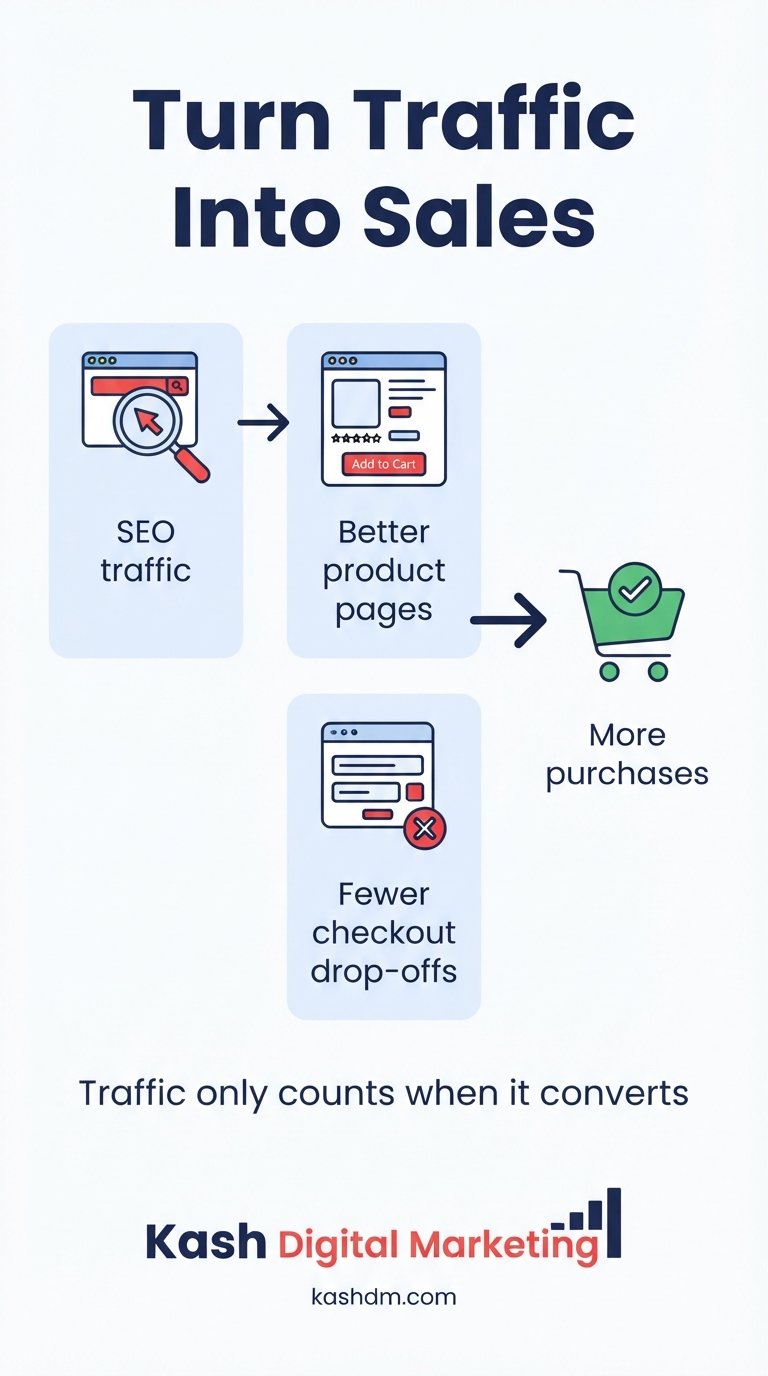
Ecommerce conversion rate optimization (CRO) ensures the organic traffic your SEO campaign earns actually converts into sales, because ranking traffic that doesn't buy is only half the return your investment could deliver. We treat CRO as inseparable from SEO on every ecommerce engagement, since a page that ranks first but converts at one percent is worth far less than a page that ranks third and converts at five percent.
Our CRO work focuses on product page trust signals, checkout friction reduction, clear calls to action, and site speed, all of which improve both the shopping experience and, often, the rankings themselves, since Google's quality systems increasingly reward genuinely useful, well-converting pages.
Reducing friction in the path to purchase
We audit the full path from landing page to completed order, streamlined product pages, a visible and simple add-to-cart flow, minimal checkout steps, and clear shipping and return information, removing the small frictions that quietly cost sales at every step.
Trust signals that close the sale
Reviews, security badges, clear return policies, and social proof reassure a shopper at the exact moment they're deciding whether to enter their payment details. We make sure these signals are visible precisely where hesitation happens, not buried in a footer link nobody clicks.
Testing changes without guessing
We don't treat CRO as a set of best-practice assumptions applied blindly. Where traffic volume supports it, we run structured A/B tests on meaningful changes, a new product page layout, a revised call to action, a simplified checkout step, so decisions are backed by real data from your actual shoppers rather than generic industry benchmarks that may not reflect how your specific audience behaves.
Why SEO and CRO belong in the same conversation
Treating SEO and CRO as separate workstreams run by separate teams routinely produces contradictions, an SEO recommendation to add more on-page content clashing with a CRO recommendation to simplify the page, for instance. Because we run both under one roof, we resolve these tensions directly, finding the version of a page that satisfies both search engines and shoppers rather than optimizing one at the other's expense.
Our Ecommerce SEO Process, Step by Step
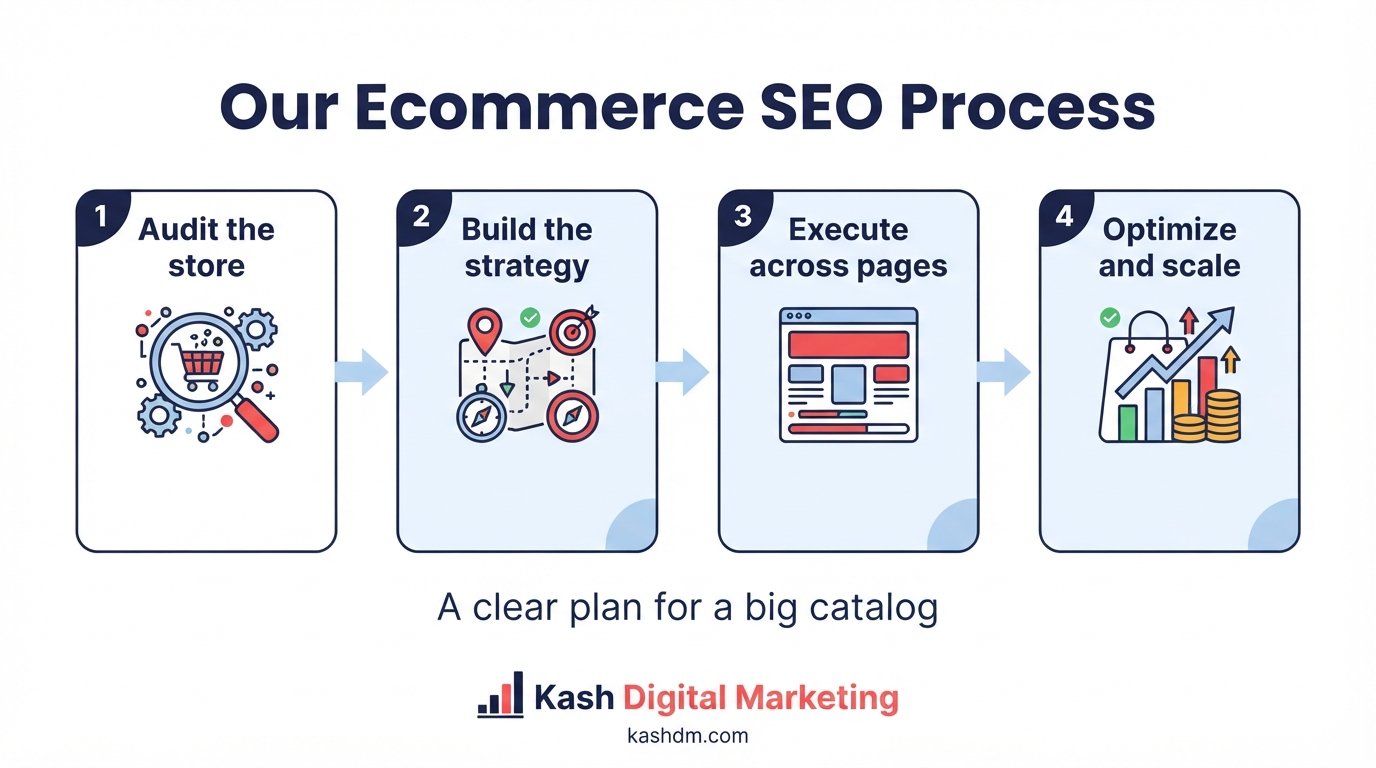
Our ecommerce SEO process follows a transparent, proven sequence, audit, strategy, implementation, and ongoing optimization, so you always know what we're doing and why, at every stage of the engagement. Ecommerce SEO involves more moving parts than most marketing services, which makes a clear process even more important than usual.
Audit and competitive strategy
We begin with the full ecommerce SEO audit described above, benchmark you against the competitors currently winning your most valuable searches, and build a prioritized roadmap sequenced for the fastest meaningful impact first.
Technical fixes and foundation work
We resolve the highest-priority technical issues, crawlability, indexation, speed, faceted navigation risk, before or alongside content work, because content built on a broken technical foundation never reaches its full ranking potential.
Content, product optimization, and link building
With the foundation solid, we optimize product and category pages, publish supporting content, and begin earning the links described in ecommerce link building, compounding authority and relevance together rather than in isolation.
Ongoing monitoring, reporting, and scaling
Each month we report on rankings, organic traffic, and, most importantly, organic revenue and conversion data, then refine and expand the strategy based on what the data shows is working, the same transparent reporting philosophy that runs through our local SEO and every other service we offer.
| Process Stage | What Happens | Typical Timing |
|---|---|---|
| Audit & strategy | Full technical, content and competitive audit | Weeks 1-2 |
| Technical foundation | Crawlability, speed, faceted navigation fixes | Weeks 2-6 |
| Content & product optimization | Product, category and supporting content | Ongoing, months 1-6 |
| Link building & authority | Digital PR, product seeding, outreach | Ongoing from month 2 |
| Reporting & scaling | Monthly reporting, refinement, expansion | Every month |
How Much Do Ecommerce SEO Services Cost
Ecommerce SEO pricing depends on catalog size, platform complexity, and competition, which is why we start every engagement with a free audit and a custom quote rather than a generic flat rate that ignores your store's actual scope. A 200-product store on Shopify and a 50,000-SKU Magento catalog require fundamentally different amounts of work, and pricing should reflect that honestly.
What determines your ecommerce SEO cost
Catalog size, platform, current technical health, and competitive intensity in your niche all factor into scope and cost. See our full SEO pricing page for how our custom quotes are built, and expect us to explain clearly why your quote is scoped the way it is.
Thinking about cost relative to organic revenue
The right way to evaluate ecommerce SEO cost is against the organic revenue it generates, not as a line-item expense. A campaign that costs a modest monthly amount but adds meaningful organic revenue every month, at a fraction of what the same traffic would cost through paid ads, pays for itself many times over and keeps compounding long after the initial investment.

Measuring Ecommerce SEO Success: Traffic, Rankings, and Revenue
We measure ecommerce SEO success the way you do, by organic revenue and conversion rate, not just rankings or traffic volume that never translates into actual sales. Rankings and traffic matter, but only as leading indicators of the metric that actually funds your business.
The metrics that matter for an online store
We track organic revenue, organic conversion rate, product and category page rankings, organic traffic by page type, and crawl and indexation health, connecting SEO activity directly to the sales data in your ecommerce platform's own analytics rather than reporting search metrics in isolation.
Attribution across a multi-touch buyer journey
Ecommerce buyers often research across multiple sessions and devices before purchasing, which makes simple last-click attribution misleading. We look at assisted conversions and full-funnel data wherever your analytics setup allows, giving you a more honest picture of how organic search contributes throughout the buyer journey, not just at the final click.
Reporting cadence and what a monthly review covers
Each month you receive a clear report covering rankings, organic traffic and revenue trends, technical health, and the specific work completed, along with a plain-English summary of what's coming next. We treat these reviews as a genuine two-way conversation: your insight into which products carry the best margins or which categories you want to grow shapes where we focus, while our data shows where the biggest untapped opportunities sit in your catalog. This ongoing dialogue, repeated month after month, is what turns a good ecommerce SEO campaign into a genuinely great one over time.
Common Ecommerce SEO Mistakes to Avoid
Part of our value is helping you avoid the mistakes that quietly cap ecommerce rankings and revenue long before most stores ever notice the cause. These mistakes are common precisely because they're easy to make and hard to spot without an experienced technical eye.
- Using unique product descriptions instead of manufacturer boilerplate
- Managing faceted navigation before it spawns millions of duplicate URLs
- Keeping out-of-stock pages live and redirecting discontinued products properly
- Building a real content strategy, not just product and category pages
- Testing every redirect and canonical tag before, not after, a site migration
- Monitoring Core Web Vitals continuously, not just at launch
- Implementing Product schema across the full catalog, not a handful of pages
The mistakes that quietly cap growth
- Copy-pasting manufacturer product descriptions across thousands of pages
- Letting faceted navigation generate unmanaged, indexable duplicate URLs
- Deleting out-of-stock product pages instead of redirecting or keeping them live
- Treating SEO as a launch task instead of an ongoing discipline
- Migrating platforms without a complete redirect map
- Ignoring mobile page speed while focusing only on desktop
- Skipping structured data because "it's just extra work"
We build every ecommerce campaign to avoid these traps from day one. Many stores come to us after one or more of these mistakes has already cost months of organic growth, and a meaningful part of the early engagement is often diagnosing and reversing that damage before new growth can even begin.
How to spot a risky ecommerce SEO provider
Be cautious of any provider who guarantees specific rankings, can't clearly explain how they'll handle your faceted navigation or duplicate content, has no experience with your specific platform, or reports only vanity traffic metrics while your organic revenue stays flat. A provider genuinely experienced in ecommerce SEO will speak fluently and specifically about the problems unique to your platform and catalog size.

Ecommerce SEO Company, Specialists, and Choosing the Best Provider
An ecommerce SEO company combines specialists in technical SEO, product and category optimization, content, and links to grow your store's organic sales, and choosing the right one comes down to proven results, not promises. However you searched, for an ecommerce SEO agency, an ecommerce SEO specialist, or the best ecommerce SEO services, here is what you are actually buying and how to choose.
What are ecommerce SEO services, and why invest in them?
Ecommerce SEO services are specialized SEO for online stores, optimizing product pages, category pages, site architecture, and technical health so your products rank and sell. The reason to invest in SEO services for ecommerce is simple math: organic search sends high-intent shoppers who are ready to buy, at a cost per sale that falls over time, unlike ads you pay for on every click. For most stores, there are more than enough reasons your ecommerce site needs SEO services, chief among them that your competitors are already ranking for the products your customers search. Understanding what ecommerce SEO is and its benefits usually makes the decision easy.
Ecommerce SEO agency, company, or specialist: who does the work
You can hire an ecommerce SEO specialist or consultant, build in-house, or work with an ecommerce SEO company, and scope matters. Ecommerce SEO spans technical fixes, product and category optimization, content, and link building, which is a lot for one specialist to cover well. As a full ecommerce SEO agency, we bring a team of experts across each area under one roof, so nothing falls through the cracks. That is the practical difference between hiring scattered ecommerce SEO experts and partnering with a company that owns your store's growth end to end.
Best ecommerce SEO services: how to choose and who offers them
When you compare the best ecommerce SEO services or ask who the leaders in ecommerce SEO are, judge providers on evidence: real store results, transparent reporting, and a clear, ROI-driven strategy rather than vanity metrics. The best ecommerce SEO services provider shows you exactly what they will fix and how it maps to revenue. There is no single best ecommerce SEO company for every store, the right one fits your platform, your catalog size, and your goals, which is why we start with a free audit so you can judge our approach before committing. For a full framework, see our guide to the best SEO services and how to choose an agency.
Affordable and ROI-driven ecommerce SEO solutions
Affordable ecommerce SEO services should never mean cheap, risky shortcuts, they should mean ecommerce SEO solutions scoped to your budget that deliver measurable ROI. We build right-sized, ROI-driven ecommerce SEO programs that prioritize the fixes with the biggest revenue impact first, so the work pays for itself as it scales. Because we tie every effort to organic revenue rather than raw traffic, you always know what your investment is returning. See how pricing works on our SEO pricing page.
AI-powered ecommerce SEO, migrations, and technical services
Modern ecommerce SEO uses AI the right way. Our AI-powered ecommerce SEO services use AI to accelerate keyword research, product-description drafting, and analysis, with human experts guiding and quality-checking every output to meet Google's standards. We also handle the high-stakes work that makes or breaks stores: ecommerce SEO migration services that preserve rankings during a replatform or redesign, plus deep technical SEO for ecommerce covering crawl budget, faceted navigation, and category-page optimization. This is where inexperienced providers cause the most damage, and where specialist skill matters most.
Ecommerce SEO across the USA, for small business, and white-label
We provide ecommerce SEO services USA-wide, so stores searching for ecommerce SEO services near me or a dedicated ecommerce SEO consultant get a senior team in any state. We tailor programs for small business ecommerce SEO, for larger catalogs, and for B2B ecommerce, and we offer white-label ecommerce SEO services for agencies that want to resell our work under their brand. If you would rather outsource ecommerce SEO entirely, we act as your dedicated, behind-the-scenes team. We also coordinate ecommerce SEO with Amazon and marketplace optimization and CRO, so your growth is not limited to a single channel.

Why Choose Kash Digital Marketing for Ecommerce SEO
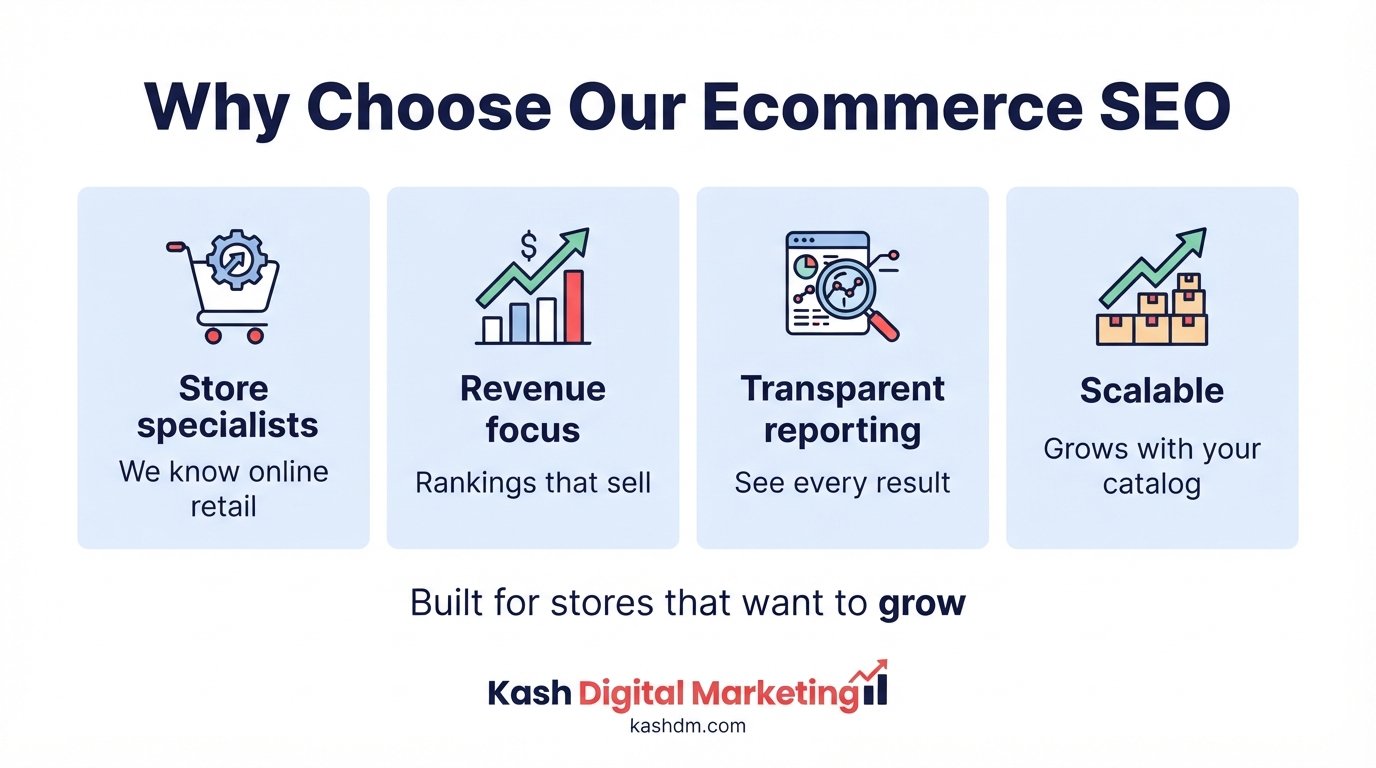
We combine deep technical expertise across every major ecommerce platform with a relentless focus on organic revenue, not vanity metrics, and back every campaign with transparent reporting and no long-term contracts. That combination of platform depth, revenue focus, and accountability is why growing online stores across the US trust us with their organic growth.
Platform expertise that goes deep, not wide
We don't treat every ecommerce platform the same. Our team understands the specific quirks, strengths, and limitations of Shopify, WooCommerce, Magento, and BigCommerce, and we apply that platform-specific knowledge from the very first audit, not as an afterthought once a generic strategy has already been drafted.
A true growth partner for your store
We see ourselves as an extension of your team, genuinely invested in your organic revenue growth. We take the time to understand your margins, your best-selling categories, and your growth goals, then build a strategy designed to hit them, communicating proactively rather than waiting for a monthly call to surface a problem.
Our commitment to you
Every ecommerce SEO campaign is backed by clear commitments: only safe, white-hat methods; no long contracts; fast, human communication; and transparent reporting tied to organic revenue, not just rankings. Start with a free audit, see exactly where your store stands, and decide for yourself, there's no risk and no obligation.
Ecommerce SEO combined with your broader marketing
Many stores that come to us for ecommerce SEO also run social media marketing to build brand awareness and drive repeat purchases, and the two channels compound when coordinated well: social content drives the branded searches that strengthen SEO, while SEO content gives social channels a steady stream of material to share. Because we offer both under one roof, your ecommerce SEO strategy never operates in isolation from the rest of your marketing.
Frequently Asked Questions About Ecommerce SEO Services
What are ecommerce SEO services?
Ecommerce SEO services optimize an online store's technical foundation, site architecture, and product and category content so it ranks higher on Google and generates more organic sales. They include keyword research, technical audits, product page optimization, structured data, content marketing, and link building, all tailored to the scale and complexity of an online catalog.
How much do ecommerce SEO services cost?
It depends on your catalog size, platform, and competition, which is why we start with a free audit and a custom quote rather than a flat rate. See our pricing page for how our quotes are built.
How long does ecommerce SEO take to work?
Long-tail product terms and quick technical fixes often show movement within four to eight weeks, while competitive category terms typically take three to six months to reach full potential. We report progress every month so you can see the direction of travel throughout.
Do you work with Shopify, WooCommerce, Magento, and BigCommerce?
Yes. We provide platform-specific ecommerce SEO for Shopify, WooCommerce, Magento, and BigCommerce stores, along with general ecommerce SEO principles that apply across any platform.
Can you help with both Amazon and my own website?
Yes. We offer dedicated Amazon listing optimization alongside your website's ecommerce SEO, and we coordinate the two into one strategy so they reinforce each other rather than competing for the same budget in isolation.
How do you handle faceted navigation and duplicate content?
We audit every filter combination and duplicate content source on your store, then apply the right fix, canonical tags, unique content, redirects, or index exclusion, for each one. This is one of the most technically involved parts of ecommerce SEO and one we handle carefully to avoid accidentally blocking Googlebot from important pages.
Will migrating to a new platform hurt my SEO?
It can, if done without a rigorous process, but it doesn't have to. Our ecommerce site migration process maps every URL, builds complete redirect coverage, and monitors closely after launch specifically to prevent the ranking and revenue loss that poorly planned migrations commonly cause.
Do out-of-stock products hurt my rankings?
Only if handled incorrectly. Deleting out-of-stock pages throws away earned rankings and links. We keep temporarily unavailable products live and clearly marked, and redirect permanently discontinued products to the closest equivalent, preserving as much value as possible either way.
Is ecommerce SEO safe for my store, or could it cause a Google penalty?
Our methods are one hundred percent white-hat. We never buy links, cloak content, or use manipulative tactics that risk a Google penalty. Every technique described on this page is safe, sustainable, and built to hold up through algorithm updates rather than collapse under them.
What's the difference between ecommerce SEO and general SEO?
Ecommerce SEO addresses challenges general SEO rarely encounters at scale: faceted navigation, duplicate product content, out-of-stock handling, marketplace competition, and catalogs of thousands of pages that need structure and internal linking to rank as a coherent whole rather than as isolated pages competing with each other.
Get Your Free Ecommerce SEO Audit
Request Your Free SEO Audit
Prefer to talk it through? WhatsApp US +2135622433 or WhatsApp PK +92 348 3879366. We usually reply within an hour, and always within 8 hours.
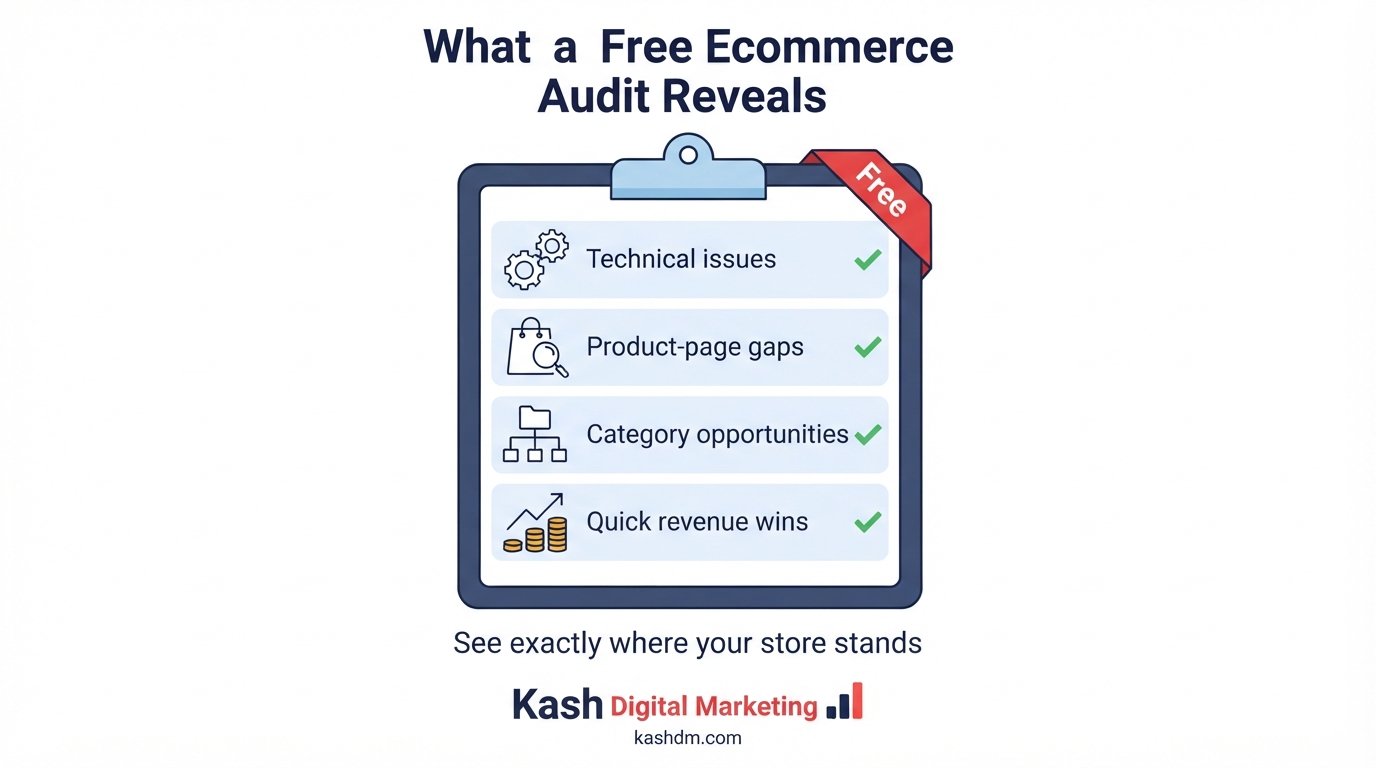
See exactly where your store stands and how to grow organic sales. Your free ecommerce SEO audit reveals where your product and category pages rank versus competitors, the technical issues holding your store back, your biggest quick-win opportunities, and a clear, prioritized action plan, yours to keep, no obligation.
Ready to turn more search traffic into sales? Request your free audit and we'll usually reply within an hour, and always within 8 hours on business days.
- 💬WhatsApp: +2135622433
- ✉️Email: contact@kashdm.com
- 📝Free audit form: start here
Every day your product and category pages aren't ranking well is a day competitors and marketplaces capture sales that could have been yours. Those shoppers are searching right now, comparing options, ready to buy. The good news is that with the right ecommerce SEO strategy, winning that traffic back is entirely achievable, and the free audit is a risk-free way to start. Let's turn your search traffic into revenue.
Kash Digital Marketing, ecommerce SEO services that help US online stores rank product and category pages, win the shoppers already searching, and grow organic revenue. No spam. No long contracts. Just results.